
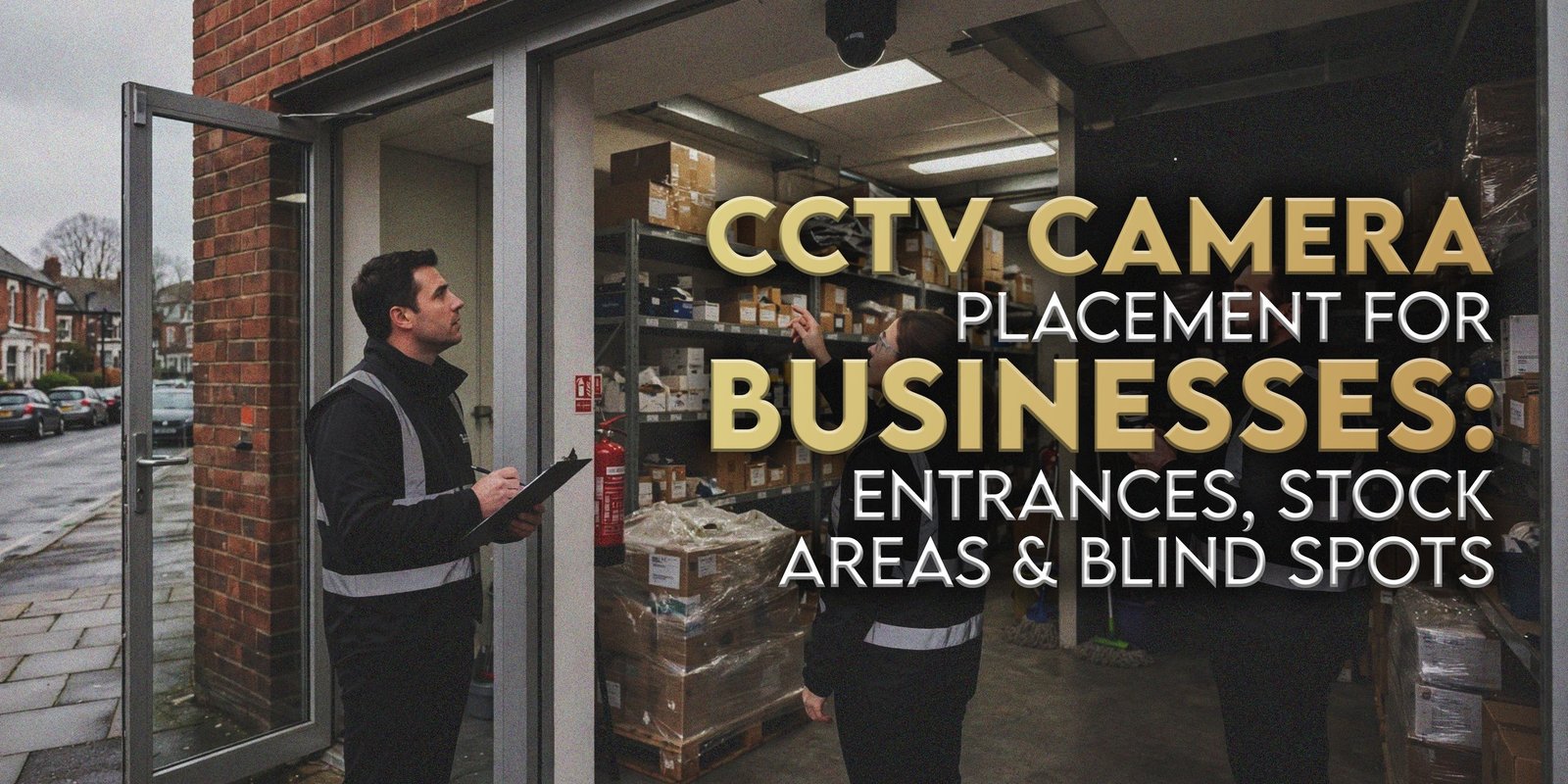
A CCTV camera can overlook important activity even when it appears to cover a large area. At a warehouse entrance, poor positioning may capture vehicles but miss useful details around the doorway. Meanwhile, shelving, lighting and moving stock can interrupt visibility inside a storeroom.
For UK businesses, effective CCTV coverage begins with understanding the premises rather than simply installing more equipment.
Retail shops, warehouses, commercial offices and distribution centres all have different observation requirements. Consequently, CCTV camera placement should reflect how people, goods and vehicles move through the site.
H&D Security, based in Hounslow, West London, provides commercial CCTV installation, monitoring and wider security services.
This guide explains how businesses can assess entrances, stockrooms, loading bays and blind spots while considering footage quality, privacy obligations and monitoring arrangements.
Why CCTV Camera Placement Matters for Business Premises
Effective CCTV camera placement determines whether recorded footage captures the activity a business actually needs to review.
A camera may display a wide view of a building without capturing enough detail at the most important access points. Conversely, a narrow viewing angle may record useful entrance activity but overlook movement nearby.
Therefore, businesses should define what each camera needs to observe before deciding where to install it.
Coverage Quality Matters More Than Camera Quantity
Installing additional cameras does not automatically improve site observation.
For example, three cameras facing the same warehouse aisle might provide overlapping footage while another access point receives little coverage.
Instead, camera coverage planning should identify operational priorities and reduce unnecessary overlap.
Think About How the Site Operates
A busy retail entrance needs different coverage from a loading bay used mainly for overnight deliveries.
Furthermore, building layouts can change when businesses install new shelving, rearrange stock or alter visitor routes.
A practical CCTV camera plan should therefore account for both current activities and foreseeable changes.
Where Should Businesses Position CCTV Cameras?
Businesses should position cameras where they can observe relevant entrances, stock movement, operational activity and external access points. However, the exact locations depend on the premises, viewing objectives, lighting and privacy requirements.
The following table shows common areas to assess.
| Business area | Main observation objective | Important consideration |
|---|---|---|
| Main entrance | Observe people entering and leaving | Lighting and useful image detail |
| Secondary entrance | Monitor less-used access points | Doors and surrounding obstructions |
| Reception | Observe visitor movement | Staff and visitor privacy |
| Stockroom | Review stock access and movement | Shelving and changing layouts |
| Warehouse aisle | Observe selected operational routes | Racking and equipment |
| Loading bay | Review deliveries and vehicle activity | Vehicle obstructions |
| Car park | Observe access and movement | Lighting and neighbouring properties |
| External perimeter | Review relevant access points | Weather, distance and field of view |
For a CCTV camera installation, this assessment is more useful than copying the layout of another business.
CCTV Camera Placement at Entrances and Exits
Entrances often deserve particular attention because they connect publicly accessible areas with the business premises.
However, a CCTV camera facing an entrance should do more than capture a distant image of the door.
Main Entrances
A useful entrance view should include the relevant approach and doorway activity without capturing excessive areas outside the business’s purpose.
For example, strong daylight behind an arriving visitor may make important image details harder to distinguish.
Therefore, review what the CCTV camera records during different lighting conditions rather than checking the daytime view alone.
Secondary Entrances and Staff Access
Side doors, staff entrances and delivery doors may require separate consideration.
A camera observing the main entrance cannot necessarily capture activity around a secondary doorway.
Furthermore, doors that open into the field of view can temporarily obstruct the picture.
Businesses should assess these access points according to actual use, operating hours and relevant site concerns.
Camera Height and Viewing Direction
Mounting a camera high above an entrance may provide a broad overview, but the viewing angle can reduce useful detail.
By contrast, a more focused position may capture the required activity while covering a smaller area.
A CCTV camera location should balance useful image detail with appropriate observation of the surrounding entrance.
CCTV Coverage for Stockrooms and Warehouse Areas
Warehouses and stockrooms present different challenges from offices or reception areas.
Tall shelving, pallet stacks, machinery and regular stock movements can change what a CCTV camera can observe.
Consequently, effective planning requires a clear understanding of how the storage and distribution areas operate.
Stockroom Access Points
Stockrooms may have several entry points, including internal doors and goods movement routes.
Instead of attempting to observe every shelf equally, identify where relevant stock movements occur and where people enter or leave the storage area.
For example, a camera near a stockroom entrance may provide useful information about movements through the doorway. However, it may not show activities hidden behind shelving.
Warehouse Aisles
Long warehouse aisles can create apparently clear sightlines.
Nevertheless, tall racking and temporary stock can interrupt the field of view.
When planning warehouse CCTV, assess the actual recorded image with pallets, handling equipment and typical activity present.
A CCTV camera that performs adequately in an empty warehouse may provide a different view during normal operations.
Goods-In and Dispatch Areas
Goods-in and goods-out zones often involve several stages of stock handling.
For example, an inbound delivery may move through unloading, checking and temporary storage before entering the main warehouse.
Therefore, CCTV placement should reflect the specific stages requiring observation rather than simply pointing towards the largest open area.
CCTV Placement for Retail Shops
Retail premises combine customer areas, stockrooms, service counters and staff-only access points.
Each area requires different observation priorities and privacy considerations.
Customer Entrances and Shop Floors
Entrance coverage can help businesses review activity at the point where customers enter and leave.
Meanwhile, selected shop-floor views may assist with incident review and understanding activity around relevant areas.
However, a CCTV camera should not monitor customers or employees more extensively than the business can justify.
Stockrooms and Delivery Entrances
Stockrooms and delivery doors may benefit from observation of goods movement.
For example, a retailer might identify the route through which incoming deliveries reach a storage room.
Then the business can assess camera positions along that route without unnecessarily recording unrelated activities.
CCTV and Retail Guarding
Video footage can support incident reporting and help authorised personnel review events.
However, cameras do not automatically replace on-site supervision, staff procedures or an appropriate incident response.
H&D Security also provides security guard services for retail sites, which businesses can consider alongside their CCTV requirements.
The appropriate combination depends on the premises and the services agreed.
How Can Businesses Identify CCTV Blind Spots?
Businesses can identify CCTV blind spots by reviewing each camera’s actual field of view during normal operations. They should consider shelving, doors, partitions, machinery, parked vehicles and lighting changes.
A walkthrough of the premises can reveal areas that a fixed camera angle does not adequately observe.
Carry Out a Practical Coverage Walkthrough
Start with a floor plan showing entrances, important operational areas and existing camera positions.
Then review live views or recorded footage while somebody moves through the relevant areas, using a planned and proportionate assessment.
Consider whether objects or building features interrupt visibility.
For example, a CCTV camera facing a loading bay may lose its view of part of the area when a large delivery vehicle arrives.
Recheck Coverage After Layout Changes
Businesses frequently rearrange displays, storage racks and equipment.
Consequently, an original CCTV installation may no longer provide the same observation after operational changes.
Schedule coverage reviews when layouts or working practices change rather than assuming the initial positioning remains suitable indefinitely.
Planning CCTV Coverage Around Your Business Premises
Before requesting CCTV camera installation or monitoring support, prepare a clear description of the premises and the areas requiring observation.
For example, a warehouse manager may prioritise loading bays, warehouse access points and stock movement routes. A retail manager may focus on customer entrances, stockrooms and delivery access.
What Should a Site Assessment Include?
Businesses should provide:
- Site type and location.
- Main and secondary entrances.
- Reception and customer areas.
- Stockrooms and warehouses.
- Loading bays and vehicle access.
- External areas and existing lighting.
- Current camera arrangements.
- Known visibility concerns.
- Operating hours and staff movement.
- Relevant privacy considerations.
- Requirements for recording, monitoring and incident reporting.
A clear brief gives the provider useful context before proposing equipment positions or service arrangements.
Businesses can request a commercial CCTV and security quotation from H&D Security to discuss their premises, existing equipment and observation requirements.
Final recommendations should follow a site-specific assessment rather than an assumed standard camera count.
CCTV Coverage for Loading Bays, Car Parks and External Areas
External CCTV camera placement requires consideration of vehicle movement, weather conditions, lighting and the surrounding property boundaries.
A camera that provides useful daytime footage may perform differently at night. Similarly, parked vehicles or delivery lorries can obstruct important parts of the view.
Loading Bays and Vehicle Entrances
Loading bays often involve overlapping movements of vehicles, goods and personnel.
Therefore, position cameras according to the activity requiring observation, such as vehicle arrivals, loading movements or access to a warehouse entrance.
However, a single CCTV camera may not capture every relevant area when large vehicles obstruct its view.
Commercial Car Parks and Perimeters
Car parks and external boundaries can include several access routes.
For example, a commercial property may have a main vehicle entrance, pedestrian access and an additional service gate.
Each location should receive an individual coverage assessment.
Furthermore, businesses must consider whether external cameras capture neighbouring properties, pavements or other public areas.
Weather and Outdoor Lighting
Rain, reflections, changing daylight and external lighting can influence recorded images.
Consequently, businesses should review the actual footage under representative conditions.
Camera equipment also needs to suit the installation environment, although the necessary specifications depend on the particular site.
CCTV Monitoring and Mobile Patrols Outside Business Hours
A CCTV camera system that records footage is not necessarily monitored by a person throughout the day or night.
Recorded CCTV, live monitoring and mobile patrols are different arrangements.
| Service | Main purpose | Important distinction |
|---|---|---|
| CCTV recording | Stores footage for later review | Does not necessarily involve active observation |
| Live CCTV monitoring | Enables authorised personnel to observe camera feeds | Requires an agreed monitoring arrangement |
| Mobile patrols | Provides scheduled or responsive site visits | Involves physical attendance under agreed instructions |
| Alarm response | Provides a process following an alarm activation | Depends on the agreed response service |
Recorded Footage Versus Active Monitoring
A recording system may help authorised personnel review an incident after it occurs.
However, continuous live observation requires a separate operational process with appropriate personnel, communication and escalation procedures.
H&D Security’s published services include CCTV monitoring and control room support. Nevertheless, businesses should confirm which monitoring arrangements form part of their particular quotation.
Combining CCTV With Patrol Visits
For example, a warehouse may use cameras to observe external access points and arrange patrol visits outside normal operating hours.
Where appropriate, operators may coordinate monitoring observations with agreed site checks or incident reporting procedures.
H&D Security provides mobile patrol security after business hours as a separate service businesses can discuss alongside CCTV.
A CCTV camera installation does not automatically include physical patrols or alarm response.
How Lighting and Camera Angles Affect Recorded Footage
A camera’s usefulness depends on what its recorded image actually shows, not simply the size of its advertised field of view.
Consequently, lighting, reflections, obstructions and viewing direction deserve attention during installation planning.
Strong Backlighting and Glare
A CCTV camera facing a bright window or doorway may capture a poorly balanced image.
For example, the outside area could appear bright while people entering a darker building appear difficult to distinguish.
Therefore, review camera views at different times of day, particularly where sunlight changes direction.
Night-Time Visibility
External areas may have very different lighting conditions after business hours.
A camera’s daytime view does not establish how useful its recording will be at night.
Furthermore, vehicle headlights, floodlights and reflective surfaces can affect image detail.
Businesses should assess representative night-time footage before finalising an installation.
Wide Views Versus Useful Detail
A wider viewing angle may show more of the premises but capture less detail at a specific observation point.
Conversely, a narrow view may provide more detail while leaving nearby areas outside the picture.
Therefore, CCTV camera selection and positioning should follow the intended observation purpose.
How Many CCTV Cameras Does a Business Need?
There is no universal number of cameras suitable for every business.
The required number depends on premises size, layout, access points, viewing objectives, lighting and existing equipment.
For example, a small retail shop may have simpler observation requirements than a large distribution centre with multiple loading bays.
However, floor area alone cannot determine the correct number.
Before adding another CCTV camera, ask whether repositioning existing equipment could improve the view and whether the additional observation is justified.
A site assessment should identify coverage gaps while avoiding unnecessary recording.
CCTV Privacy Rules UK Businesses Should Consider
UK businesses using CCTV must consider applicable data protection law, including the UK GDPR and Data Protection Act 2018 where identifiable individuals appear in recorded footage.
A CCTV camera does not become automatically lawful simply because the business owns the premises.
The Information Commissioner’s Office (ICO) advises organisations to establish a clear purpose, assess whether surveillance is necessary and proportionate, inform individuals about recording and restrict access to footage.
ICO
+1
CCTV Signage and Transparency
Businesses should provide clear, visible information explaining that CCTV operates and why.
Appropriate signage should identify the organisation responsible and provide contact information.
Consequently, signs should appear where people can reasonably see them before entering monitored areas.
ICO
Staff and Visitor Privacy
Employers should explain relevant workplace monitoring arrangements to staff.
In addition, CCTV camera positions should avoid unjustified observation of private areas.
For example, toilets and changing facilities involve particularly strong privacy expectations.
The purpose of recording must remain clear, and employers should not repurpose footage for unrelated staff monitoring without a lawful basis.
GOV.UK
+1
Footage Retention and Access
Businesses should establish how long they need recordings and restrict access to authorised personnel.
However, UK data protection law does not specify one universal retention period for every CCTV system.
Instead, the organisation should justify and document a period appropriate to its purpose.
ICO
Public Areas and Audio Recording
A camera may capture a pavement, neighbouring property or other area beyond the business boundary.
Therefore, assess whether that coverage is necessary and whether the view can be limited appropriately.
Audio recording requires particular caution. The ICO considers recording conversations significantly more intrusive than video-only surveillance and advises organisations to disable audio by default unless they can justify its use.
ICO
Businesses should also assess whether a data protection impact assessment or other additional measures are required for their circumstances.
Common CCTV Camera Placement Mistakes
Several mistakes can limit the usefulness of business CCTV footage.
1. Cameras Facing Strong Light
Bright entrances may create images that lack useful detail.
Better approach: Test recorded images under different daylight conditions.
2. Overlooking Secondary Entrances
Focusing only on the main doorway can leave other access routes outside the intended coverage.
Better approach: Review every relevant entrance during the site assessment.
3. Ignoring Shelving Obstructions
Racking and stored goods can interrupt warehouse visibility.
Better approach: Test the CCTV camera view under normal operational conditions.
4. Poor Stockroom Observation
A camera may show the centre of a storeroom without adequately observing access or stock movement.
Better approach: Define which activity needs recording before choosing the position.
5. Failing to Review Night-Time Footage
Daytime image quality does not establish night-time performance.
Better approach: Assess representative footage after dark.
6. Installing Cameras Without Defined Objectives
A camera may record extensive footage without capturing information relevant to the business.
Better approach: Document the observation purpose for every proposed position.
7. Overlooking Neighbouring Property Privacy
External cameras may capture areas beyond the intended premises.
Better approach: Limit unnecessary coverage and consider suitable privacy controls.
8. Not Testing Recorded Footage
A live preview can differ from the stored image available for later review.
Better approach: Check actual recordings for image detail, lighting and visibility.
9. Assuming CCTV Includes Live Monitoring
A recording system may operate without continuous observation.
Better approach: Confirm whether active monitoring and incident escalation are included in the agreed service.
Business CCTV Camera Placement Checklist
Before finalising a CCTV camera plan, review the following:
- Identify the purpose of each camera.
- Assess main and secondary entrances.
- Review reception and visitor movement.
- Identify relevant stockroom access points.
- Check warehouse racking and obstructions.
- Assess loading bays and vehicle entrances.
- Review external lighting and night-time footage.
- Identify blind spots during normal operations.
- Consider staff, visitor and neighbouring property privacy.
- Provide appropriate CCTV signage.
- Establish footage access and retention procedures.
- Confirm whether live monitoring is required.
- Define incident reporting and escalation arrangements.
- Review coverage following site layout changes.
Frequently Asked Questions About CCTV Camera Placement
Where should CCTV cameras be placed in a business?
Businesses should consider relevant entrances, exits, stockrooms, loading bays, vehicle access points and operational areas. However, the final CCTV camera locations depend on the premises and the purpose of recording. A site assessment should review viewing angles, lighting, obstructions and privacy requirements before installation.
What is the best CCTV camera position for a shop entrance?
The best position provides useful observation of entrance activity without recording unnecessary areas. Businesses should consider doorway movement, lighting changes and image detail. For example, a camera facing strong sunlight may produce less useful footage than expected. Review actual recordings before confirming the position.
How can businesses identify CCTV blind spots?
A business can identify blind spots by walking through the premises while reviewing camera views under normal operating conditions. Shelving, partitions, machinery, vehicles and changing layouts may obstruct important areas. Consequently, businesses should revisit the CCTV camera plan whenever they change the layout or introduce significant new equipment.
Should warehouses have cameras in stock areas?
Stock areas may benefit from CCTV where a business has a legitimate, proportionate reason to observe access or goods movement. However, businesses should define the intended purpose before selecting camera positions. Warehouse shelving and machinery can also affect visibility, so test actual footage and consider employee privacy.
Can CCTV cameras monitor loading bays?
Yes, businesses can use CCTV to observe loading bays where they have a lawful and proportionate purpose. Camera positions should reflect relevant vehicle movements, delivery routes and access points. However, parked lorries and changing lighting can obstruct footage, so the site assessment should account for normal loading activity.
What privacy rules apply to business CCTV in the UK?
Business CCTV that records identifiable individuals generally engages UK data protection law. Organisations must consider a lawful basis, appropriate signage, proportionality, footage access and retention. They should also respect staff and visitor privacy and assess any recording beyond their premises. Requirements depend on the circumstances, so seek appropriate professional advice for complex installations.
Is live CCTV monitoring different from CCTV recording?
Yes. CCTV recording stores footage for later review, while live monitoring involves personnel actively observing camera feeds under an agreed arrangement. A recorded CCTV camera system does not automatically include continuous monitoring, incident escalation or physical response. Businesses should confirm these services separately.
How often should a business review camera coverage?
Businesses should review camera coverage whenever significant changes affect the premises, including new shelving, altered access routes, changes to operating hours or different lighting arrangements. Periodic checks can also identify equipment faults and changes to visibility. The appropriate review schedule depends on the site’s requirements and the agreed maintenance arrangements.
Review Your Business CCTV and Security Requirements
Effective CCTV camera placement begins with understanding how the premises operate.
For retail businesses, that may mean reviewing customer entrances, stockrooms and delivery access. Meanwhile, warehouses and logistics facilities may need greater attention to goods movement, loading bays and external routes.
However, coverage quality depends on more than the number of installed cameras. Lighting, viewing angles, obstructions, privacy requirements and monitoring responsibilities all influence whether the system meets its intended purpose.
H&D Security provides commercial CCTV installation, monitoring and wider security services from its Hounslow, West London base. Businesses considering new cameras or reviewing an existing installation can discuss their premises and operational requirements.
To assess suitable options, prepare your site layout, key observation areas, current CCTV arrangements and monitoring needs. You can then discuss your CCTV requirements with H&D Security and request a quotation based on your actual business premises.