
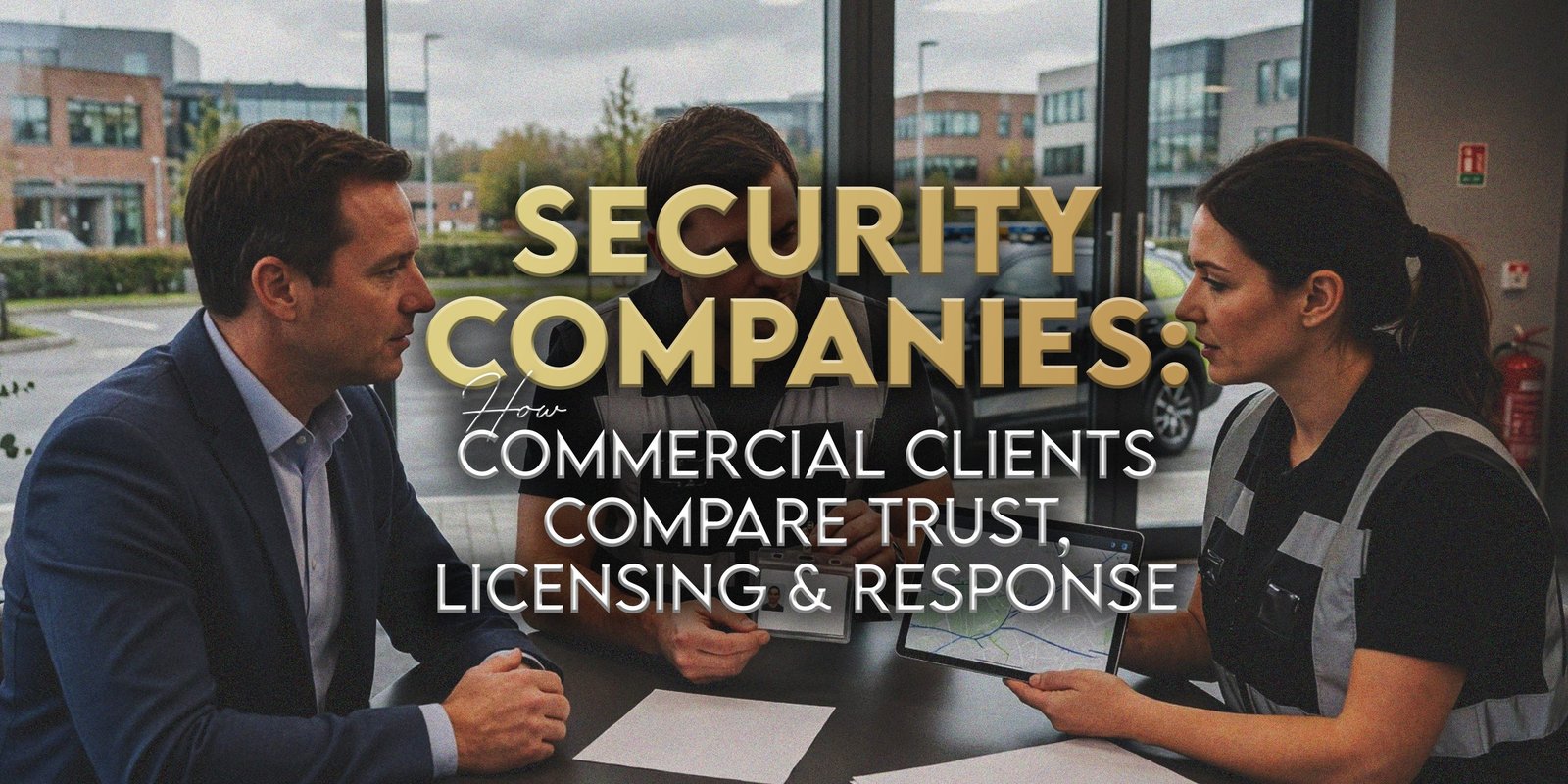
Choosing between security companies involves more than checking an hourly price or reading a sales brochure. A warehouse manager may need access control overnight, while an office team may prioritise visitor reporting. Both require evidence that the proposed service fits the premises.
The best comparison examines individual SIA licences, supervision, site instructions, response procedures and the contract itself. For example, a promise of round-the-clock control room support means little unless the buyer understands what the operator monitors and who responds when an incident occurs.
H&D Security is a Hounslow-based provider of commercial guarding, mobile patrols, CCTV monitoring and related services. This guide explains how businesses can assess security companies using practical questions and verifiable information rather than promotional claims.
What Should Businesses Compare When Choosing Security Companies?
Commercial buyers should compare security companies against the same site brief. The best security companies explain exactly how their proposed duties support that brief. Start with licence requirements, relevant experience, officer supervision, reporting, response arrangements and transparent contract terms. Then request evidence showing how each provider intends to deliver the work.
| Comparison factor | Question to ask | Evidence to request |
|---|---|---|
| Licensing | Which duties require an SIA licence? | Relevant officer licence details and verification process |
| Experience | Have personnel worked in a similar environment? | Role profiles, training approach and references where available |
| Supervision | Who checks service delivery? | Named management contact and supervision process |
| Response | What happens after an incident or alarm? | Written escalation procedure and agreed responsibilities |
| Reporting | What will the client receive? | Sample incident report and reporting schedule |
| Contract | What exactly is included? | Scope, hours, exclusions and charging terms |
Consequently, an apparently cheaper quotation may not represent equivalent coverage. Security companies should explain precisely what the client receives rather than relying on broad descriptions of protection.
What Makes a Commercial Security Company Trustworthy?
A trustworthy security company explains its responsibilities clearly, understands the premises and can demonstrate how it supervises personnel. Therefore, credible security companies should welcome specific operational questions. Reputation matters, but operational evidence is more informative than unsupported claims of being the best provider.
How SIA Licensing Works for Commercial Security Services
The Security Industry Authority, or SIA, regulates specified private security activities in the UK. Consequently, security companies must distinguish roles requiring licences from other duties. People carrying out relevant licensable work generally need the individual licence. Therefore, clients should check the activity and officer’s licence category, not simply accept the phrase “SIA trained”.
For example, guarding, door supervision and public space surveillance can involve different licence categories. The appropriate requirement depends on the duties performed, and some roles or circumstances have exemptions. A client should describe the job accurately before deciding what evidence is needed.
How Can Businesses Verify a Licence?
Use the official SIA licence-holder register to check individual licence details, including whether the relevant licence is current. The government service explains which personal details or licence number are needed.
Furthermore, ask the provider how it checks licences before deployment and handles changes to an officer’s status. Security companies should have a clear method for matching the person assigned to the duties requested.
SIA Licensing vs Approved Contractor Status: What Is the Difference?
An individual SIA licence authorises a person to perform relevant regulated activities. Security companies should explain this distinction to buyers. By contrast, the SIA Approved Contractor Scheme, or ACS, assesses eligible security businesses against a quality standard. The scheme is voluntary, and approval applies to specified activities rather than every service a firm might offer.
| Individual SIA licence | SIA Approved Contractor Scheme |
|---|---|
| Relates to a person | Relates to an eligible security business |
| Required for relevant licensable activities, subject to applicable rules | Voluntary business approval scheme |
| Check the licence-holder register | Check the register of approved contractors |
| Verify the appropriate activity category | Verify the business and approved activities |
Therefore, security companies without ACS approval are not automatically operating unlawfully. Equally, employing licensed officers does not itself establish that the company holds ACS approval.
Clients can consult the official ACS guidance and contractor register when a provider claims approval. H&D Security’s ACS status is not asserted here; buyers should independently check any accreditation claim.
Why Site-Specific Security Planning Matters
Security requirements follow the way a building operates. For this reason, security companies need practical information about every site. A business with public reception areas, staff doors and loading bays faces different access challenges from a closed office occupied only during the day.
Map People, Goods and Access Routes
Start with entrances, contractor access, valuable stock, vehicle routes and areas requiring observation. Next, identify which activities occur after hours and who authorises entry. For instance, a Heathrow-area logistics site may receive deliveries while administrative offices are closed.
As a result, security companies need the operating pattern, not just the street address. An effective site brief identifies responsibilities, important restrictions and the procedures for unusual events.
Specify What Officers Can Decide
Guard instructions should establish who can grant visitor access, refuse entry under the agreed rules, contact a manager and record incidents. ## Security Guard Services for Offices and Commercial Premises
Office security can include reception duties, visitor checks, contractor coordination, access monitoring and agreed internal patrols. Security companies should identify which tasks belong to the officer. The balance depends on the building’s layout and whether reception remains staffed during all opening hours.
Before comparing security companies, establish who holds visitor records, which access systems officers use and how incidents reach the facilities manager. H&D Security provides security guard services for offices as one relevant option to discuss alongside the premises’ requirements.
How to Compare Security Requirements for Your Business
A useful quotation begins with a consistent specification. Otherwise, security companies may interpret the same enquiry differently. Without one, security companies may price different duties, hours or staffing arrangements, leaving the buyer unable to compare like for like.
Prepare your premises type and postcode, opening hours, access points, existing guards or cameras, known concerns and proposed start date. Then outline whether you need static guarding, patrol visits, CCTV monitoring, alarm response or a combination.
Define Reporting and Escalation Before Pricing
Explain who should receive incident reports, which events require immediate contact and who can authorise changes to site instructions. In addition, request a clear description of any expected out-of-hours support.
Businesses can request a tailored commercial security quotation from H&D Security using this information. A detailed brief makes the provider’s proposal more relevant and helps identify assumptions before a contract is agreed.
Why Incident Response Procedures Matter
Security companies must explain what happens after a guard observes a problem or a monitoring operator receives an alert. A useful response procedure distinguishes detection, verification, escalation and attendance, rather than describing every event as an immediate response.
However, control room availability does not establish a guaranteed attendance time. Ask which personnel can attend, where they operate and what conditions affect availability.
Agree How Incidents Are Recorded
Incident reporting should identify the time, location, observations, actions and people contacted. Consequently, facilities managers can review what happened and decide whether site instructions need changing. Security companies should clarify the format, delivery method and responsibility for follow-up.
Mobile Patrol Security: What Should Clients Check?
Mobile patrols involve agreed visits rather than a permanent on-site officer. Security companies should explain what officers document after each visit. Therefore, security companies need to define the purpose of each visit. They may suit commercial premises requiring periodic checks of doors, gates, car parks or external areas outside business hours.
Before appointing security companies for patrols, ask how the visits are scheduled, whether timing varies, what officers inspect and how attendance is documented. Also confirm key access, alarm escalation and reporting procedures.
H&D Security’s guide to what to check before booking mobile patrol security covers related buyer considerations. Importantly, a patrol contract should not be interpreted as a promise of a particular emergency attendance time unless that term is expressly agreed.
Static Security Guards vs Mobile Patrols vs CCTV Monitoring
Security companies can offer different service models, and the correct choice depends on what the site needs to achieve. The following comparison clarifies the main differences.
| Factor | Static guarding | Mobile patrols | CCTV monitoring |
|---|---|---|---|
| Main purpose | Continuous duties at an assigned site during contracted hours | Periodic site checks | Observation of agreed camera feeds |
| Physical presence | Officer based on-site | Visits under an agreed schedule | Not necessarily on-site |
| Typical use | Reception, entry and visitor control | External and after-hours inspections | Alarm verification and visual oversight |
| Reporting | Shift and incident records | Visit and incident reports | Monitoring logs and escalation records |
| Confirm before booking | Duties, cover and supervision | Frequency, access and attendance terms | Which cameras, hours and response process |
How Commercial Clients Should Compare Security Quotations
Request itemised descriptions before comparing totals. Security companies should state the hours and duties explicitly. Security companies may quote different coverage hours, officer numbers, supervision arrangements or monitoring responsibilities, making the lowest figure misleading.
Questions to Ask Security Companies Before Signing a Contract
- Which duties require an SIA licence, and how will you verify the assigned officers? Ask for the verification process, not a broad assurance.
- Who supervises the team? Confirm the management contact and escalation route.
- What are the precise post instructions? Check access control, visitors, deliveries and incident duties.
- How do you cover an absent officer? Request the contingency process without assuming immediate replacement.
- What does your response service include? Separate alarm verification from physical attendance.
- How are patrol visits recorded? Ask about schedules, evidence of attendance and exceptions.
- What incident reports will we receive? Review content, timing and recipients.
- Which parts of the service are subcontracted? Clarify accountability and any contractual requirements.
- What is excluded from the price? Review extra hours, call-outs and changes to scope.
- How will the service adapt if our operations change? Confirm review and variation procedures.
These questions help distinguish operationally prepared security companies from providers offering only general marketing assurances.
Common Mistakes Businesses Make When Selecting Security Providers
Another mistake is confusing ACS approval with individual licensing. The schemes serve different purposes, so check the appropriate register for each claim.
Finally, avoid assuming around-the-clock control room support means immediate physical attendance. Ask about verification, escalation, location and contractual response arrangements. Security companies should document how an incident moves from observation to action.
How H&D Security Supports Commercial Clients
H&D Security operates from Hounslow, West London, and advertises commercial guarding, mobile patrols, CCTV monitoring, control room services, key holding, alarm response and access control. Like other security companies, its proposals should be assessed against your brief. Its published portfolio also covers retail, logistics, construction and other commercial settings.
Importantly, businesses should assess H&D Security against the same evidence-led questions they apply to other security companies: role requirements, individual licensing, supervision, reporting and agreed response terms. No accreditation, response time or client result is implied beyond the described services.
Frequently Asked Questions About Security Companies
How do I compare security companies in the UK?
Compare security companies using a written site brief. Check the duties, appropriate SIA licences, relevant experience, supervision, reporting and incident escalation arrangements. Then review comparable quotations for hours, staffing and exclusions. A clear contract and practical site plan usually reveal more about suitability than a general claim of reliability.
What makes a security company trustworthy?
Look for understandable responsibilities, evidence of relevant experience, clear management contacts and transparent reports. In addition, ask how the provider handles officer absence, changes to site instructions and incidents outside normal business hours. Reliable security companies should explain processes and limitations rather than promising that every problem will be prevented.
Do all security guards need an SIA licence?
Not every person with a security-related job title needs the same licence in every circumstance. Relevant licensable private security activities generally require the appropriate individual SIA licence, while exemptions and role distinctions can apply. Therefore, identify the actual duties and consult current SIA guidance rather than relying on the title alone.
How do I verify an SIA security licence?
Use the official SIA licence-holder register provided through GOV.UK. It allows checks using a licence number or certain personal details. Confirm that the licence is current and corresponds to the activity the officer will perform. In addition, ask the provider how it maintains licence checks throughout the assignment.
Is SIA Approved Contractor status mandatory?
No. The SIA Approved Contractor Scheme is a voluntary quality assurance scheme for eligible security businesses. It differs from the individual licensing rules for relevant security work. Clients can verify claimed ACS approval using the official contractor register. Consequently, do not assume every lawful provider must be ACS-approved or that licensed officers prove business approval.
What should I check about security response times?
Ask who receives alarms, how events are verified, who is contacted and whether an agreed responder can attend. Furthermore, distinguish control room hours from physical attendance obligations. Security companies should set out any response commitments, limitations and additional charges in the contract rather than leaving them to assumption.
Are mobile patrols suitable for commercial premises?
Mobile patrols can suit properties requiring periodic checks rather than continuous on-site staffing. For example, offices, industrial units and some construction sites may need agreed out-of-hours visits. However, the appropriate schedule, access arrangements and reporting depend on the premises. Compare patrol terms against your actual risks and operating hours.
What information should I provide for a security quotation?
Provide the premises type and location, operating hours, access points, current arrangements, preferred services and expected start date. Also describe relevant incidents or concerns, reporting needs and who authorises escalation. A complete brief allows security companies to propose clearer responsibilities and makes commercial quotations easier to compare fairly.
Find Commercial Security Support That Fits Your Business
Comparing security companies should lead to a decision about operational suitability, not merely a lower quoted figure. Confirm individual licensing, relevant site experience, supervision and incident reporting before examining the proposed price.
Furthermore, review how guarding, mobile patrols, CCTV monitoring and response procedures fit your business’s opening hours and access requirements. H&D Security can discuss these needs for commercial premises in Hounslow, Heathrow-area locations, West London and other UK sites. Comparing security companies fairly starts with a precise brief.
To begin comparison, prepare your premises details, coverage requirements and questions about supervision and incident response. Then discuss your business security requirements with H&D Security.