
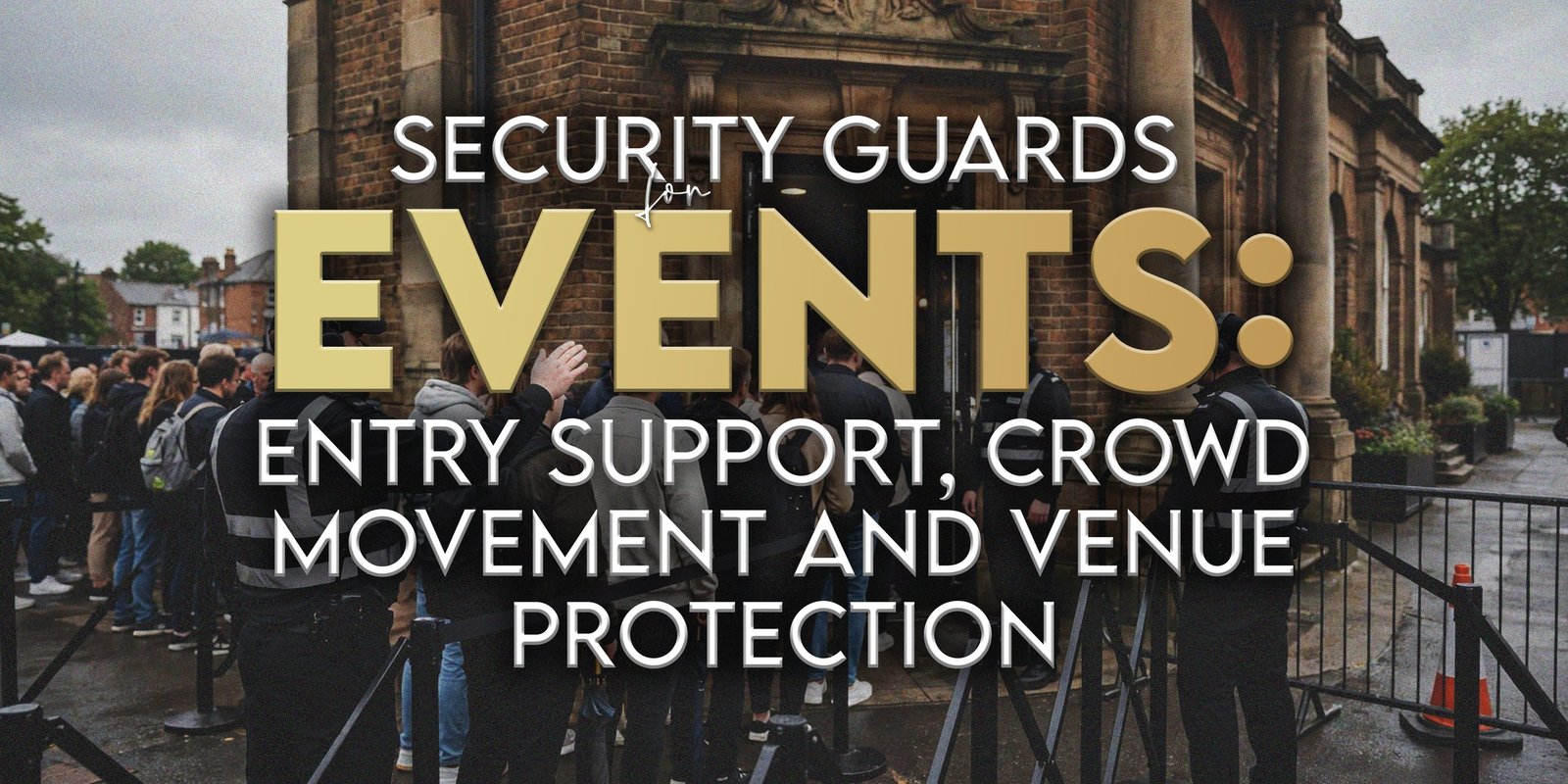
A conference begins with a queue at registration, while another venue welcomes guests for an evening concert. At both locations, the way people arrive, move around and leave can affect the event experience and safety planning. Security guards may help with authorised entry, restricted areas and incident reporting, but their duties must match the event’s risk assessment and relevant licensing conditions.
Organisers must distinguish licensed security work from stewarding. This guide covers practical arrangements for concerts, corporate functions and festivals around Hounslow and West London.
Quick Answer: What Do Security Guards Do at Events?
Security guards at events may check authorised entry, manage restricted access and report incidents under agreed venue procedures. Appropriate SIA-licensed personnel perform licensable security duties, while stewards may provide directions and general visitor assistance. Effective crowd management support depends on the event risk assessment, organised queues, accessible routes and coordination with venue management.
Why Do Events Need Security Guards?
Events bring together guests, suppliers, performers and venue personnel, sometimes within a short arrival window. Security guards can support specific access and incident procedures where the organiser identifies a need for licensed security activity.
However, security guards do not replace the organiser’s responsibility for event safety. The Health and Safety Executive advises organisers to assess crowd risks across arrival, movement and departure, then establish suitable controls and communication.
For example, conferences may need separate registration and restricted-access staff, while concerts may need licensed security alongside stewards.
What Is the Difference Between Event Security Guards and Event Stewards?
Event security guards and Event Stewards may work at the same venue, but their responsibilities are not interchangeable. SIA licensing is determined by the activity, premises and contractual context, not simply the uniform or job title.
| Role | Typical duties | Licensing considerations | Practical event use |
|---|---|---|---|
| Event Steward | Directions, information and non-security visitor assistance | Not automatically SIA-licensed; duties must remain appropriate | Wayfinding and general guest support |
| SIA Door Supervisor | Relevant licensable door-supervision and security activities | Appropriate SIA licence where legally required | Licensed premises and security-related entry duties |
| Security Officer | Agreed guarding and access duties | Applicable SIA requirements depend on duties and circumstances | Restricted operational areas or premises security |
| Event Supervisor | Coordinates assigned teams, briefings and reporting | Licence needs depend on any security activities personally performed | Operational communication and team direction |
Before assigning security guards, review the actual tasks against official SIA guidance. A steward should not be asked to undertake licensable security activity merely because they are already standing near an entrance.
How Do Security Guards Support Event Entry?
Entrance management begins before the first guest arrives. Organisers should identify designated access points, ticket-check procedures, accessible routes, staff-only entrances and the authority for resolving entry questions.
Security guards may carry out relevant security checks or access duties as agreed. Meanwhile, ticketing teams and stewards can provide ordinary registration assistance and directions within their respective roles.
Establish who approves exceptions. Additionally, give security guards venue policies, reporting contacts and clear instructions.
Plan for uneven arrivals, clearly marked queues and suitable waiting space.
Crowd Movement and Queue Management at Events
Crowd management support covers how people enter, circulate and leave a venue safely. It requires appropriate planning for routes, potential congestion points, accessible movement and clear communication between teams.
Security guards may contribute observations and undertake agreed security responsibilities, while stewards and event staff perform their assigned visitor-support tasks. However, the organiser must coordinate the wider crowd management plan.
For instance, guests may converge near a stage, bar or popular attraction. The event team should monitor crowd distribution and use its established procedures to respond to changing conditions.
Furthermore, organisers should keep accessible routes and emergency arrangements in mind when allocating personnel. There is no universal ratio of security guards to attendees that suits every event; decisions depend on risk, layout, activities and licensing conditions.
Venue Security Guards and Restricted-Area Access
Backstage corridors, control rooms, staff facilities and loading entrances may have different access requirements from public guest areas. Venue security guards can support agreed permission checks and report concerns, subject to their duties and relevant licensing requirements.
Provide clear identification procedures and a named decision-maker. Otherwise, security guards may receive conflicting instructions from suppliers, organisers and venue teams.
Restricted access also matters during setup and breakdown, when contractors move equipment. Consequently, update permissions when the event changes phase instead of relying on a guest-entry plan throughout the day.
Security Guards for Concerts, Corporate Events and Festivals
A corporate reception, concert and outdoor festival present different operating conditions. Security guards should therefore receive an event-specific brief instead of generic instructions copied from another venue.
At corporate events, organisers may prioritise invitation checks, guest arrival and access to meeting spaces. Concerts may require attention to licensed security activity and crowd movements during performance changes. Outdoor festivals can involve multiple entrances, weather considerations and widely separated operational areas.
In every setting, assign clear reporting lines and determine staffing through a suitable risk assessment.
How Can SIA Event Staff Support Licensed Venue Requirements?
SIA event staff performing licensable private security duties must hold the appropriate licence when the legal conditions apply. The Security Industry Authority provides guidance explaining when a door supervisor or security guard licence may be required at events.
For licensed premises and regulated entertainment, the distinction can be particularly important. Organisers should describe the intended activity accurately, check appropriate licensing and obtain specialist advice if the position is unclear.
An SIA licence does not replace event-specific induction. Security guards also need instructions about the venue layout, communication channels, emergency arrangements and who supervises their assignment.
CCTV Monitoring for External Event Areas
Appropriate CCTV monitoring can assist with observation and review of incidents around entrances, external grounds or car parks. However, recordings do not automatically mean that someone is watching live or that security personnel will respond on site.
Businesses assessing security camera monitoring for external areas should clarify the purpose of surveillance, footage access, privacy notices and monitoring responsibilities.
Security guards may receive information through agreed reporting channels where monitoring and guarding services have both been arranged. Camera equipment, monitoring and physical attendance remain separate considerations.
Mobile Patrols for Events at Commercial Estates
Some events take place in business parks, commercial estates or venues surrounded by other occupied buildings. Security arrangements for shared grounds may differ from duties at the event’s guest entrance.
For wider premises, mobile patrol security for business parks may be worth considering where the location and service scope justify it. Nevertheless, patrol visits do not automatically replace dedicated security guards managing venue entry or restricted areas.
How Should Organisers Plan Event Security Staffing?
Start with the event risk assessment, venue layout and expected attendance. Then identify activities requiring licensed security, ordinary stewarding, ticketing assistance or operational supervision.
Confirm entry and exit routes, opening hours, licensed premises conditions, accessible access, restricted spaces and the guest departure plan. The organiser should also agree emergency contacts, briefing arrangements and communication methods.
When requesting security guards, explain duties by position and shift. For example, a licensed entry role differs from a steward giving directions near a conference room. Avoid estimating a single headcount without considering these distinctions.
Additionally, decide who will maintain attendance information, communicate changes and record incidents. A useful security brief makes responsibility clear before teams arrive.
How Can Security Guards Support Event Departures?
Crowd movement does not end when a performance finishes. Guests may leave at once, queue for transport or move towards car parks and nearby public routes.
Security guards may assist with assigned access and security duties during closing, while stewards provide directions and organisers coordinate the overall departure plan. Furthermore, teams should communicate any changes to exit arrangements and maintain accessible routes.
Event Security in Hounslow and West London
Hounslow and West London include hotels, conference spaces, hospitality venues and commercial estates that may host corporate functions, entertainment and private events. Each location has its own entrances, operating hours and transport considerations.
H&D Security is based in Hounslow and supports relevant event and commercial security enquiries around West London, the Heathrow area and Greater London. Event security near Heathrow should not be confused with providing official airport or terminal security.
Managers should share the venue address, relevant licences, guest-arrival times and any external access concerns when discussing security guards for a local event.
How H&D Security Supports Venue and Event Operations
H&D Security supports event requirements through SIA Door Supervisors, Event Stewards, Event Supervisors, Security Officers, venue access-control support, CCTV monitoring and incident reporting. Relevant wider site patrol arrangements may also be discussed separately.
Organisers can request an event security quote describing the venue, expected attendance and required duties. Available arrangements depend on the event’s needs and the agreed service scope.
Common Event Security Planning Mistakes
- Treating security guards and Event Stewards as identical roles.
- Failing to define who approves entry exceptions or restricted access.
- Overlooking queue space, crowd circulation and accessibility.
- Preparing an arrival plan but no departure arrangements.
- Assuming a mobile patrol replaces dedicated entry personnel.
- Omitting briefings, emergency contacts and incident-reporting procedures.
- Forgetting to check relevant licensing and venue conditions.
- Assuming CCTV automatically provides continuous live observation.
Event Security Checklist for Organisers
- Confirm event type, venue address, date and operating hours.
- Review expected attendance and the event risk assessment.
- Identify entrances, exits, queue areas and accessible routes.
- Separate security guards, stewards and other event roles.
- Check appropriate SIA licensing requirements.
- Define restricted areas and permission procedures.
- Agree staff briefings, supervisor contacts and communications.
- Document emergency arrangements and incident escalation.
- Plan guest departure, car park and surrounding-site requirements.
- Clarify monitoring, patrol and guarding service scopes.
- Review quotation terms and procedures for schedule changes.
Frequently Asked Questions
What do security guards do at events?
Security guards may undertake agreed access-control, guarding and incident-reporting duties according to the venue and event plan. Their responsibilities depend on the activity and applicable SIA licensing rules. Organisers should clarify where security personnel are needed and coordinate them with stewards, venue management and emergency arrangements.
Do all event security staff need an SIA licence?
No. An SIA licence is required for particular licensable activities under relevant circumstances, not every role associated with an event. General stewarding may not require licensing if it does not involve licensable security duties. Organisers should assess actual tasks using official SIA guidance before allocating positions.
What is the difference between Event Stewards and SIA Door Supervisors?
Event Stewards often provide directions, information and general visitor assistance. SIA Door Supervisors undertake appropriate licensable security activity where required by law. A steward’s presence at an entrance does not authorise them to perform licensed duties. Staffing briefs should distinguish both positions and their reporting responsibilities.
How do security guards support event entry?
Security guards may support agreed security-related entry checks, restricted access and reporting when concerns arise. However, event organisers must establish policies, accessible arrangements and ticketing responsibilities. Clear instructions help security personnel coordinate with registration teams, venue managers and stewards without duplicating or confusing their respective roles.
Can event security teams help manage queues?
Yes, teams may support queue observations, directions and agreed control measures within their assigned roles. Nevertheless, the organiser remains responsible for wider event safety planning. Queue arrangements should reflect expected arrivals, the venue layout, accessibility and changes in crowd movement rather than rely on security guards alone.
Can CCTV complement venue security personnel?
CCTV may support authorised observation and review of incidents around suitable venue areas. It does not automatically provide a live operator or on-site response. When CCTV and security guards are used together, organisers should agree communication, escalation, privacy and service responsibilities before the event begins.
How many event security guards are needed?
There is no universal number of security guards per attendee that fits every venue. Organisers should assess event type, expected attendance, venue layout, activities, licence conditions and operational risks. Staffing decisions should distinguish licensed duties from stewarding and other visitor-support positions before confirming the required team.
How can organisers request event security in Hounslow?
Share the venue location, event date, hours, expected attendance and proposed security duties. Explain entry arrangements, restricted areas and any external monitoring needs. H&D Security can discuss relevant event security services around Hounslow and West London, with staffing and service scope confirmed during the enquiry process.
Building a Practical Event Security Plan
Effective planning begins with the venue’s risks, guest movement and clear division of responsibilities. Security guards should have defined duties, appropriate licensing where necessary and reliable communication with venue management.
Additionally, review how people arrive, move around and depart. Combining event-specific briefings with suitable stewarding, security and monitoring arrangements helps organisers prepare without assuming any service eliminates all risks.
Discuss Your Event Security Requirements With H&D Security
H&D Security can discuss relevant event security guards, SIA Door Supervisors, Event Stewards, access-control support and related monitoring for suitable venues. Share your event type, site location, date, expected attendance, entry arrangements and required operating hours.
Request an event security quote from H&D Security, or contact 0208 476 7676 or info@handdsecurity.co.uk to outline your requirements.