
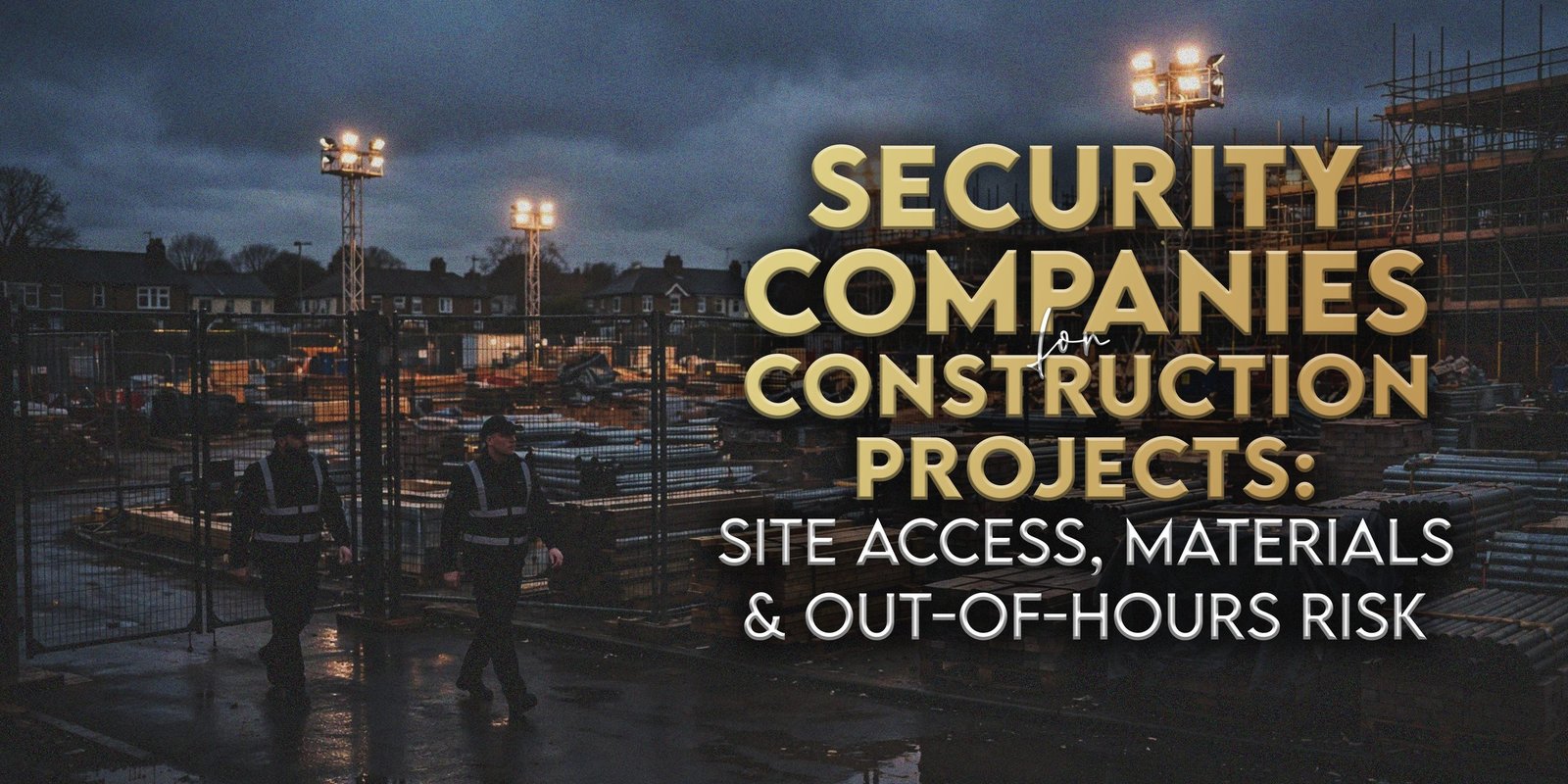
A construction project can change significantly between the first site clearance and the final fit-out. Delivery vehicles arrive, specialist contractors rotate between tasks, and valuable materials may remain on-site after the workforce leaves. Consequently, comparing security companies means looking beyond a guard at the entrance. Project managers need arrangements that reflect changing access routes, working hours, equipment storage and incident-reporting responsibilities.
Quick Answer: What Should Construction Projects Expect From Security Companies?
Security companies supporting construction projects may provide licensed guarding, contractor and visitor access checks, gatehouse duties, mobile patrols, CCTV monitoring and incident reporting. Managers should review site boundaries, stored tools and materials, working hours and out-of-hours risks before agreeing coverage. Clear escalation contacts and site instructions help align security duties with the project’s current stage.
Why Do Construction Projects Use Security Companies?
Building sites are dynamic workplaces. Temporary entrances, changing delivery schedules and newly established storage compounds can alter how people and vehicles move around the premises. Therefore, security companies should assess the operational context rather than offer one unchanged guarding arrangement for every construction stage.
What Does a Construction Security Company Typically Provide?
Security companies may discuss several complementary services. Selection depends on layout, risk and agreed scope.
- Static guarding: Personnel at a designated entrance or other agreed post during specified hours.
- Gatehouse support: Checking authorised visitor and contractor arrangements against site instructions.
- Mobile patrols: Scheduled or otherwise agreed visits to relevant site areas.
- CCTV monitoring: Observing appropriate feeds or reviewing recorded incidents under an agreed service.
- Key holding and alarm response: Defined responsibilities for keys, notifications and escalation.
- Incident reporting: Recording relevant events and communicating them to named site contacts.
When comparing security companies, ask exactly which activities the proposed quotation includes. Monitoring does not automatically include a permanent guard, equipment installation or guaranteed response times.
Construction Site Access Control: Contractors, Visitors and Deliveries
Multiple contractors may operate on one site. Security companies need access instructions based on a current list of authorised contractors, named contacts, delivery procedures and the entrances that should be used.
Security companies may support checking visitor details and recording entry under the site’s instructions. Nevertheless, the construction management team must define who is authorised and ensure visitors receive appropriate site-specific safety information.
Make delivery arrangements clear
Provide expected delivery windows, the relevant gate, vehicle reporting instructions and a contact who can resolve discrepancies. Additionally, specify how security personnel should communicate with the site team when a delivery arrives outside the agreed schedule.
Avoid giving guarding personnel responsibility for accepting hazardous deliveries or directing specialist construction operations unless the duties, competence and arrangements have been separately established.
Building Site Protection for Tools, Materials and Equipment
A construction site may store tools, plant, fuel, copper, timber and other valuable materials in temporary or changing locations. Building site protection through security companies requires a practical inventory and storage plan, not simply additional patrol instructions.
When briefing security companies, project managers should decide which compounds hold equipment, who has permission to access them and how the site records movements. Security companies can then discuss suitable observation and reporting tasks around the agreed operational areas.
Why Is Out-of-Hours Construction Security Important?
Overnight closures, weekends and bank holidays can change who is present and which entrances remain in use. Meanwhile, construction activity may pause even though equipment and partly completed works remain on the premises.
Security companies should discuss how the site is handed over at the end of the working day, who is contacted about incidents and which duties are expected during closure periods. The scope may involve on-site guarding, patrol visits or suitable monitoring, depending on the location and risk assessment.
Mobile Patrols vs Static Security Guards
Security companies may offer different levels of attendance. Neither static guarding nor mobile patrols is universally preferable; managers should compare them against access activity, site size and operating hours.
| Security arrangement | Typical use | Potential advantage | Limitation | Relevant site condition |
|---|---|---|---|---|
| Static guard | Designated gate or occupied security post | Continuous presence during agreed hours | Scope depends on assigned duties | Active entry and delivery periods |
| Mobile patrol | Agreed visits to commercial premises | Flexible site-check arrangement | Not continuous on-site attendance | Defined lower-activity periods |
| CCTV monitoring | Observation or review under agreed arrangements | Supports visual incident information | Does not automatically provide physical response | Appropriate monitored areas |
| Combined arrangement | Separate guarding, patrol and monitoring duties | Coordinates several functions | Requires clear handovers and terms | Complex or changing operations |
Mobile Patrols for Construction Projects in Commercial Estates
Refurbishment and development works sometimes take place within business parks or mixed-use commercial estates. They may have shared roads and access arrangements.
A patrol plan should acknowledge those boundaries and identify which sections belong to the construction project. For a comparison when evaluating security companies, see H&D Security’s mobile patrol security for business parks.
External CCTV and Security Cameras for Construction Sites
CCTV may assist with authorised observation of site boundaries, delivery gates and suitable material storage areas. Yet cameras and monitoring services are separate from guards, access procedures and technical installation work.
Security companies should explain whether they offer observation, recording review or another defined service, and who receives alerts or incident reports. In addition, project managers should agree which organisation controls footage and how access is authorised.
When evaluating security companies, consult security camera monitoring for external areas. Security companies should also consider employee and visitor privacy. The ICO advises organisations using identifiable footage to establish a lawful, proportionate purpose, provide transparency and manage retention appropriately.
What Should Project Managers Confirm About Commercial Guarding?
Commercial guarding proposals should define duties clearly. When evaluating security companies, start with the following questions rather than assuming similar-sounding services have identical terms.
- Which entrances, compounds or buildings form part of the assignment?
- What hours will personnel attend, and who authorises changes?
- Which duties require relevant SIA licensing, and how is suitability checked?
- Who provides site induction and updates security staff about construction hazards?
- What patrol, visitor-checking or reporting activities are included?
- Who receives incident notifications, and what is the escalation process?
- How are cancellations, additional hours and commercial terms agreed?
SIA licensing depends on the security activity and circumstances; it is not a substitute for appropriate construction site induction or competence in specialist construction duties.
How Do Security Requirements Change During Construction?
Security companies should revise their instructions as the project develops. During site establishment, attention may centre on temporary entrances and early deliveries. Later, main construction can create additional contractor movements, plant storage and changes to the perimeter.
Fit-out work may involve different subcontractors and stored materials. Subsequently, handover and temporary closure can alter who is authorised to enter and which areas remain occupied.
Therefore, security companies and project managers should schedule reviews when access routes, working hours or storage arrangements change. An outdated site instruction can undermine an otherwise sensible plan.
Security Companies in Hounslow and West London
Construction projects in Hounslow, the Heathrow area and West London can include refurbishments, commercial development and works within existing business parks. Such settings may involve shared roads, delivery restrictions and neighbours whose access must remain separate from the project.
H&D Security is based in Hounslow and supports relevant commercial and construction security enquiries. For local contractors comparing security companies, the enquiry should include the site postcode, access arrangements, operating hours and project stage.
A Heathrow-area location does not imply any connection to airport terminal security. Security needs should be assessed for the individual commercial construction site.
How H&D Security Supports Construction Site Requirements
H&D Security’s services include construction site guarding, SIA-licensed personnel, access-control and gatehouse support, mobile patrols, CCTV monitoring, relevant key-holding and alarm-response arrangements, and incident reporting.
For an effective discussion, contractors should describe the site layout, material storage, work schedule and existing controls. Like responsible security companies, H&D Security can discuss site security services within an agreed scope rather than promise that every incident will be prevented. Employers can request construction guarding support with the relevant site brief.
Common Construction Site Security Planning Mistakes
Even project teams comparing security companies can overlook details when site conditions change. Frequent problems include:
- Unclear access authority: Guards receive contractor names but no current permission process.
- Outdated site layout: Patrol instructions fail to reflect new work areas or entrances.
- Weak material records: Teams cannot reconcile equipment movements with delivery documents.
- Undefined out-of-hours contacts: Incident information reaches someone who cannot authorise action.
- Missing induction: Security personnel lack relevant information about the working construction environment.
- Confused service scope: The contractor assumes CCTV, monitoring and static guarding are included together.
- Poor handovers: Incoming personnel cannot see recent instructions, incidents or site changes.
Instead, update the security plan during project coordination and confirm changes in writing.
Construction Site Security Checklist
Use this checklist when comparing security companies or preparing a construction security quotation.
- Record the complete site address, project stage and working hours.
- Identify gates, vehicle entrances and authorised access procedures.
- List contractor, visitor and delivery reporting arrangements.
- Describe equipment, tool and material storage locations.
- Confirm existing fencing, lighting, alarms and CCTV arrangements.
- Identify static posts, patrol needs and out-of-hours requirements.
- Clarify relevant SIA licensing and induction responsibilities.
- Appoint authorised site contacts and emergency escalation contacts.
- Agree incident logs, handovers and communication procedures.
- Review quotation scope, schedule changes and commercial terms.
- Set review points when construction stages or access routes change.
Frequently Asked Questions
What do security companies provide for construction projects?
Security companies may provide site guarding, gatehouse checks, authorised access support, patrols, CCTV monitoring and incident reporting. The precise activities depend on the site, provider and contract. Contractors should define operating hours, storage areas and escalation contacts before agreeing a service rather than assume that every arrangement includes continuous attendance.
Why do construction sites need out-of-hours guarding?
Out-of-hours arrangements may be appropriate when a construction site holds materials or equipment while normal activity has stopped. However, a guard is not the only possible arrangement. Project managers should review access risk, site conditions, patrol options, monitoring and emergency contacts before selecting an appropriate level of coverage.
What should a construction security company check before deployment?
A construction security company should discuss the location, project stage, entrances, operating hours, assigned duties and relevant incidents or concerns. Additionally, contractors should provide site instructions, safety information and named supervisory contacts. The agreed scope should clarify reporting, induction and any relevant SIA licensing requirements before attendance begins.
Can mobile patrols support construction site monitoring?
Mobile patrols may support agreed checks around construction compounds, commercial estates or temporarily closed premises. Nevertheless, visits are not equivalent to continuous on-site guarding. Contractors should confirm patrol instructions, permitted areas, operating times and escalation procedures, taking account of the construction site’s changing layout and hazards.
How can CCTV support building site security?
CCTV may provide recorded or monitored visual information about appropriate gates, external areas and material storage locations. It can support incident reviews and reporting, but it does not replace access procedures or physical supervision. Where identifiable people are recorded, the organisation should consider UK data-protection obligations and current ICO guidance.
Do construction security guards need an SIA licence?
Relevant contracted private security duties may require an appropriate SIA licence, depending on the activity and circumstances. Not every task at a construction site is licensable in the same way. Employers should verify applicable requirements and ensure personnel also receive site-specific safety information and instructions.
What should managers consider about material storage?
Managers should identify where materials, tools and plant are stored, who may access them and how movements are recorded. Where security companies provide guarding or monitoring, the agreed duties should reflect those arrangements. Clear inventory records and reporting procedures remain important alongside security personnel and equipment.
How can I find construction security services in Hounslow?
Businesses can compare security companies by reviewing relevant construction experience, service scope, licensing where applicable and communication arrangements. H&D Security is based in Hounslow and can discuss suitable commercial site requirements. Share the site postcode, project stage, required hours and guarding or monitoring needs when making an enquiry.
What information is needed for a construction security quote?
Provide the location, site layout, current construction stage, project operating hours, access points and relevant material storage concerns. Additionally, describe existing CCTV, alarm arrangements and desired patrol or guarding duties. An accurate brief helps security companies clarify their proposed scope and commercial terms before an arrangement begins.
Choosing Security Arrangements That Fit Your Construction Project
Security companies should be evaluated against site conditions, not simply the number of guards or patrol visits quoted. Review who needs access, how materials are managed and what happens after working hours.
As the project changes, update the guarding and monitoring brief. Good commercial guarding coordination depends on clear communication between the contractor, site manager and security provider.
Discuss Your Construction Site Security Requirements With H&D Security
When comparing security companies for a building project, refurbishment or temporary site closure, H&D Security can discuss relevant guarding, patrol, access-control and monitoring services. Share the location, construction stage, operating hours, entry procedures, equipment storage and existing security arrangements.
Request a construction site security quote from H&D Security or contact 0208 476 7676 and info@handdsecurity.co.uk with your requirements.