
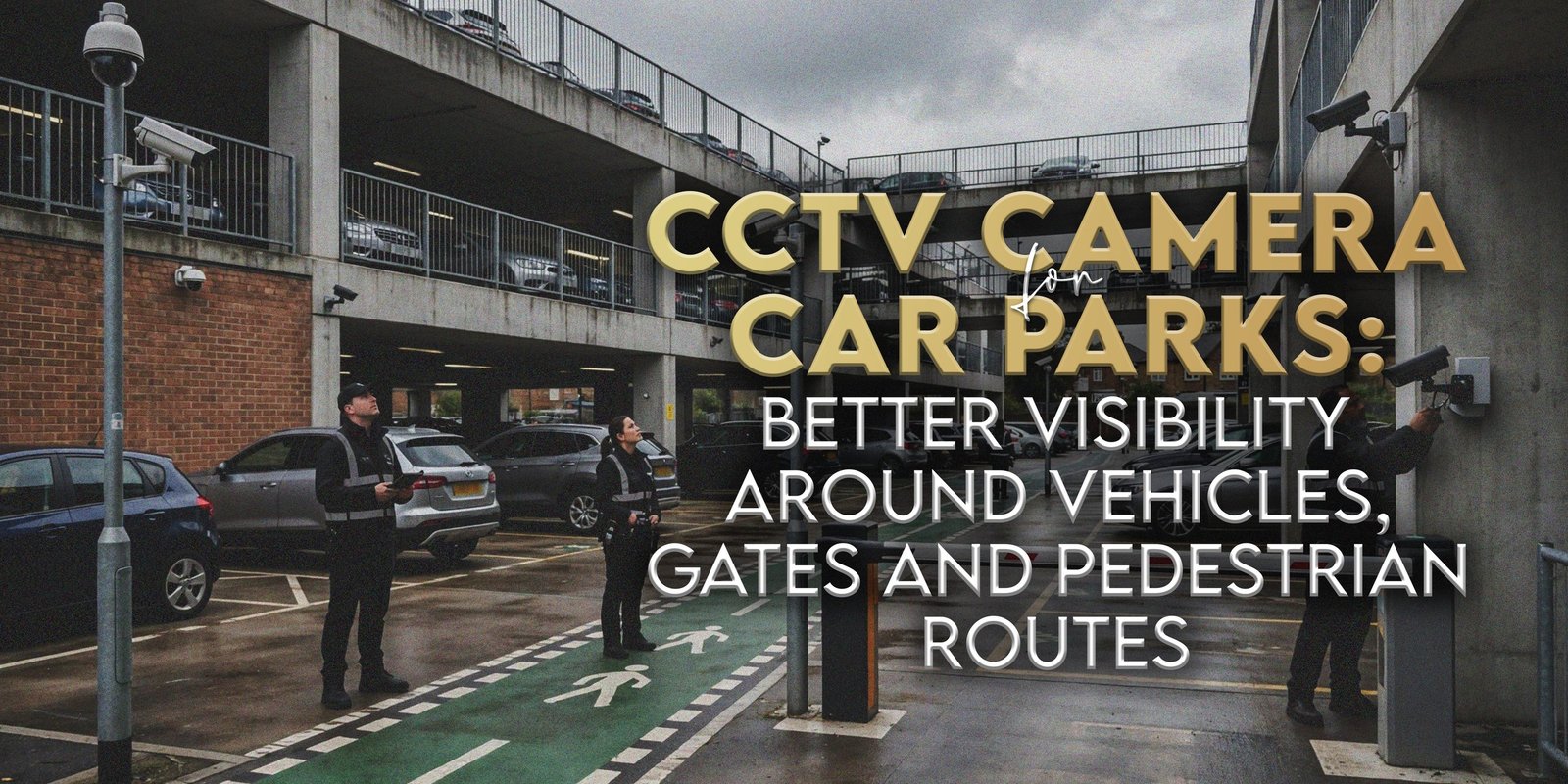
A delivery van approaches a car park entrance while visitors cross towards a shopping centre. Vehicles and pedestrians share busy commercial routes. A CCTV camera can provide a useful visual record, but effective oversight requires more than installing equipment and assuming that every incident will be noticed.
Managers must define coverage, viewing permissions and reporting, while distinguishing recording from monitoring and number plate recognition.
Quick Answer: How Does CCTV Camera Monitoring Help Car Parks?
A CCTV camera can record relevant activity at car park entrances, exits, gates, vehicle areas and pedestrian routes. Authorised footage review may help managers investigate incidents, while separately arranged live monitoring can support observation and escalation. Effective CCTV camera coverage should complement access-control procedures, visitor information, site maintenance and appropriate privacy safeguards.
Why Do Commercial Car Parks Use CCTV Cameras?
Commercial car parks bring together drivers, delivery personnel, customers and pedestrians. A CCTV camera can inform investigations of damage or access disputes, but managers should compare footage with site records.
Footage may establish when a vehicle entered, but not necessarily who drove or caused damage.
Which Car Park Areas Should CCTV Camera Coverage Consider?
A CCTV camera coverage review should focus on legitimate operational needs, proportionate viewing and the site’s actual layout. Not every bay or external space needs the same arrangement.
| Area | Potential monitoring purpose | Important management consideration |
|---|---|---|
| Vehicle entrance | Review incoming traffic and access incidents | Gate procedures, signage and visibility |
| Vehicle exit | Review departure-related reports | Exit movements and authorised footage use |
| Parking areas | Support incident enquiries | Privacy and appropriate viewing scope |
| Pedestrian walkways | Review relevant movement incidents | Accessible routes and avoiding unnecessary intrusion |
| Building approaches | Coordinate site and reception procedures | Shared public access and responsibilities |
| Loading or delivery zone | Review commercial vehicle activity | Delivery logs and separation from general parking |
| Gate or barrier | Document relevant access events | Barrier management and distinct ANPR functions |
Managers should justify each CCTV camera view and consider less intrusive alternatives.
CCTV Camera Monitoring Around Vehicle Entrances and Exits
Vehicle entrances combine changing traffic flow, access permissions and pedestrian crossings. A CCTV camera may support later review of a reported gate incident or an access-related complaint, while staff follow their existing entry procedures.
Car park CCTV cannot replace clear signs, safe routes or functioning gates.
Document monitoring hours; recording does not imply continuous observation.
Outdoor CCTV Cameras for Commercial Parking Areas
Outdoor CCTV cameras must be assessed for the conditions in which they will operate. A suitable technical assessment considers weather exposure, changing light, existing power and connectivity, and maintenance access without relying on invented equipment specifications.
A CCTV camera that records a busy daytime area may face different operating conditions after dark. Consequently, buyers should ask which night-time viewing options a proposed package actually includes, and whether these suit the site’s documented needs.
Clarify maintenance and monitoring responsibilities separately.
Gate Cameras and Vehicle Access Control
Gate cameras may help authorised teams review events around barriers and vehicle entrances. However, a standard CCTV camera records visual information and does not automatically grant access, operate a barrier or recognise registration plates.
An ANPR system uses technology to read vehicle registration marks and may compare them with other data for an agreed purpose. Meanwhile, a barrier or gate controller manages physical access according to its separate configuration and procedures.
Clarify CCTV camera, ANPR and access-control responsibilities separately, including data protection.
Pedestrian Route Monitoring in Car Parks
People walking between parked vehicles and buildings may use marked walkways, crossings and accessible routes. A CCTV camera may help review relevant reported incidents around those areas, but it should not be treated as an alternative to thoughtful traffic management.
Managers must also consider accessible routes and proportionate observation.
Vehicle area surveillance should avoid unnecessary recording of neighbouring properties.
Recorded CCTV vs Live Monitoring vs ANPR
A CCTV camera can be part of several different services. Recording, real-time observation and number plate recognition are not interchangeable.
| System type | Primary purpose | Typical use | Important limitation | Business consideration |
|---|---|---|---|---|
| Recorded CCTV | Retain visual footage | Review a reported event | No automatic human intervention | Footage security, access and retention |
| Live CCTV monitoring | Observe selected feeds during agreed periods | Report relevant activity | Depends on operator availability and service scope | Escalation and monitoring hours |
| Remote viewing | Access supported footage from another location | Authorised off-site review | Depends on system access and connectivity | Permissions and contractual responsibilities |
| ANPR | Read vehicle registration marks | Defined vehicle-management requirements | Not the same as general video monitoring | Lawful purpose, accuracy and privacy |
| Gate access system | Manage authorised vehicle entry | Barrier and permit procedures | Does not replace incident observation | Maintenance and access permissions |
Clarify incident handling and the distinction between technical features and response.
CCTV and Commercial Security Guards: How Can They Work Together?
A CCTV camera can provide visual information, while security personnel may carry out separately agreed patrol, access or incident-reporting duties. Combining services can improve coordination, but the responsibilities must be defined rather than assumed.
A control-room report does not guarantee an on-site response.
Agree each service’s hours, duties and relevant licensing requirements.
Retail Car Park CCTV and Shop Security
Shopping centres and retail parks often combine customer parking, delivery routes and building entrances. A CCTV camera may support car park incident review, while separately arranged security personnel manage agreed duties inside retail premises.
For mixed locations, security guards for retail premises may be relevant to wider commercial security planning. Retail guarding does not automatically include parking enforcement, barrier operation or dedicated CCTV camera monitoring.
Assign clear responsibilities between the property, parking and retail teams.
CCTV for Industrial Parking and Warehouse Vehicle Areas
Industrial premises may have staff parking beside dispatch yards, loading bays and delivery gates. Here, CCTV camera priorities can differ from those of customer-facing car parks because commercial vehicle movements and goods handling create separate monitoring needs.
For warehouse-specific information, see warehouse CCTV for loading bays and stockrooms. Nevertheless, keep the car park assessment focused on relevant vehicle entrances, parking spaces and pedestrian approaches rather than treating every industrial area as one surveillance zone.
Car Park CCTV Monitoring in Hounslow and West London
Commercial properties in Hounslow, the Heathrow area, West London and Greater London can include hotel parking, retail parks, office car parks and distribution-site vehicle areas. Operating hours, visitor turnover and access procedures differ from one location to another.
H&D Security operates from Hounslow and describes commercial CCTV camera packages, professional installation, monitoring, car park patrols and relevant vehicle access services. Employers should describe their actual site requirements before agreeing a package.
Heathrow-area commercial premises have no implied affiliation with airport security.
What Should Managers Check Before Choosing CCTV Cameras?
Before purchasing a CCTV camera service, managers should review the purpose of observation, existing equipment and operating responsibilities. A written site brief makes comparisons more useful and reduces confusion between equipment and monitoring.
Ask which entrances, parking areas, pedestrian routes or gates require legitimate observation. Next, discuss lighting, outdoor conditions, recording arrangements, maintenance and whether any monitoring service is active during the relevant hours.
Confirm footage access, incident escalation and separate ANPR or barrier responsibilities.
UK Car Park CCTV Privacy and Recording Responsibilities
A CCTV camera recording identifiable people or vehicle information may process personal data. The Information Commissioner’s Office advises businesses to establish a lawful purpose, use proportionate surveillance and provide clear information before individuals enter monitored areas.
Signs should identify the surveillance and operator; footage access must be controlled.
There is no universal retention period for every CCTV camera recording under UK data-protection law. Instead, keep footage only for a justified period linked to the purpose and delete it appropriately when no longer needed. Assess whether a data protection impact assessment is required for the planned surveillance.
ANPR adds duties concerning number plate information, assessment, signage, accuracy and retention. ICO guidance is under review.
Common CCTV Camera Planning Mistakes
- Undefined objectives: Selecting equipment without deciding which incidents or access events the CCTV camera should help review.
- Confusing services: Assuming recording, live monitoring, ANPR and parking enforcement are the same function.
- Ignoring pedestrians: Focusing only on vehicles while overlooking accessible routes and site traffic arrangements.
- Unclear responsibilities: Not assigning maintenance, incident response or footage-access contacts.
- Weak privacy planning: Forgetting transparent signage, appropriate viewing purposes or retention decisions.
- Outdated procedures: Failing to review a CCTV camera arrangement when gates, entrances or operating hours change.
How H&D Security Supports Car Park CCTV and Commercial Security
H&D Security’s published offering includes commercial CCTV camera packages, installation, monitoring, remote viewing and recording options, plus relevant ANPR, access control, car park patrols and commercial guarding services. Confirm the exact package and availability.
For operators, discuss your CCTV camera requirements by sharing the car park layout, operating hours, gate arrangements and monitoring expectations.
Car Park CCTV Planning Checklist
- Define a legitimate purpose for each CCTV camera view.
- Identify entrances, exits, relevant parking areas and pedestrian routes.
- Explain any gate, barrier and ANPR requirements separately.
- Review outdoor conditions, lighting and existing equipment.
- Confirm recording, remote viewing and live monitoring options.
- Assign maintenance and incident-reporting responsibilities.
- Document privacy information, signage and authorised footage access.
- Establish justified data-retention and deletion procedures.
- Agree any guarding, patrol or parking-management arrangements.
- Plan a review when layout or operating hours change.
Frequently Asked Questions
What is the purpose of a CCTV camera in a car park?
A CCTV camera may record relevant activity around vehicle entrances, exits, parking areas and pedestrian routes. Footage can help authorised managers investigate reported events and understand operational concerns. However, it does not replace access procedures, traffic management or site staff, and no camera system guarantees that incidents will be prevented.
Where should car park CCTV coverage be considered?
Consider appropriate entrances, gates, pedestrian approaches and parking areas where a documented purpose supports observation. A CCTV camera should not capture more personal information than necessary. Assess the site layout, nearby properties and privacy expectations, then ask a competent provider to review technical suitability and proportionate coverage.
Are outdoor CCTV cameras suitable for vehicle entrances?
Outdoor CCTV cameras can form part of entrance monitoring where equipment is suitable for the environment and monitoring purpose. Managers should discuss changing lighting, weather exposure, installation arrangements and maintenance responsibilities. The precise CCTV camera options depend on the site and supplier; do not assume every package includes the same features.
What should managers consider when choosing gate cameras?
Gate cameras should serve a clear purpose such as reviewing a reported access event. Confirm their relationship to barriers, visitor permissions and any separate ANPR system. A CCTV camera is not automatically a number plate reader or gate controller, so document the required functions before approving equipment or monitoring services.
Can CCTV monitor pedestrian routes?
A CCTV camera may support appropriate incident review around walkways and building approaches. However, managers should also maintain clear pedestrian routes, signage and accessibility arrangements. Any surveillance should be necessary and proportionate, with suitable privacy information and controls over who can view identifiable footage.
What is the difference between ANPR and CCTV?
General CCTV records visual activity for monitoring or later review, whereas ANPR processes vehicle registration marks for a defined purpose. A CCTV camera does not necessarily include ANPR functionality. Both may involve personal data, but ANPR introduces additional considerations around accuracy, matching records, retention and informing drivers.
Do UK car parks need CCTV signage?
When CCTV processes personal data, organisations must provide appropriate transparency information. Visible signage before or upon entering monitored areas is a common way to tell drivers and pedestrians about recording and the operator. The exact information and wider legal requirements depend on the system and purpose, so consult ICO guidance.
How long can car park CCTV footage be retained?
There is no universal UK retention period for every CCTV camera recording. Organisations should identify the purpose of collection and keep personal data only for as long as necessary. A documented retention and deletion policy, access controls and appropriate treatment of footage needed for specific investigations are important.
Can CCTV work alongside security guards and patrols?
Yes. A CCTV camera can supply relevant visual information to authorised personnel, while guards or patrol teams undertake separately agreed duties. However, recording does not guarantee someone is watching or attending an incident. Define monitoring hours, communication, reporting and guarding responsibilities in the proposed service agreement.
Planning CCTV Coverage for Your Car Park
An effective CCTV camera plan reflects the site layout, vehicle flow, pedestrian movements and operational requirements. Recorded footage, live observation, gate control and ANPR each serve different purposes, so choose only the functions that address a justified need.
Moreover, review privacy, maintenance and incident responsibilities before confirming a service. CCTV camera coverage works best as one part of a wider, well-managed commercial site arrangement.
Discuss Your Car Park CCTV Requirements With H&D Security
H&D Security can discuss relevant CCTV camera installation, monitoring and commercial security support for suitable car parks. Share the site postcode, entrance and exit arrangements, operating hours, existing equipment, recording expectations and any patrol or gate requirements.
Request a car park CCTV quote from H&D Security or contact 0208 476 7676 and info@handdsecurity.co.uk to outline your requirements.