
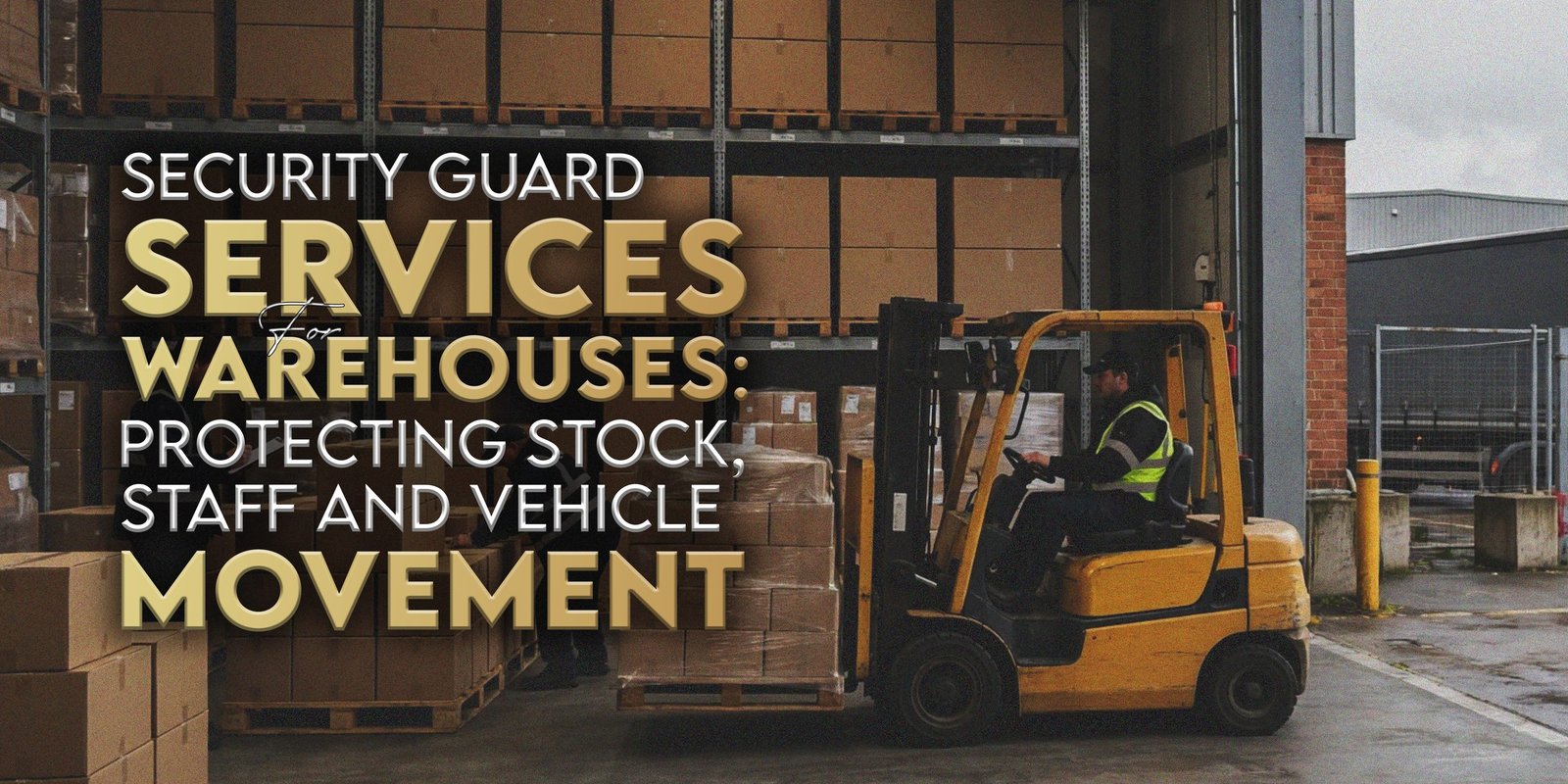
Warehouses bring together staff, contractors, delivery drivers, vehicle movement, loading areas, stock and restricted zones, often across changing shifts. Effective security guard services should therefore fit the actual operating pattern of the site rather than rely on a generic guarding model.
For warehouse managers, the key question is not simply whether guards are present. Instead, security guard services should support authorised access, orderly vehicle movement, site procedures, incident reporting and coordination with operations teams without disrupting normal workflow.
What Do Security Guard Services Do in a Warehouse?
Security guard services in a warehouse can support authorised access, staff and visitor movement, vehicle entry, loading areas, stock zones, patrols, incident reporting and site procedures. The right setup depends on the warehouse layout, operating hours, delivery activity and restricted areas, so duties should be designed around the site rather than copied from another facility.
A practical deployment may involve a gatehouse, reception point, defined patrol responsibilities, support around loading areas or out-of-hours access. However, not every warehouse requires the same combination.
Why Warehouses Need Site-Specific Guarding
No two warehouses operate in exactly the same way. Building size, gate layout, shift patterns, staff numbers, delivery volume, yard space and stock type can all change what security guard services need to support.
A distribution centre with constant vehicle movement may place more emphasis on gate and yard procedures. By comparison, a smaller warehouse with limited deliveries may need stronger focus on staff access, contractor entry and out-of-hours procedures.
Before arranging security guard services, warehouse managers should map the normal movement of people, vehicles and goods. This creates a clearer basis for assigning duties and avoids using the same guarding pattern everywhere.
Warehouse Security Guards at Entrances and Access Points
Warehouse security guards can support entry procedures for staff, visitors, contractors and delivery drivers. Their role may include checking authorised access, following visitor procedures, directing people to the correct contact point and applying site instructions consistently.
At busy entrances, security guard services should support operations rather than create unnecessary delay. Well-defined security guard services can also make access decisions more consistent across busy periods.
Therefore, site managers should define who can enter, what information needs to be checked and when an issue should be escalated.
Restricted areas may require a different process from general staff access. In practice, the best arrangement is one that reflects the site’s existing access rules and operational responsibilities.
Site Security Guards and Staff Movement
Site security guards may support staff entrances, reception activity, contractor access and movement into restricted zones. Shift changes can create short periods of higher footfall, so procedures should remain clear even when many people arrive or leave at once.
Good security guard services should complement staff-management processes rather than unnecessarily monitor employees. Clear instructions, defined escalation routes and consistent visitor procedures help guards support the site without interfering with routine operations.
For larger sites, communication between security, operations and facilities teams is especially important. When procedures change, guarding instructions should change with them.
Logistics Security and Vehicle Movement
Logistics security involves more than guarding a gate. In a warehouse environment, it can include vehicle access, delivery-driver procedures, contractor vehicles, yard movement, loading areas, goods-in and dispatch activity.
Where vehicle volumes are high, security guard services can support orderly access by checking authorised entry, applying site procedures, directing drivers to the right process and escalating irregular situations to site management.
The aim is not to publish rigid gate routines or predictable schedules. Instead, businesses should define the responsibilities, communication channels and escalation steps that fit the site’s traffic flow and operational needs.
Security Guard Services for Loading Bays
Loading bays bring together drivers, staff, goods and vehicles, often within a limited operating area. As a result, security guard services may support access procedures, authorised movement, communication with warehouse teams and escalation when activity falls outside normal site instructions.
The guard’s role should be clearly defined. For example, site management should decide which deliveries require confirmation, who can authorise access and what should happen when information does not match the expected process.
Because loading activity can vary through the day, security guard services should remain aligned with the warehouse’s operating pattern rather than rely on one fixed assumption.
Security Guard Services for Stock Areas
Stock rooms, restricted storage, goods-in areas and dispatch zones can require different levels of access control. Security guard services may support these areas by reinforcing authorised-entry procedures, carrying out agreed checks and reporting issues through the site’s escalation process.
Deployment should reflect layout and workflow. A guard positioned around one access point may add more value than trying to cover several unrelated areas without a clear purpose.
For high-value inventory or restricted storage, warehouse managers should define who requires access, how access is authorised and how exceptions are handled. Security guard services should then support those rules consistently.
SIA Guarding: What Should Businesses Check?
Businesses arranging security guard services should confirm whether the duties being supplied fall within current SIA licensing requirements and ensure the role matches the licence held. Contracted manned guarding can require an SIA licence when it involves licensable activity, while in-house arrangements can be treated differently under current guidance.
Current SIA guidance identifies security guarding as a licensable activity in relevant contracted guarding arrangements and explains that licence-linked qualifications apply to front-line security guarding licences.
Before deployment, businesses should check:
- the actual guarding duties
- the current licensing requirement for those duties
- whether the operative holds the appropriate current licence where required
- communication and reporting expectations
- site-specific instructions
- escalation arrangements
The SIA register can also be used to check whether a person holds a current licence for relevant private-security work.
Daytime vs Night-Time Warehouse Guarding
Warehouse requirements can change according to operating hours, staffing levels, delivery patterns and site occupancy. Daytime may involve more visitors, contractors and vehicles, while reduced staffing periods may place greater emphasis on access procedures and site checks.
That does not mean one period is automatically more risky than another. Instead, security guard services should reflect how the warehouse actually operates during each period.
Managers should review whether duties, communication routes and access arrangements remain appropriate when staffing or delivery activity changes.
Security Guards and Vehicle Gate Control
At vehicle gates, guards may support authorised access, relevant arrival records, visitor direction and escalation where the information provided does not match site procedures.
Effective security guard services should fit the site’s traffic-management process rather than operate as a separate system. Therefore, warehouse managers should define what guards are expected to check, who they contact when clarification is needed and how exceptions are handled.
The objective is consistency and operational support, not unnecessary delay. In this context, security guard services should reinforce the warehouse’s existing gate procedures.
Warehouse Patrols: What Should They Achieve?
Warehouse patrols should have a defined purpose. Depending on the site, they may support visible presence, checks of designated areas, reporting of unusual conditions and verification that agreed site procedures remain in place.
However, security guard services should avoid overly predictable or unnecessary routines. Patrol design should remain site-specific and should not expose detailed routes or timings publicly.
A useful patrol process also includes reporting. If an issue is found, the business should already know who receives the report and what action follows.
Security Guard Services and CCTV
CCTV and guarding can complement each other when roles are clearly defined. CCTV may help with observation or incident verification, while security guard services can support communication, on-site checks and escalation under the site’s procedures.
Neither automatically replaces the other. The right combination depends on the size of the warehouse, operating hours, site layout, access activity and management requirements.
Businesses should also define who is authorised to monitor or access CCTV footage and ensure any related activity follows current legal and operational requirements.
Security Guard Services During Shift Changes
Shift changes can produce short periods of heavier staff, vehicle and gatehouse activity. Security guard services can help maintain consistent access procedures while people arrive, leave or move between designated areas.
The planning goal should be smooth flow. Therefore, guards need clear instructions on staff entry, visitor handling, vehicle access and escalation without turning routine movement into unnecessary delay.
If shift patterns change, warehouse managers should review whether the guarding arrangement still fits the operation.
Warehouse Security During Deliveries and Collections
Deliveries and collections often require coordination between drivers, loading teams, warehouse staff and security personnel. Security guard services can support the process by following access procedures, confirming the correct point of contact and escalating exceptions to operations teams.
Some sites may use booking references, pre-arrival information or other internal procedures. However, the exact process should remain site-specific rather than treated as a universal model.
Clear communication is particularly important when deliveries arrive outside the normal pattern or when several vehicles reach the site at once. In those situations, security guard services should follow defined escalation routes rather than improvise outside the site brief.
Temporary, Emergency and Ongoing Guarding
Warehouses may require security guard services on an ongoing basis or for temporary periods. Common commercial situations can include peak operating periods, refurbishment, temporary cover, site shutdowns, increased delivery activity or short-term changes in occupancy.
Temporary guarding should still use clear site instructions. Temporary security guard services still need clearly defined responsibilities from the start.
Likewise, ongoing arrangements should be reviewed periodically so the guarding model reflects current operations rather than historic assumptions.
Warehouse Security During Closure Periods
Some warehouses become temporarily closed, partly occupied, under refurbishment or between tenants. During these periods, security guard services may need to support different access and monitoring priorities because normal staffing and delivery activity have reduced.
Businesses managing unoccupied or partially occupied premises can also review vacant property monitoring as part of the wider site plan.
The important point is to update the guarding arrangement when the site’s operating condition changes.
Security Compliance and Wider Site Planning
Guarding should sit within wider site procedures, access management, emergency planning and operational responsibilities. Security guard services work best when duties connect clearly with management processes rather than operate in isolation.
Businesses reviewing broader operational controls can also consider security planning and compliance as part of a layered approach to site management.
For larger or public-facing premises, the relationship between guarding, access procedures, CCTV and emergency arrangements should be clearly documented.
Common Warehouse Security Guarding Mistakes
- Using the same guarding plan for every warehouse. Site layout and operating patterns differ.
- Failing to define responsibilities. Guards need clear duties and escalation routes.
- Ignoring vehicle movement. Yard and gate activity can be central to logistics operations.
- Overlooking loading-bay procedures. Drivers, goods and staff interact in the same area.
- Weak communication between security and operations. Information needs to move quickly and clearly.
- Failing to review shift-change activity. Access volumes can change at specific operational periods.
- Using unclear visitor and contractor procedures. People need a consistent route through the site.
- Not reviewing arrangements after operational changes. New gates, layouts or workflows can change requirements.
- Treating guarding as separate from CCTV and access procedures. These controls often need coordination.
- Failing to review current licensing requirements. Roles and activities should be checked against current SIA guidance where applicable.
What Should Businesses Check Before Hiring Security Guard Services?
Before hiring security guard services, businesses should define the site’s operating hours, access points, vehicle gates, delivery volumes, loading areas, shift patterns, restricted zones, visitor procedures, contractor access, CCTV arrangements, reporting expectations, emergency procedures and the exact duties expected from guards.
A practical checklist includes:
- Site size and layout
- Operating hours
- Main staff entrance
- Visitor entrance
- Number of vehicle gates
- Delivery and collection volume
- Loading bays
- Goods-in and dispatch activity
- Shift patterns
- Restricted areas
- Contractor access
- Out-of-hours access
- CCTV arrangements
- Reporting requirements
- Communication procedures
- Emergency procedures
- Guard duties
- Current SIA licensing requirements where applicable
- Temporary or ongoing cover
- Review process when operations change
This gives providers a clearer brief and helps the business compare proposals on more than price alone. It also helps decision-makers assess whether proposed security guard services match real operational requirements.
Warehouse Security Planning Table
| Warehouse Area | What Security Staff May Support | What the Business Should Define |
|---|---|---|
| Main entrance | Authorised access and visitor procedure | Who can enter and how access works |
| Vehicle gate | Vehicle-entry procedures | Driver and vehicle process |
| Loading bay | Delivery and collection activity | Access and escalation process |
| Goods-in | Movement of deliveries | Authorised personnel and procedures |
| Dispatch | Collection activity | Access and communication process |
| Stock areas | Restricted-area procedures | Who requires access |
| Staff entrance | Shift-change access | Staff-entry process |
| Yard | Vehicle and contractor movement | Site traffic procedures |
The table provides a planning framework rather than a fixed model. Security guard services should still be designed around the actual warehouse, operating pattern and management responsibilities.
How Often Should Warehouse Guarding Arrangements Be Reviewed?
Businesses should review security guard services when site operations change and periodically as part of normal management. New access points, revised shifts, higher delivery volumes, refurbishment, changes in stock handling or altered yard layouts can all change what guards need to support.
A review should ask whether duties remain clear, whether communication routes still work and whether the guarding arrangement continues to match the current site. This keeps security guard services aligned with operational change rather than outdated assumptions.
What do security guard services do in a warehouse?
Security guard services can support authorised access, visitor and contractor procedures, vehicle entry, loading areas, stock zones, patrols, incident reporting and site instructions. The exact duties should reflect the warehouse layout, operating hours, delivery activity and management procedures rather than follow one standard template.
What are warehouse security guards responsible for?
Warehouse security guards may support access checks, visitor handling, contractor procedures, loading-area activity, patrols, incident reporting and communication with site management. Responsibilities depend on the assignment, so warehouse managers should define duties clearly before deployment and review them when operations change.
How can site security guards support vehicle movement?
Site security guards can support authorised vehicle access, direct drivers into the correct site process, record relevant arrival information where required and escalate irregular situations. The aim is to support orderly movement while following the warehouse’s own traffic and access procedures.
What does logistics security involve?
Logistics security can include staff access, vehicle gates, delivery drivers, loading bays, goods-in, dispatch, restricted stock areas and communication between operations and guarding teams. The exact controls depend on the site’s layout, delivery volume, operating hours and movement of people and goods.
Do warehouse guards need SIA licences?
It depends on the duties and employment arrangement. Contracted manned guarding can require an SIA licence where the work involves licensable activity, while some in-house arrangements are treated differently under current SIA guidance. Businesses should check the current rules for the exact role and verify licences where required.
Can guards support loading-bay access?
Yes. Security guard services may support authorised access, driver procedures, communication with warehouse teams and escalation of situations that fall outside normal site instructions. The exact role should be agreed with operations management so guarding supports rather than disrupts loading activity.
How do warehouse security guards work with CCTV?
Warehouse security guards and CCTV can complement each other. CCTV may support observation or incident verification, while guards can carry out site checks, communicate with operations teams and follow escalation procedures. The right combination depends on the warehouse layout and operating requirements.
When should a warehouse use temporary security guard services?
Temporary security guard services may be useful during peak periods, refurbishment, temporary cover, site shutdowns, increased delivery activity or changes in occupancy. Even short-term deployments should use defined duties, communication routes, access procedures and escalation arrangements.
Discuss Your Warehouse Security Requirements
A strong warehouse guarding plan starts with the real movement of people, vehicles and stock. Review access points, staff and visitor procedures, vehicle activity, loading bays, restricted areas and operating hours before deciding how security guard services should be deployed.
H&D Security can discuss temporary or ongoing guarding requirements around your site operations. To review your needs and compare an appropriate approach, request a tailored quotation.