
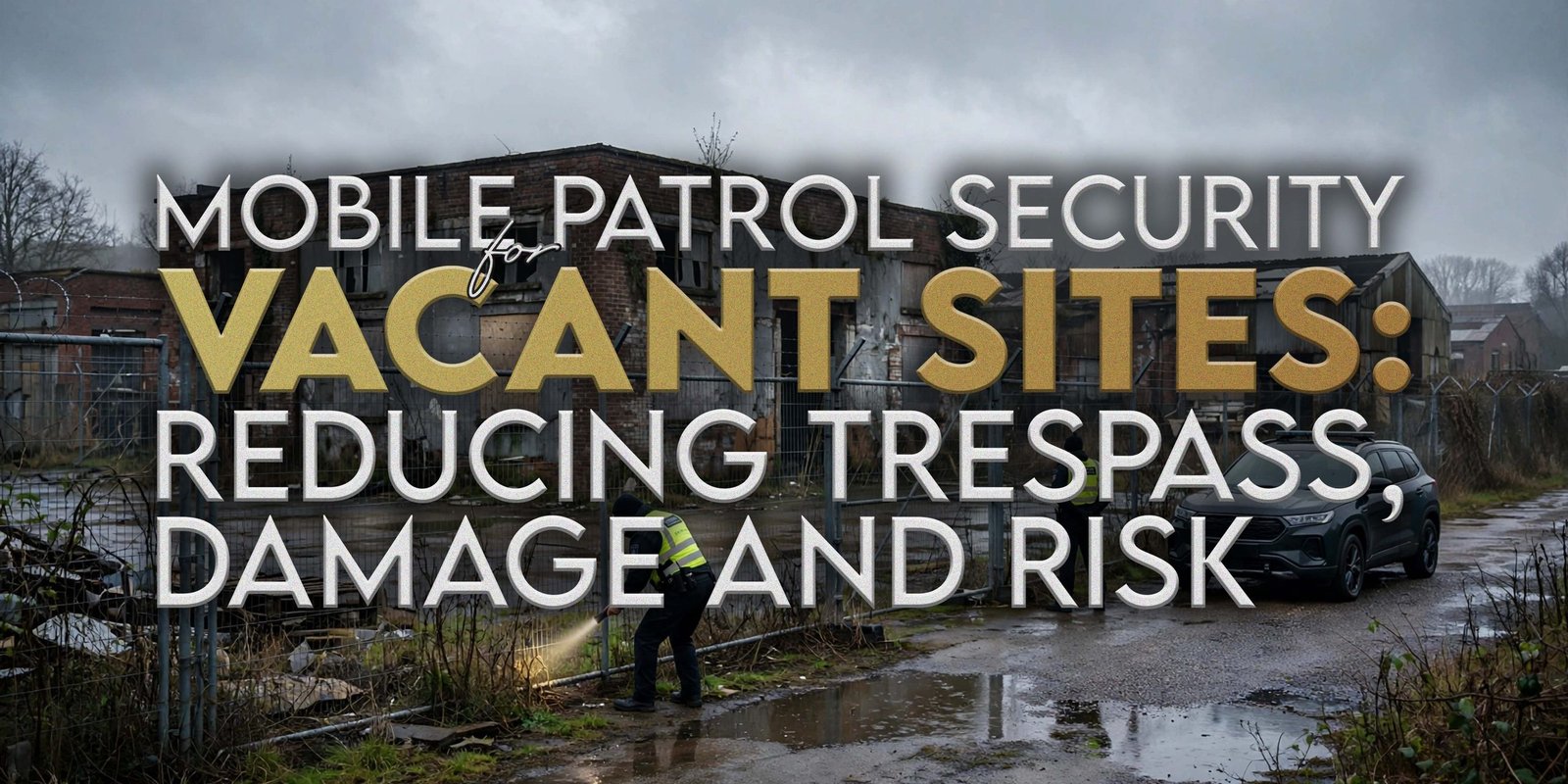
An unoccupied commercial property can have fewer people on site, reduced day-to-day oversight and long periods with limited routine activity. Mobile patrol security can support a site-specific plan by providing authorised attendance, agreed checks, reporting and escalation without relying on undefined visits.
The strongest mobile patrol security arrangements start with the property itself. Site type, vacancy period, access arrangements, existing CCTV, contractor activity and escalation requirements should all shape what officers are expected to observe and report.
What Is Mobile Patrol Security?
Mobile patrol security generally involves security personnel attending designated commercial sites to carry out agreed checks, observe visible site conditions and report or escalate issues under defined procedures. It can support vacant properties, temporary closures and reduced-occupancy sites without requiring continuous on-site guarding in every case.
The purpose is not simply to visit a building. Instead, each attendance should have clear objectives that match the property, occupancy status and wider security plan.
Why Vacant Sites Need a Different Security Plan
Vacant properties operate differently from occupied premises. Fewer staff and legitimate visitors may be present, while contractors, maintenance teams or authorised inspections can still take place.
Therefore, mobile patrol security should reflect the building type, expected vacancy period, site layout, existing monitoring and current property condition. A temporarily closed office may need different checks from an empty warehouse, retail unit or paused construction site.
During a vacancy, property managers should also review changes in lighting, access arrangements, temporary works and planned contractor visits. If the property’s status changes, the patrol plan should change with it.
Vacant Site Patrols: What Can They Check?
Vacant site patrols can support high-level checks of agreed areas without following one generic inspection sequence. Depending on the site brief, officers may review visible property condition, designated entrances, gates, lighting where relevant and obvious signs of interference or damage.
A mobile patrol security plan should define what counts as an issue and who should receive the report. For example, a visibly damaged access point may require a different escalation route from a routine maintenance observation.
The plan should avoid publishing predictable routes or timings. Instead, it should focus on the categories of checks required and the reporting standard expected.
Property Patrols for Commercial Buildings
Property patrols should reflect the type of commercial building being managed. Offices, warehouses, retail units, industrial premises, commercial estates and refurbishment properties can all create different operational priorities.
For vacant offices, mobile patrol security may focus on agreed external and internal conditions, authorised contractor activity and building access arrangements. Empty warehouses may require greater attention to yards, loading areas and large external approaches, while retail units may have different frontage and shared-area considerations.
As a result, property managers should avoid copying the same patrol instructions across every asset.
How Can Mobile Patrol Security Help Reduce Trespass Risk?
Mobile patrol security may help deter trespass by providing visible attendance, signs of active site management, checks of agreed areas and prompt reporting of unusual activity. It cannot make trespass impossible, but it can form part of a wider plan that combines physical attendance, monitoring, clear escalation procedures and appropriate site controls.
Visible attendance can also help property managers confirm that the site remains under active oversight during a vacancy. However, the wider plan should still consider the property’s layout, occupancy status and existing systems.
Mobile Patrol Security and Property Damage
Mobile patrol security may help identify visible damage, interference with access points, signs of unauthorised activity and certain property-condition issues during authorised visits. The value comes from observation, documentation and escalation rather than any promise that damage will be prevented.
Where authorised and appropriate, reports may include photographs, notes on visible condition and actions taken. Consistent reporting can help facilities or property teams compare site condition over time.
For extended vacancies, mobile patrol security should be reviewed if repeated issues, maintenance activity or changes in access affect the site plan.
Mobile Patrol Security for Empty Warehouses
Empty warehouses can differ significantly from operational warehouses because normal staff, deliveries and vehicle activity may be reduced. Mobile patrol security should therefore reflect the changed occupancy pattern rather than continue an old operational brief.
At a high level, the plan may cover agreed entrances, gates, loading areas, yard condition, perimeter condition and visible property issues. It should not expose detailed weak points or predictable checking sequences.
When refurbishment or maintenance teams attend, managers should update the site brief so authorised activity is understood.
Mobile Patrol Security for Vacant Offices
Vacant offices may still have authorised visitors, contractors, maintenance teams or managing agents attending periodically. Mobile patrol security should account for that expected activity while supporting checks of agreed access points, external areas, car parks where relevant and visible property condition.
Shared buildings require particular clarity about which areas fall within the patrol brief. Therefore, property managers should define boundaries and responsibilities before the service begins.
Mobile Patrol Security for Retail and Commercial Units
Closed retail units, standalone stores, retail parks and premises between occupiers can have different layouts and vacancy periods. Mobile patrol security should reflect whether the unit sits within a managed estate, has shared areas or operates as a standalone commercial property.
For shorter closures, the brief may focus on temporary changes. For longer vacancies, the property manager may need periodic reviews as contractor activity, maintenance or handover plans evolve.
Security Patrol Service vs Static Guarding
A security patrol service and static guarding solve different operational needs. Mobile patrols can suit sites where continuous on-site presence is not required, multiple properties need physical attendance or patrols complement CCTV, alarms or other controls.
Static guarding may be more appropriate where an on-site presence is needed for defined periods, access activity requires regular management or the property has operational needs that cannot be addressed through periodic attendance alone.
Therefore, mobile patrol security should be chosen because it fits the site’s requirements, not simply because it is different from static guarding.
Mobile Patrols vs 24-Hour Security
Mobile patrols and continuous on-site coverage serve different purposes. Businesses should assess occupancy, operating hours, access activity, site layout, wider monitoring and management requirements before deciding which model fits.
For some properties, mobile patrol security may form one element of a wider plan. Sites needing continuous on-site presence can review business 24-hour security separately rather than assuming patrol visits are sufficient.
The decision should remain site-specific and should be reviewed if occupancy or operating conditions change.
Mobile Patrol Security and CCTV
CCTV and mobile patrol security can complement each other when responsibilities are clear. CCTV may provide recorded or remote observation, while patrol officers can attend the site, check agreed visible conditions and follow escalation procedures.
Neither should automatically be treated as a complete replacement for the other. Businesses considering a layered approach can review security cameras for business alongside physical patrol requirements.
A useful plan also defines who monitors systems, who receives alerts and how site attendance fits the wider process.
Mobile Patrol Security During Temporary Closures
Holiday shutdowns, warehouse closures, refurbishment, tenant changes and reduced operating periods can all change how a property is used. Mobile patrol security should be reviewed when that happens.
For example, a site that is normally busy may suddenly have fewer legitimate visitors and different contractor activity. Therefore, patrol instructions should reflect the temporary operating state rather than the site’s normal routine.
Mobile Patrol Security for Construction Sites During Pauses
Paused construction sites can contain temporary compounds, machinery, materials and changing layouts. Mobile patrol security can support defined site checks during periods of reduced occupancy without publishing detailed access weaknesses or inspection routes.
Because construction layouts change frequently, the patrol brief should be reviewed when temporary works, boundaries or contractor arrangements change.
Site Protection During Out-of-Hours Periods
Site protection during out-of-hours periods can combine several controls depending on the property. These may include mobile patrols, CCTV, alarms, static guarding where appropriate, key holding and documented escalation procedures.
There is no universal mix that suits every vacant property. In practice, mobile patrol security should sit within a wider plan based on occupancy, site condition, access activity and management requirements.
What Should a Mobile Patrol Officer Report?
Reporting should give property managers a consistent record of authorised attendance and visible site condition without exposing sensitive operational detail. A report may include the authorised visit record, agreed checks completed, visible abnormalities, incidents, actions taken and escalation where necessary.
For the patrol service, consistency matters. Clear reports help managers identify changes between visits and decide whether maintenance, management or wider security arrangements need review.
What Should Businesses Define Before Starting Mobile Patrol Security?
Before starting mobile patrol security, businesses should define the property type, vacancy status, agreed inspection areas, access arrangements, existing CCTV or alarms, reporting expectations, escalation contacts, contractor activity and emergency procedures. The brief should explain objectives without publishing predictable patrol routes, exact timings or sensitive access information.
A practical checklist should cover:
- Property type and use
- Expected vacancy period
- Current occupancy status
- Site size and general layout
- Agreed areas for checking
- Authorised access arrangements
- Existing CCTV
- Alarm arrangements where applicable
- Key holding where applicable
- Reporting requirements
- Escalation contacts
- Emergency procedures
- Planned contractor attendance
- Maintenance activity
- Temporary works
- Expected changes in occupancy
- Current SIA licensing requirements where relevant
This gives patrol officers a clear operational brief while keeping the plan flexible enough to change with the property.
How Often Should Vacant Site Patrols Take Place?
There is no universal frequency for vacant site patrols. The appropriate pattern depends on property type, vacancy duration, site circumstances, existing monitoring, operational requirements and any relevant contractual or insurer conditions. Businesses should avoid predictable public schedules and review patrol arrangements when the property’s status or circumstances change.
The frequency should follow a documented assessment rather than a generic rule. Therefore, mobile patrol security arrangements should be reviewed as vacancy periods extend or site conditions change.
Common Mobile Patrol Security Planning Mistakes
- Using generic patrol instructions for every site. Property type and vacancy conditions differ.
- Failing to define what officers should check. A patrol needs clear objectives.
- Ignoring changes in property condition. The brief should evolve as the site changes.
- Failing to update the plan after contractor activity. Temporary works can alter site conditions.
- Treating patrols and CCTV as unrelated. They may work better as coordinated controls.
- Using weak reporting procedures. Managers need consistent information.
- Leaving escalation contacts unclear. Officers need a defined route for reporting issues.
- Failing to review long vacancies. Extended closure can change requirements.
- Publishing predictable routines. Operational details should remain appropriately restricted.
- Choosing patrols without considering wider coverage. Static or continuous guarding may fit some sites better.
Mobile Patrol Planning Table
| Site Factor | What to Consider | Why It Matters |
|---|---|---|
| Property type | Office, warehouse, retail, industrial or construction | Different properties need different patrol instructions |
| Vacancy period | Short-term or extended | Site conditions can change over time |
| Access areas | Agreed areas requiring checks | Helps define patrol objectives |
| Existing CCTV | Areas already monitored | Helps coordinate physical attendance with technology |
| Reporting | Required visit records and escalation | Supports consistent property oversight |
| Contractors | Planned authorised attendance | Helps distinguish expected activity |
| Out-of-hours needs | Patrol, static guard or wider coverage | Helps match the service to operational requirements |
| Site changes | Refurbishment, handover or new works | May require revised instructions |
The table is a planning framework rather than a fixed specification. Mobile patrol security should still be tailored to the specific property and current vacancy conditions.
How Should Businesses Review Mobile Patrol Security Over Time?
Businesses should review mobile patrol security whenever occupancy, contractor activity, access arrangements, building condition or monitoring systems change. Extended vacancies also justify periodic reassessment because the property’s operational context may no longer match the original brief.
A useful review asks whether patrol objectives remain relevant, reporting still provides useful information and escalation contacts are current. This keeps the service aligned with the property instead of an outdated plan.
What is mobile patrol security?
Mobile patrol security involves authorised security personnel attending designated sites to complete agreed checks, observe visible site conditions and report or escalate issues under defined procedures. It can support vacant or reduced-occupancy properties where continuous on-site guarding is not always required.
What do vacant site patrols check?
Vacant site patrols may check agreed areas such as designated entrances, gates, visible property condition, lighting where relevant and signs of interference or damage. The exact brief should depend on the site and should avoid publishing sensitive routes, timings or predictable routines.
How can property patrols support an empty commercial building?
Property patrols can provide physical attendance, agreed condition checks, documented reporting and escalation during periods with reduced on-site activity. When combined with a clear brief, mobile patrol security can help property managers track changes and coordinate responses without claiming to eliminate risk.
How often should a vacant site receive patrol visits?
There is no universal patrol frequency. Property type, vacancy duration, wider monitoring, operational requirements and relevant contractual conditions can all influence the plan. Businesses should avoid predictable public schedules and review mobile patrol security as site circumstances change.
What is the difference between a security patrol service and static guarding?
A security patrol service provides periodic site attendance, while static guarding provides an on-site presence for defined periods. The better fit depends on occupancy, access activity, operating requirements and the wider security plan. Neither model is universally better.
Can mobile patrol security work alongside CCTV?
Yes. Mobile patrol security can complement CCTV when roles are clearly defined. CCTV may provide recorded or remote observation, while patrol personnel can attend the property, check agreed visible conditions and follow reporting or escalation procedures.
When should a business consider 24-hour security instead of patrols?
A business may consider continuous guarding when operational needs require an on-site presence for longer periods, regular access activity needs management or patrol attendance alone does not fit the site. The decision should follow a site-specific assessment rather than a universal rule.
What should property managers check before arranging mobile patrol security?
Before arranging mobile patrol security, property managers should define vacancy status, property type, agreed check areas, access arrangements, CCTV or alarms, contractor activity, reporting requirements, escalation contacts and any relevant licensing requirements. They should also plan how the brief will be updated when the site’s status changes.
Discuss Mobile Patrol Security for Your Property
A useful vacant-site plan starts with the property’s current status, agreed patrol objectives, existing monitoring and escalation requirements. Review how mobile patrol security should fit alongside CCTV, alarms, key holding or wider guarding arrangements rather than treating patrol visits as a standalone solution.
H&D Security can discuss temporary or ongoing patrol requirements for commercial properties, warehouses and other vacant sites. To review your requirements, request a tailored security quote.