
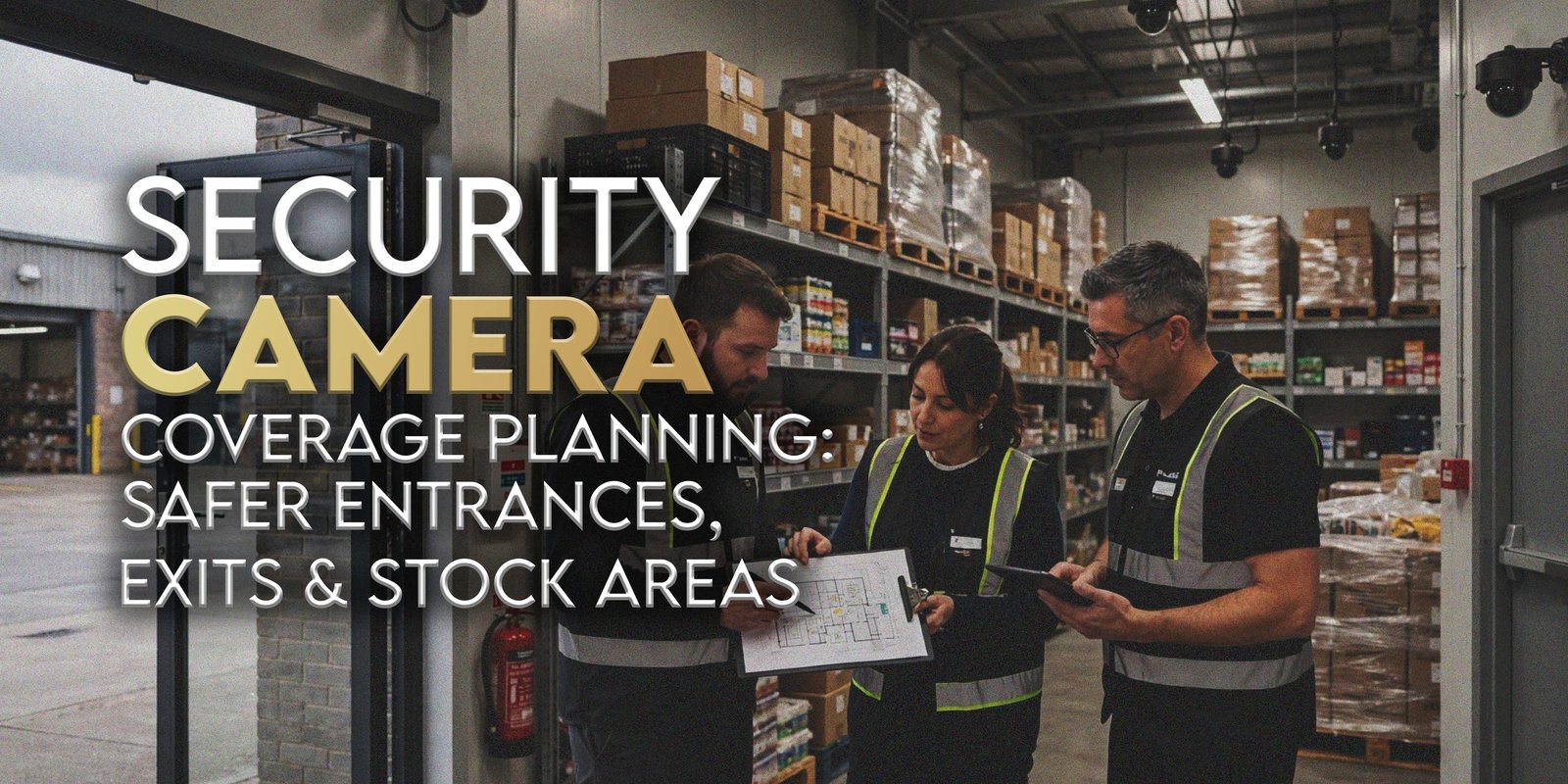
Installing a security camera does not automatically create useful CCTV coverage. A poorly planned system can leave blind spots, capture the wrong part of an entrance or lose useful detail behind shelving, signs, vehicles or changing stock.
Effective security camera planning starts with purpose. Businesses should decide what activity needs to be observed, where it happens, what field of view is useful and how lighting or obstructions may affect the image before choosing camera positions.
What Is Security Camera Coverage Planning?
Security camera coverage planning is the process of deciding what a business needs to observe, where each camera should sit, what field of view is required and how multiple views work together. The aim is useful, proportionate coverage of relevant activity while reducing blind spots, unnecessary duplication and avoidable monitoring.
A good plan connects each camera position to a specific operational purpose. For example, one camera may help review people entering through a reception door, while another may focus on activity around a loading bay or stock-room access point.
Start With the Purpose, Not the Camera
Before choosing a security camera position, define what that view needs to achieve. A camera installed simply because there is spare wall space may create footage without answering the operational question the business actually has.
Businesses may need to observe:
- People approaching or entering a main entrance
- Staff or visitors leaving through designated exits
- Deliveries arriving at loading access
- Movement into and out of stock rooms
- Activity around restricted access points
- Vehicle movements at a loading bay
- Reception or visitor approach areas
- Defined external approaches where monitoring is justified
Different purposes require different camera placement. For example, a broad overview of a loading area may support general situational awareness, while a doorway may need a view designed around the approach and access point rather than the whole surrounding wall.
Planning CCTV Coverage for Entrances
Entrance CCTV coverage should be designed around what happens before, at and immediately beyond the doorway. Businesses should consider the width of the entrance, people approaching, door movement, lighting changes, signs, canopies, reception furniture and other objects that may block the view.
A security camera aimed too widely may show the entrance area without providing the useful view the business expected. Therefore, field of view should match the purpose rather than simply cover as much space as possible.
During planning, check whether bright exterior light, darker interiors or reflective glass could affect image usefulness. Likewise, review whether a door swings into the viewing area or whether seasonal displays, promotional stands or temporary barriers could create new obstructions.
Reception areas may need a different security camera view from external entrance approaches. In practice, separating the purpose of the outside approach from the purpose of the internal access area can create clearer planning decisions.
Security Camera Placement at Exits
Security camera placement at exits should complement entrance coverage rather than duplicate it without a clear reason. Primary exits, staff exits, delivery exits, rear doors and loading access can each involve different patterns of movement.
First, identify why the exit matters operationally. A staff exit may require coverage of the doorway and immediate approach, while a delivery exit may need to account for cages, pallets, vehicles or doors that regularly change the available sight line.
A security camera should not be positioned solely because an exit exists. Instead, businesses should decide whether the area needs monitoring, what information is required and whether another view already covers the relevant activity.
Emergency routes also need careful treatment. CCTV planning should not interfere with how the route functions, and the monitoring purpose should remain proportionate to the business need.
Security Camera Planning for Stock Areas
Security camera planning for stock rooms and warehouses should reflect how goods, people and equipment move through the site. Racking, shelving, pallets, forklifts and changing stock levels can all alter CCTV coverage over time.
Important areas may include:
- Stock-room entrances
- Receiving areas
- Dispatch zones
- Storage access points
- Selected high-value stock areas
- Loading bays
- Warehouse cross-aisles
- Restricted storage areas
A security camera facing down an aisle may appear useful when the space is empty but become obstructed once stock heights change. Therefore, site reviews should consider normal operating conditions rather than only the appearance of the area during installation.
Businesses should also avoid assuming that every aisle needs its own camera. The better approach is to identify the activity that matters, review likely blind spots and decide which fields of view provide operational value without unnecessary duplication.
How Do You Identify CCTV Blind Spots?
Businesses can identify CCTV blind spots by walking the site, reviewing each security camera sight line and checking corners, doorways, shelving, racking, signs, vehicles and changing storage layouts. Compare individual fields of view with the activities that need to be observed, then look for important areas that remain hidden or poorly covered.
A practical site review should reflect normal operations. For example, a loading bay may look clear when empty but change considerably when vehicles, roll cages or pallets occupy the space.
Next, compare neighbouring camera views. Some overlap can reduce gaps around important access points, but overlapping footage should serve a purpose rather than repeat the same scene unnecessarily.
Finally, repeat the blind-spot review after significant layout changes. New shelving, screens, partitions, stock configurations or signage can alter security camera coverage even when the equipment has not moved.
Camera Height and Angle: What Should Businesses Consider?
There is no single security camera height or angle that fits every commercial site. Placement should depend on the monitoring purpose, available field of view, likely obstructions, lighting conditions and the level of useful detail required.
A higher position may provide a wider overview, while a different angle may better support a doorway or defined access point. However, greater width is not always more useful if important activity becomes too small or partially hidden.
During planning, businesses should also consider whether structures, lighting fittings, beams, signs or stored goods could interfere with the view. Camera placement should be checked in the actual environment rather than decided from a floor plan alone.
Lighting Can Change Security Camera Performance
Lighting can significantly affect the usefulness of a security camera view. Entrances may experience strong daylight, darker interiors, glare, reflections or major changes between daytime and evening conditions.
Therefore, review the viewing area under the lighting conditions that matter to the site. A camera that appears well positioned during a daytime survey may perform differently when exterior light falls, internal lights switch off or vehicle headlights enter the scene.
Reflective floors, glass doors, glossy stock wrapping and bright signs can also affect the scene. Businesses should test relevant conditions and avoid making product-specific performance assumptions without checking the actual system.
Overlapping CCTV Coverage: When Is It Useful?
Overlapping CCTV coverage can be useful around important entrances, junctions, loading areas or other points where one view may be obstructed. A second security camera can sometimes provide a different angle that reduces a meaningful gap.
However, duplication should have a clear purpose. Adding several views of the same area can increase equipment cost, monitoring workload and data-management responsibilities without improving operational usefulness.
In practice, the strongest plan balances continuity with efficiency. Overlap should help answer a defined need rather than simply increase camera quantity.
Business CCTV Systems Should Match the Site
Business CCTV systems should reflect the layout, operating pattern and monitoring purpose of the premises. A warehouse, retail unit, office, hotel, construction site and logistics facility can each require a different security camera plan.
Warehouses may need attention around loading, stock movement and restricted areas. Retail premises may prioritise customer entrances, selected till areas, stock rooms and delivery access. Offices may focus more heavily on defined entrances, receptions and access-controlled areas.
Likewise, construction sites and vacant commercial properties can change over time. Therefore, the design should allow for periodic review when access routes, boundaries, storage areas or working zones change.
CCTV Planning for Warehouses and Stock Areas
Warehouse CCTV planning should begin with movement. Review where people, vehicles, stock and deliveries enter, where they travel and where important handovers or access events occur.
A security camera covering a loading bay should account for vehicle positions and temporary obstructions. Similarly, warehouse aisles can change as pallets, stock and equipment move, so sight lines should be tested under realistic operating conditions.
Restricted storage areas may require focused coverage of access points rather than broad recording of every nearby workspace. This purpose-led approach can reduce unnecessary monitoring while keeping the system useful.
Because layouts evolve, businesses should review security camera coverage after racking changes, refurbishment, workflow changes or major changes in stock configuration.
CCTV Planning for Retail Premises
Retail CCTV planning often involves customer entrances, exits, selected till areas, stock rooms, delivery doors and back-of-house corridors. However, each camera should have a defined purpose rather than being added simply because an area exists.
For example, an entrance view may need to account for doors, window glare and promotional displays. Meanwhile, a stock-room security camera may need to consider shelving, delivery cages and frequently changing stock.
Retailers should also review whether seasonal merchandising or temporary displays alter existing CCTV coverage. A good plan remains useful during normal trading conditions, not just on installation day.
CCTV Planning for Venues and Public-Facing Sites
At venues and public-facing premises, camera coverage should sit within broader operational arrangements. Entrances, exits, public areas and restricted access points may all require different security camera purposes.
For example, coverage planning should be coordinated with access management, staff procedures and other site controls rather than treated as a standalone technical exercise. Businesses reviewing public-facing operations can also consider their wider venue security and compliance arrangements.
Where CCTV processes identifiable individuals’ personal data, businesses should also consider transparency, necessity, proportionality and other current data-protection duties.
CCTV for Vacant or Unoccupied Properties
Vacant buildings can create different monitoring priorities because routine on-site activity is reduced. Businesses may therefore focus security camera planning on important entrances, external approaches, relevant access points and periods when the site has limited physical presence.
Remote monitoring arrangements may also affect how camera views are prioritised. For example, an external entrance may need to support a different operational purpose from an internal stock area at an occupied warehouse.
Organisations responsible for unoccupied premises can review broader vacant property monitoring alongside CCTV requirements.
Privacy, Data Protection and CCTV Planning
Commercial CCTV that processes identifiable people’s personal data can fall within the UK GDPR and Data Protection Act 2018. Businesses should define a clear purpose, identify an appropriate lawful basis, consider whether surveillance is necessary and proportionate, and limit personal data to what is needed for that purpose.
Transparency also matters. Current UK guidance says organisations need to let people know when surveillance is operating; visible signage is a common way to provide that information. Businesses should also control access to recordings and be prepared to handle applicable individual-rights requests.
There is no single UK GDPR or Data Protection Act retention period that applies to every surveillance system. Instead, the necessary retention period should follow the purpose of the processing.
Where surveillance is likely to create a high risk to individuals, a Data Protection Impact Assessment may be required. ICO guidance identifies large-scale monitoring of publicly accessible areas and certain workplace monitoring as situations that can trigger particular DPIA considerations.
Audio recording deserves additional care because it can be more intrusive and requires separate justification. Businesses should review current ICO guidance before deploying or materially changing a security camera system; the ICO also notes that parts of its detailed surveillance guidance are under review following legislative changes.
This section provides general practical information rather than legal advice.
Should Every Area Have a Security Camera?
No. A business should not aim to place a security camera in every possible area simply to maximise quantity. Coverage should follow a defined business need, useful field of view and lawful, proportionate monitoring purpose.
Unnecessary coverage can add equipment cost, monitoring effort and data-management responsibilities. It can also create additional privacy considerations without improving the usefulness of the CCTV system.
A practical plan therefore asks what needs to be observed first. Only then should the business decide how many views are necessary.
Common Security Camera Planning Mistakes
- Installing cameras before defining their purpose. Each view should answer a clear operational need.
- Ignoring blind spots. Corners, shelving, vehicles and door positions can hide important activity.
- Planning around walls instead of activity. Security camera placement should follow the area that needs observation.
- Ignoring lighting. Glare, backlighting and low-light conditions can change image usefulness.
- Allowing stock or signage to obstruct views. Normal operations can change sight lines.
- Forgetting delivery and rear access. Secondary access points may matter to the site plan.
- Failing to review layout changes. Refurbishment or racking changes can alter CCTV coverage.
- Creating unnecessary duplicated coverage. Overlap should support a defined purpose.
- Ignoring privacy and data-protection obligations. Monitoring should remain lawful, necessary and proportionate.
- Failing to test and maintain the system. A security camera plan needs periodic operational review.
Security Camera Coverage Planning Checklist
Before finalising a security camera plan, review:
- Main entrances
- Secondary entrances
- Main exits
- Staff exits
- Delivery doors
- Loading bays
- Stock rooms
- Warehouse aisles
- Restricted access points
- Reception areas
- External approaches where relevant
- Lighting conditions
- Temporary and permanent obstructions
- Camera height
- Camera angle
- Field of view
- Blind spots
- Useful overlapping coverage
- Monitoring arrangements
- Recording requirements
- Access to recorded footage
- Maintenance and testing
- Current privacy and data-protection obligations
- Signage where applicable
- Layout changes that may affect future coverage
A strong checklist helps keep security camera planning tied to business purpose rather than equipment quantity.
CCTV Coverage Planning Table
| Area | Main Planning Consideration | Common Issue to Check |
|---|---|---|
| Entrance | Approach and doorway visibility | Backlighting, door movement or obstruction |
| Exit | Useful view of departing activity | Poor angle or unnecessary duplication |
| Stock room | Access points and stock movement | Shelving blocking sight lines |
| Warehouse aisle | Layout, racking and stock height | Changing obstructions |
| Loading bay | Vehicle and delivery activity | Temporary large blind areas |
| Reception | Visitor approach and access | View positioned too widely |
| Rear access | Doorway and approach | Lighting or stored items affecting the view |
| Vacant property | Important access points | Reduced on-site presence and changing conditions |
The table provides a starting framework, not a fixed design. Every security camera position should still be checked against the site’s actual layout and operating purpose.
How Often Should Businesses Review CCTV Coverage?
Businesses should review CCTV coverage whenever the site’s layout, operating pattern or monitoring purpose changes, and periodically as part of routine system management. New racking, partitions, entrances, stock arrangements, signs or work areas can turn a previously useful security camera view into a partially obstructed one.
Maintenance checks should also confirm that cameras remain aligned with the intended purpose. If the business no longer needs a particular view, the organisation should reassess whether continuing that monitoring remains justified.
What is security camera coverage planning?
Security camera coverage planning is the process of defining what needs to be observed, deciding where cameras should be positioned and checking how their fields of view work together. A good plan considers entrances, exits, stock areas, lighting, obstructions, blind spots and operational purpose before deciding how many cameras are needed.
Where should a security camera be positioned at a business entrance?
A security camera at an entrance should be positioned around the specific view the business needs, such as the approach, doorway or immediate access area. Businesses should consider door movement, lighting changes, glass, signs and obstructions. There is no single mounting position that works for every entrance.
How can a business identify CCTV blind spots?
Walk the site and compare each security camera sight line with the activity that needs to be observed. Check corners, doorways, racking, shelves, signs, vehicles and temporary stock. Then review neighbouring fields of view and repeat the exercise after significant layout changes.
Where should cameras be placed in stock areas?
Camera placement in stock areas should follow important access points, receiving and dispatch activity, selected storage areas and movement routes rather than automatically covering every aisle. A security camera view should also account for shelves, stock height, temporary obstructions and changes in the layout.
How many security cameras does a business need?
There is no universal number. The number of cameras depends on the site layout, monitoring purpose, relevant access points, blind spots and required fields of view. Businesses should define what needs to be observed first, then determine how many security camera views are necessary without creating unnecessary duplication.
How does lighting affect CCTV coverage?
Lighting can change image usefulness through glare, backlighting, reflections and low-light conditions. Therefore, businesses should assess each security camera view under the lighting conditions relevant to the site, including changes between daytime and evening where appropriate, rather than judging placement under one condition only.
Should every area of a business have a camera?
No. Camera coverage should follow a clear business purpose and remain proportionate. A security camera should not be installed simply because a space exists. Unnecessary coverage can increase cost, monitoring workload and data-management responsibilities without adding useful operational information.
How often should business CCTV coverage be reviewed?
Review CCTV coverage periodically and whenever the site changes significantly. New shelving, partitions, stock arrangements, entrances or workflows can alter a security camera field of view. Businesses should also check whether each existing view still supports the original purpose and current privacy obligations.
Review Your Business Security Requirements
Effective CCTV planning starts with the site, not the equipment list. Identify important access points, review blind spots, consider lighting and stock movement, then connect each security camera position to a clear operational purpose.
H&D Security can discuss CCTV requirements alongside wider site arrangements, including guarding, access support and commercial security needs. Businesses ready to review their premises can request a tailored quotation based on their site requirements.