
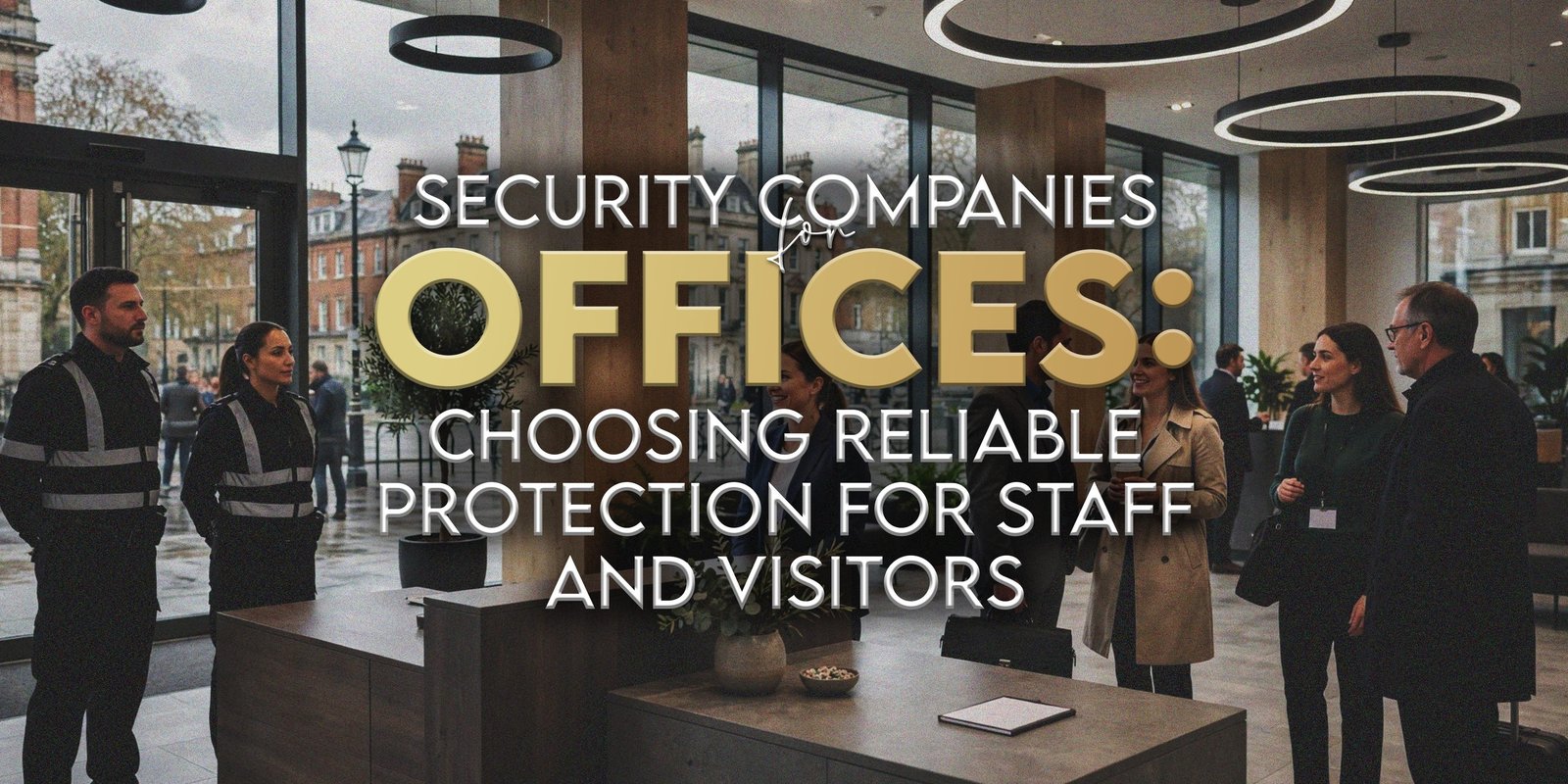
An office may receive visitors and deliveries at one entrance. That creates practical questions about access, supervision and incident reporting. Security companies should be compared on how well they address those questions, not simply on the number of officers or the advertised price.
Security companies serving shared West London offices must understand reception procedures, while a corporate building near Heathrow could require separate arrangements for deliveries and out-of-hours contractors. Consequently, office managers need to define their premises before asking providers to quote.
H&D Security is a Hounslow-based commercial provider offering guarding, CCTV monitoring and related services. This guide explains how to compare security companies using licensing, visitor management, camera coverage, response procedures and written contract details.
Why Offices Need a Clear Workplace Security Plan
Office protection starts with users, arrival times and permissions. For example, a single-tenant office with a staffed reception presents different requirements from a multi-tenant building with shared lifts and independent occupiers.
Therefore, map entrances, staff-only floors, delivery routes and the people authorised to approve access. The brief helps security companies propose relevant duties.
Map Normal and Unusual Activity
Identify busy visitor periods, evening cleaners and weekend contractors. Moreover, name the people responsible for visitor approval, lost access passes and unusual incidents.
What Should Offices Compare When Choosing Security Companies?
Offices should compare security companies by checking individual SIA licensing where required, relevant building experience, visitor procedures, supervision, CCTV arrangements, incident reporting and contract scope. They should also confirm how the provider covers absences, handles changes to opening hours and communicates during an incident.
| Comparison area | What to ask | Why it matters |
|---|---|---|
| Licensing | Which activities need an SIA licence? | Confirms suitable personnel for regulated duties |
| Reception | Who registers and approves visitors? | Avoids ambiguous access decisions |
| Supervision | Who reviews performance and handovers? | Defines operational accountability |
| CCTV | Is footage recorded or actively monitored? | Separates observation from response |
| Coverage | Which hours, posts and breaks are included? | Clarifies the service being purchased |
| Reporting | When and how will incidents reach management? | Supports timely decision-making |
| Contract | What is included, excluded or chargeable? | Makes quotations comparable |
Rather than accepting a general reliability claim, request sample reporting formats and a proposed assignment brief. This reveals how security companies would work in your office.
Office Security Services: Which Responsibilities Matter?
Office security services can include reception guarding, visitor registration, staff entry checks, contractor access, agreed patrols and incident reporting. However, not every office needs every duty or requires the same coverage throughout the day.
Reception and Visitor Registration
An officer from security companies may confirm that visitors have appointments and direct them to an authorised host. For example, the office should decide whether employees approve guests through a reception list or by telephone.
Consequently, security companies should ask who can authorise exceptions and what to do when a host cannot be reached. Reception procedures also need to respect personal information collected from visitors.
Contractors, Deliveries and Closing Procedures
Contractors may need access to plant rooms or shared areas that ordinary visitors cannot enter. Therefore, define authorisation, identification and sign-in procedures separately from everyday reception tasks.
Likewise, deliveries may arrive before normal office hours. Discuss who receives goods, who may enter loading areas and whether an officer is expected to sign for anything.
How SIA Licensing Affects Office Guarding
In the UK, the Security Industry Authority licenses individuals carrying out relevant licensable private security activities. For contracted guarding duties, businesses should check whether the role requires a frontline licence and ensure its category matches the work.
Use the official SIA licence-holder register to check licence status and category before appointing officers. Furthermore, ask security companies how they manage ongoing licence checks and role-specific briefing.
Individual Licences Are Not Company Approval
The SIA Approved Contractor Scheme is a separate, voluntary scheme for eligible private security businesses. It does not replace personal licences or impose compulsory business approval.
Therefore, do not assume a company’s marketing statement establishes its ACS status. Check claims from security companies against the official register.
Workplace Security for Staff, Visitors and Contractors
Good workplace security separates employee access from visitor and contractor permissions. Otherwise, a person with approval for one part of a building might mistakenly gain entry elsewhere.
For example, a multi-tenant office may share a lobby while each tenant controls entry to its floor. Security personnel need instructions explaining which organisation can approve which access request.
Meanwhile, security companies should account for accessibility, reception queues and situations where staff forget passes. Clear procedures reduce improvised decisions.
Keep Access Rules Current
When tenants move, opening hours change or contractors finish projects, update the access list and officer instructions. As a result, security staff can work from information that reflects the present building layout and occupiers.
Planning Security Services Around Your Office
Before requesting quotations, prepare an office profile with the activities that require attention. This helps security companies assess actual coverage.
Useful details include the building address, number of floors and entrances, reception hours, expected visitors, contractor routines, existing cameras, access control arrangements, out-of-hours requirements and incident reporting expectations.
For example, a Hounslow office may need weekday reception cover, while shared premises might need evening access coordination.
Once the requirements are clear, request a tailored office security quotation from H&D Security. Specify the proposed start date and the decisions for which the provider would be responsible.
How CCTV Monitoring Supports Office Security
CCTV can support access procedures and later incident review, but recording footage is not the same as continuous live monitoring. Therefore, security companies should explain whether cameras simply record, whether authorised operators watch feeds and what happens after an alert.
Offices may monitor entrances or selected access points. However, recording must serve a defined purpose.
Explain Monitoring and Escalation
If monitoring forms part of the contract, ask who receives alerts, how incidents reach office management and who can authorise physical attendance. Moreover, establish whether control room work and on-site guarding are separate services.
Response depends on agreed procedures and personnel availability. A round-the-clock control room does not promise immediate attendance.
When Should Offices Review or Upgrade Older CCTV?
Review older systems when footage loses useful detail, access fails or layouts change. Age alone does not justify replacement.
First, examine real recordings from entrances and important routes during normal operations. Next, assess image clarity, lighting, storage, maintenance and who can retrieve footage when needed.
Where changes are needed, security companies should clarify whether repositioning, maintenance or equipment replacement would address the issue. For further considerations, read when to upgrade an older CCTV system.
CCTV Camera Placement for Office Entrances and Blind Spots
Useful camera coverage begins with the intended observation point. An entrance camera may show a doorway but miss meaningful detail when sunlight shines from behind a visitor.
Similarly, tall partitions, opening doors, delivery vehicles and changes to reception furniture can create blind spots. Therefore, inspect recorded views during normal activity rather than judging coverage from a floor plan alone.
Consider reception entrances, secondary doors, corridors, staff-only access points, car parks and loading areas where there is a justified monitoring purpose. Our guide to how businesses can plan CCTV camera placement explores these practical decisions in more detail.
Importantly, security companies should explain the privacy implications of proposed views, including areas beyond the premises and employee spaces where monitoring would be inappropriate.
Daytime vs Out-of-Hours Office Security
During working hours, a building may focus on reception, visitor appointments and deliveries. After closing, the main requirements could shift towards contractor entry, alarm handling and authorised access.
However, security companies should not assume every office needs overnight guards. Instead, clients should assess the nature of out-of-hours activity and compare physical guarding, monitoring and agreed patrol visits.
For instance, a shared office might need planned weekend access for maintenance contractors without requiring a continuously staffed reception. Confirm who issues permissions and how the visit will be documented.
Static Guards vs CCTV Monitoring vs Mobile Patrols
These services differ. Consequently, buyers comparing security companies should match each option to an identified business requirement.
| Factor | Static guards | CCTV monitoring | Mobile patrols |
|---|---|---|---|
| Main purpose | Carry out assigned on-site duties | Observe agreed camera feeds | Visit the premises under agreed arrangements |
| Physical presence | During contracted shifts | Not necessarily on site | During individual visits |
| Typical work | Reception and access control | Observation and escalation | External checks and site inspections |
| Out-of-hours relevance | For continuous required posts | Where active monitoring is agreed | For periodic visits or response arrangements |
| Reporting | Shift and incident records | Monitoring and incident records | Visit and incident records |
| Confirm first | Posts, breaks and supervision | Coverage hours and escalation | Visit scope and attendance terms |
Combined services require explicit agreement.
What Makes a Commercial Security Company Reliable?
A commercial security company demonstrates reliability through clear site instructions, relevant personnel experience, appropriate licensing, supervision and consistent communication. Broad claims about professionalism are less useful than evidence of an operating process.
Ask security companies how officers receive site briefings, who reviews logs and how a manager contacts the supervisor when an incident arises. In addition, request clarity about replacement arrangements if the scheduled officer becomes unavailable.
For a multi-tenant building, the provider should also explain how different tenant instructions are managed without creating conflicting access decisions.
What Affects the Cost of Office Security Services?
Prices depend on the duties, guarding hours, number of personnel, building location, monitoring requirements, patrol arrangements and commercial terms. Therefore, security companies should quote against the same written brief if an office manager wants a meaningful comparison.
For example, a weekday reception post is not directly comparable with a contract that includes night coverage and additional visits. Ask security companies to separate main and optional services.
Also confirm break coverage, changes to working hours, reporting, contract duration, additional charges and cancellation conditions. For security companies, a lower price may mean narrower coverage.
Common Mistakes Offices Make When Choosing Security Companies
Even experienced managers can overlook important operational details. However, these mistakes are easier to prevent when security companies receive complete requirements.
- Choosing solely on price: Compare the included duties and coverage, not just the quoted amount.
- Leaving reception duties vague: Specify who authorises visitors and contractors.
- Ignoring multiple tenants: Define which occupier controls each restricted area.
- Skipping licence checks: Verify relevant individual SIA licences for licensable work.
- Assuming CCTV covers everything: Examine blind spots and actual recorded images.
- Overlooking ageing cameras: Review footage quality and maintenance before relying on a system.
- Forgetting evening access: Include cleaners, contractors and unusual opening periods.
- Leaving incidents undefined: Agree reporting channels and escalation contacts.
- Missing contract exclusions: Clarify monitoring, patrols and other separately charged services.
As a result, the chosen office security arrangements can reflect the site’s actual operations rather than assumptions made during procurement.
Office Security Provider Comparison Checklist
Before appointing security companies, use this checklist to compare proposals consistently:
- Map entrances, tenants, reception desks and restricted areas.
- Confirm individual SIA licences for applicable duties.
- Define officer roles and visitor authorisation procedures.
- Agree contractor and delivery access instructions.
- Review existing CCTV footage, coverage and blind spots.
- Clarify recording versus active monitoring.
- Check staff and visitor privacy arrangements.
- Identify daytime and out-of-hours requirements.
- Confirm shift supervision, handovers and replacement processes.
- Agree reporting, escalation and emergency contacts.
- Compare complete quotation terms and exclusions.
Frequently Asked Questions About Security Companies for Offices
How do I choose a security company for an office?
Start with a written site brief describing entrances, tenants, visitor activity and operating hours. Then compare security companies on appropriate licences, guarding responsibilities, supervision, CCTV arrangements and incident reporting. Compare security companies against identical requirements and establish which services form part of the quoted contract.
What services do office security companies provide?
Providers may offer reception guarding, visitor registration, access control, agreed patrols, incident reporting, CCTV monitoring and out-of-hours arrangements. However, security companies differ in their service scope, and clients should not assume all these functions are included in one contract. Request a written scope.
Do office security guards require SIA licences?
Individuals performing relevant contracted licensable private security duties generally require an appropriate SIA licence. The exact requirement depends on the activity and employment circumstances, including certain exemptions. Check the official licence-holder register and confirm the category matches the work. Company ACS approval is a separate voluntary scheme.
Can security companies manage reception and visitor access?
Yes, reception guarding and visitor management can form part of an agreed service. For example, officers may check appointments, follow visitor registration procedures and contact authorised hosts. However, security companies need clear instructions about exceptional access, tenant boundaries and how to handle visitors when a host is unavailable.
How does CCTV support office security?
CCTV may help organisations observe selected entrances and review incidents through recorded footage. Where active monitoring is agreed, operators may also follow specified escalation procedures. However, recording alone does not provide a live response. Offices must consider camera purpose, employee and visitor privacy, access permissions and suitable retention arrangements.
When should a business upgrade old CCTV cameras?
Review existing equipment when recordings lack useful detail, changing layouts create blind spots or maintenance problems affect reliability. However, replacement is not always necessary. Check actual footage, lighting, coverage and retrieval procedures before deciding whether maintenance, repositioning or new equipment is appropriate.
Does every office need out-of-hours security?
No. Offices should assess evening and weekend activity, contractor access, the building layout and relevant operational concerns. Static guarding, monitored CCTV or patrol visits may suit different circumstances. Compare security companies on the cover provided rather than assuming all workplaces require continuous physical attendance.
How can a business request an office security quotation?
Prepare the address, entrances, hours, visitor activity, CCTV and guarding duties. Then describe out-of-hours requirements, incident reporting and the preferred start date. This helps security companies give relevant quotations.
Find Office Security Services That Suit Your Workplace
Choosing between security companies requires more than comparing guarding rates. Offices should assess licences, visitor procedures, access control, camera coverage, supervision and practical reporting arrangements together.
H&D Security operates from Hounslow, West London, and publishes commercial guarding, CCTV monitoring, control room and related security support services. The suitable combination depends on the building and the responsibilities agreed with the client.
If your office needs a new arrangement or a review of existing workplace security, outline your building layout, operating hours, visitor procedures and monitoring needs. Then discuss your office security requirements with H&D Security.