
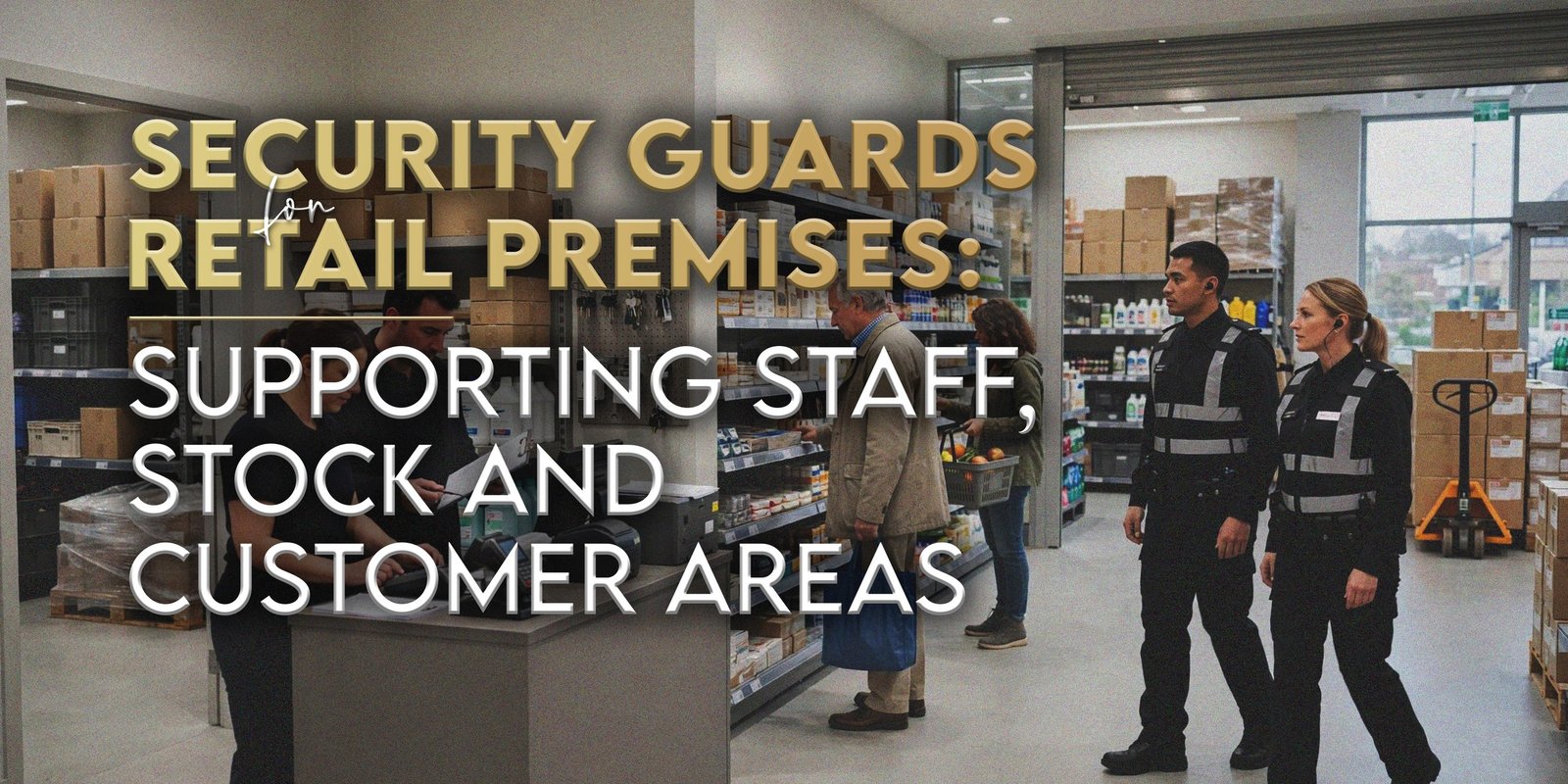
A busy shop floor creates several challenges at once. Customers need assistance, employees manage sales and stock deliveries arrive through separate entrances. Meanwhile, unexpected incidents can interrupt normal trading and place additional pressure on store managers.
Security guards can support retail operations by following agreed procedures for entrances, customer areas, stockrooms and incident reporting. However, effective guarding requires much more than positioning an officer near the front door.
Retail managers need to decide which activities require supervision, how guards communicate with employees and what responsibilities belong to the store’s management team.
H&D Security, based in Hounslow, West London, provides commercial guarding and related security services for business premises.
This guide explains how retailers can assess guarding requirements, compare providers and coordinate staff, stock protection and customer-facing procedures.
Why Retail Premises Use Security Guards
Retail businesses use security guards to support agreed site procedures, observe relevant activity and assist with incident reporting. Their duties may include monitoring entrances, carrying out shop-floor patrols, checking authorised access and communicating concerns to management.
However, responsibilities should reflect the premises rather than follow an identical arrangement for every shop.
Different Stores Have Different Requirements
A convenience store with one customer entrance may need a different guarding approach from a supermarket with multiple exits, stockrooms and frequent deliveries.
Similarly, a busy retail park may experience changing visitor numbers throughout the day.
Therefore, store managers should identify the areas requiring attention before deciding how many personnel they need.
For example, security guards at a larger retail premises might follow agreed observation routes, while a smaller shop could prioritise entrance coverage and communication with the duty manager.
Support Daily Store Procedures
An effective guarding arrangement should complement the way employees already work.
For instance, store personnel may remain responsible for stock checks and customer service, while guards follow agreed procedures for observing concerning behaviour and reporting incidents.
Consequently, clear responsibilities matter more than general promises about preventing losses.
What Do Retail Security Guards Actually Do?
Retail security guards carry out duties agreed between the retailer and the guarding provider. These may include observing customer entrances, patrolling shop floors, supporting access procedures, documenting incidents and communicating with store management.
However, guards do not automatically have authority to carry out every type of intervention.
Entrance and Customer Area Observation
A shop entrance is often one of the first areas to assess.
The manager should consider customer movement, door arrangements and any nearby service desks.
For example, a guard might observe activity around the main entrance while remaining available to contact a supervisor if an incident develops.
Nevertheless, security guards should operate according to clear instructions rather than independently introducing unfamiliar customer checks.
Shop-Floor Patrols
Agreed patrol routes may help officers observe designated sales areas and identify matters requiring attention.
However, patrols should not interfere unnecessarily with customers browsing or staff completing their duties.
Instead, retailers should define the areas, timing and reporting expectations involved.
Reporting and Communication
Relevant information might include the time of an incident, the location, the individuals involved and the actions taken.
Therefore, security guards need an agreed reporting process and an appropriate management contact.
The aim is to help the store maintain useful records and respond according to its established procedures.
How Security Guards Support Retail Staff
Retail employees often manage multiple responsibilities during a shift.
They may serve customers, replenish shelves, receive deliveries and resolve service enquiries simultaneously.
Consequently, security guards can support employees by handling agreed security-related observations and communicating concerns through an established process.
Clear Communication Reduces Confusion
A store assistant should know whom to contact if they notice an issue requiring security attention.
Similarly, the guard should understand which situations need the duty manager’s involvement.
For example, an employee may report unusual behaviour near a staff-only door. The officer can assess the information and follow the agreed procedures without making unsupported assumptions about the person involved.
Professional Customer Interactions Matter
A guarding officer working in a retail environment will often encounter customers.
Therefore, communication should remain calm, respectful and proportionate.
Security guards should also understand the business’s approach to customer complaints, accessibility needs and situations involving vulnerable individuals.
They do not replace store employees who are responsible for sales, refunds or ordinary customer service decisions.
Improve Shift Handovers
Communication matters when guarding shifts change.
For instance, the outgoing officer may need to report an unresolved incident, temporary access instructions or an expected contractor visit.
A structured handover allows security guards to understand the current situation without relying solely on verbal assumptions.
Shop Security Guards and Customer Area Management
Customer-facing security requires a balance between observation and normal retail activity.
Shop security guards should understand the layout, customer movement and busy trading periods before beginning an assignment.
A crowded entrance or promotional event may require different attention from a quiet weekday afternoon.
Managing Busy Entrances
Store managers should explain whether personnel are expected to observe entry routes, assist with agreed access procedures or communicate problems to employees.
However, officers should not create unnecessary queues or restrict customers without an appropriate lawful and operational basis.
Handling Concerning Behaviour
If an incident occurs, security guards should follow their training, lawful powers and site instructions.
Observation, accurate reporting and proportionate communication are important.
Any physical intervention, search or detention raises additional legal and practical considerations and must not be treated as an unrestricted guarding power.
Therefore, retailers should clarify escalation procedures before the contract begins.
Stockroom and Delivery Area Guarding
Stockrooms, delivery entrances and staff-only areas often involve movements that customers do not normally see.
For example, employees may transfer deliveries from a loading point into storage before moving goods onto the shop floor.
Security guards can support relevant access procedures and incident documentation where these duties form part of the agreement.
Define Stockroom Access
A store manager should identify which employees and contractors may enter restricted areas.
Then the manager can explain how guards should respond when somebody requests access without recognised authorisation.
For example, a delivery driver arriving outside the expected time may need confirmation from an authorised employee.
Coordinate Delivery Arrangements
Incoming deliveries may involve drivers, warehouse employees, stockroom personnel and external contractors.
Consequently, retailers should define who checks delivery paperwork, who receives goods and who authorises access.
Security guards should not automatically be expected to undertake stock administration or goods inspections unless the agreed duties include them.
Review Storage Layouts
Stockroom layouts can change as inventory levels rise.
Therefore, managers should assess whether shelving, pallets or temporary storage affect designated observation routes and existing CCTV views.
Loss Prevention Support: What Can Retail Guards Contribute?
Loss prevention support involves managing processes that help retailers identify, document and respond to stock-related concerns.
Security personnel may contribute through observation, access procedures, incident reporting and communication with store staff.
However, security guards cannot guarantee that theft or stock losses will never occur.
Observation Works Alongside Store Procedures
Effective retail loss prevention also depends on stock control, delivery checks, staff training and accurate records.
For example, a discrepancy identified during a stock count may require an operational review rather than immediate assumptions about misconduct.
Consequently, security observations should support established procedures rather than replace them.
Document Incidents Consistently
A useful report should distinguish observed facts from assumptions.
Managers may need details about the location, time, relevant activity and actions taken.
Therefore, security guards should follow an agreed reporting format that allows the store to review incidents appropriately.
Planning Security Guard Coverage for Your Retail Premises
Before booking security guards, retailers should prepare a clear site brief.
This should explain the size and layout of the premises, customer activity, trading hours and areas where additional supervision may be relevant.
What Should Store Managers Include?
A useful guarding request should contain:
- Store location and premises type.
- Trading and opening hours.
- Main and secondary customer entrances.
- Stockroom and staff-only access points.
- Delivery schedules and contractor procedures.
- Expected guarding responsibilities.
- Number of officers under consideration.
- Existing CCTV arrangements.
- Incident reporting and escalation contacts.
- Required shift coverage and assignment duration.
- Proposed service start date.
For example, a high street retailer in Hounslow may prioritise afternoon and weekend trading periods, while a larger store near Heathrow could have additional delivery access requirements.
The appropriate arrangement depends on the actual site.
Retail businesses can request a retail security quotation from H&D Security to discuss guarding duties, relevant coverage and related services.
A detailed brief helps the provider assess the requirement without assuming a standard package suits every store.
How Retail Security Guards Work With CCTV
CCTV can support retail guarding through footage of relevant entrances, shop-floor areas, stockroom access points and delivery routes.
However, camera placement affects what the system can actually record.
Security guards and CCTV systems serve related but different purposes.
CCTV Coverage and Blind Spots
A camera facing a customer entrance may provide useful footage of arrivals and departures.
Nevertheless, shelving, partitions, displays and changing lighting conditions can obstruct other areas.
Therefore, retailers should examine actual recordings during normal trading conditions rather than assuming a camera captures everything in its general direction.
Our guide to planning CCTV camera placement for business premises explains how businesses can assess entrances, stock areas and potential blind spots.
Recorded CCTV Versus Active Monitoring
A CCTV system may record footage for later review without anyone watching the cameras continuously.
By comparison, live monitoring involves personnel actively observing agreed feeds.
Consequently, security guards should not be assumed to receive live control room support unless the contract includes it.
Incident Coordination
Where CCTV monitoring is included, the retailer should specify how observations reach on-site staff.
For example, an operator may contact the duty manager or guarding officer after identifying a matter that requires attention.
However, the communication procedure and response arrangements must be agreed in advance.
SIA Licensing for Shop Security Guards
Retailers appointing contracted guarding personnel should understand the relevant Security Industry Authority (SIA) licensing rules.
Individuals who perform licensable guarding activities under a contract for services generally require an appropriate SIA licence.
However, licensing depends on the actual duties and employment arrangement.
Check Individual Licence Details
Businesses can use the official SIA licence-holder register to check an individual’s licence status and category.
Ask the provider how it verifies licences before assignments and confirms suitability for the work.
For instance, different regulated activities may require different licence categories.
Therefore, security guards should not be treated as interchangeable simply because they work within the same industry.
Understand the In-House Distinction
Employees directly hired by a retailer for ordinary in-house guarding do not usually need an SIA licence solely for that work.
However, exceptions apply, including certain door supervision activities at licensed premises.
Consequently, retailers should check the requirements for their circumstances rather than assume every in-house employee is exempt.
The SIA’s Approved Contractor Scheme is also separate from individual licensing. It is a voluntary approval arrangement for eligible security businesses, not a compulsory licence held by every guarding company.
Review Training and Assignment Suitability
A valid licence is important, but it does not replace site-specific instructions.
Retailers should also ask about relevant experience, customer communication, incident reporting and supervision.
These details help determine whether SIA security staff suit the intended assignment.
Daytime, Evening and Weekend Retail Guarding
Retail activity changes throughout the week.
A small store may experience its busiest customer period after normal working hours, while another retailer may see greater activity on weekends.
Therefore, guarding schedules should reflect actual trading patterns.
Daytime Trading
During normal opening hours, security guards may focus on customer areas, entrances and communication with employees.
However, some sites may need additional attention during deliveries or planned promotional activity.
Evening and Closing Procedures
Store closing can involve final customers, cash-handling processes, employees leaving and access to staff-only areas.
Retailers should define any required duties clearly rather than assume every officer handles all closing procedures.
Seasonal and Weekend Peaks
Busy shopping periods may increase customer movement and operational demands.
Consequently, a retailer could review whether additional temporary guarding coverage is appropriate.
However, extra security guards should be considered against actual site requirements, staffing arrangements and provider availability.
How Retailers Should Compare Security Guard Providers
Choosing a guarding provider involves more than checking price and general experience.
Retailers should compare relevant licensing, customer-facing ability, supervision, reporting and contract scope.
Ask About Guard Supervision
Who provides site instructions? How are incidents reported? What happens if an officer cannot attend a scheduled shift?
Answers to these questions can reveal how a provider manages practical service delivery.
Review Relevant Experience
A guard familiar with retail environments may understand typical visitor patterns and customer-facing responsibilities.
However, businesses should still explain their store-specific procedures rather than assuming past experience covers every requirement.
Compare Written Service Specifications
A provider’s quotation should identify responsibilities, hours, reporting, supervision and any additional services.
For further guidance, see what to check when comparing security companies.
This helps retailers understand why security guards should be assessed through defined duties and operational arrangements rather than marketing claims alone.
Retail Security Guards vs CCTV Monitoring
On-site guarding and CCTV monitoring can complement each other, but they perform different functions.
| Consideration | On-Site Retail Guards | CCTV Monitoring |
|---|---|---|
| Physical presence | Personnel attend the store during agreed shifts | Remote monitoring does not necessarily provide on-site personnel |
| Customer interaction | Can communicate with customers under agreed procedures | Cannot provide direct face-to-face assistance |
| Stockroom oversight | Can follow authorised patrol and access duties | Can observe designated areas where camera coverage allows |
| Incident reporting | Officers document relevant events | Operators may report observations under agreed procedures |
| Operating arrangements | Depend on staffing and shift coverage | Depend on monitoring service and equipment |
| Key consideration | Duties, licences and supervision | Camera coverage, monitoring hours and escalation |
For example, security guards may help manage an entrance while relevant CCTV footage supports later incident review.
However, neither arrangement automatically replaces every other store procedure.
What Affects the Cost of Retail Security Guards?
The cost of retail security guards depends on the premises, required hours, number of officers, specific duties, shift arrangements and contract conditions.
Therefore, retailers should compare complete service specifications rather than relying solely on advertised hourly rates.
Guarding Hours and Staffing Levels
A store requesting weekday daytime coverage has different requirements from a retailer seeking evening and weekend assignments.
Similarly, larger premises may need separate consideration of entrances, stockrooms and customer areas.
However, size alone does not determine how many officers are appropriate.
Duties and Additional Services
Guarding, active CCTV monitoring, mobile patrols and control room support may involve separate service arrangements.
Consequently, security guards should only be one part of a quotation where wider services are relevant.
Review Contract Conditions
Ask providers to explain assignment duration, agreed hours, additional charges, amendments and termination provisions.
Furthermore, retailers should establish how the provider handles supervision, reporting and changes to staffing schedules.
Common Mistakes Retailers Make When Booking Security Guards
Several booking mistakes can make retail guarding less effective or create confusion about responsibilities.
1. Failing to Define Guard Duties
A vague request for store security leaves important questions unanswered.
Better approach: Specify entrance duties, patrol requirements, reporting and escalation procedures.
2. Choosing Only by Price
A lower quoted rate may involve a different service scope.
Better approach: Compare duties, coverage and commercial terms.
3. Not Checking Licence Requirements
Appropriate individual licensing matters for contracted licensable duties.
Better approach: Verify relevant SIA licence details before assignments begin.
4. Ignoring Customer-Facing Communication
Retail officers may interact with customers and employees throughout their shifts.
Better approach: Discuss communication expectations and proportionate conduct.
5. Overlooking Stockroom Access
Stock movements may involve several staff members and contractors.
Better approach: Define who authorises entry and who handles deliveries.
6. Leaving Reporting Unclear
Incident records become less useful when employees follow inconsistent procedures.
Better approach: Agree the reporting format and management contacts.
7. Assuming CCTV Covers Every Area
Camera views can contain blind spots or lose useful detail under different lighting conditions.
Better approach: Review recorded footage and camera positioning.
8. Missing Contractor Procedures
Unexpected delivery or maintenance visits may create access questions.
Better approach: Provide authorisation instructions for relevant arrivals.
9. Not Clarifying Shift Coverage
Different opening periods may require different guarding arrangements.
Better approach: Agree scheduled hours, handovers and reporting responsibilities before booking.
Retail Security Guard Booking Checklist
Before arranging security guards, review the following:
- Define the responsibilities of guarding personnel.
- Confirm store opening hours and relevant shift patterns.
- Identify customer entrances and shop-floor areas.
- Review stockrooms and delivery access points.
- Specify staff and contractor entry procedures.
- Confirm individual SIA licensing requirements.
- Discuss relevant retail guarding experience.
- Establish supervision and shift handover procedures.
- Review CCTV coverage and incident coordination.
- Agree incident reporting and escalation contacts.
- Compare the complete quotation and contract terms.
- Confirm the proposed start date and any site-specific instructions.
Frequently Asked Questions About Retail Security Guards
What do retail security guards do?
Retail security guards support agreed store procedures such as entrance observation, shop-floor patrols, access management, incident reporting and communication with employees. Their responsibilities depend on the contract and site instructions. They may also support opening or closing procedures where specifically agreed, but they do not replace ordinary store management.
Do shop security guards need an SIA licence?
Contracted personnel undertaking relevant licensable retail guarding generally need an appropriate individual SIA licence. However, directly employed in-house staff are not automatically subject to the same licensing requirement, and exceptions may apply. Retailers should check the duties and employment arrangements, then verify relevant licences through the official SIA register.
Can retail security guards help with loss prevention?
Yes. Security guards may contribute to loss prevention through observation, access procedures, appropriate communication and incident reporting. However, effective stock control also depends on wider store processes, including deliveries, inventory records and employee responsibilities. No guarding arrangement can guarantee that every incident or stock loss will be prevented.
How do guards support retail staff?
Guards can support retail staff by following agreed procedures for reporting concerns, observing designated areas and contacting store management when needed. For example, an employee may notify an officer about an access problem or customer-related incident. Clear roles and calm communication help maintain appropriate coordination without shifting management responsibilities to guarding personnel.
Can guards monitor stockroom areas?
Yes, where the agreed assignment includes stockroom patrols or access oversight. Retailers should identify restricted entry points, authorised personnel and delivery procedures. However, security guards should not automatically handle stock counts, inventory investigations or receiving tasks unless those duties form part of the contract and are appropriate to the role.
How do retail guards work with CCTV?
On-site guards may use authorised CCTV information to support incident review or follow agreed communication procedures with monitoring personnel. However, CCTV recording differs from active monitoring, and continuous observation is not automatically included in guarding services. Retailers should confirm camera coverage, access permissions, monitoring duties and escalation arrangements separately.
What affects the cost of shop security guards?
Costs depend on store location, guarding hours, number of officers, assignment duration, required responsibilities and applicable commercial terms. Additional services may also affect the quotation. Therefore, businesses should compare written specifications rather than hourly figures alone and confirm what the proposed arrangement includes before making a decision.
How can a retailer request guarding services?
A retailer should prepare details about the premises, opening hours, customer entrances, stockroom access, delivery schedule and guarding responsibilities. The business should also identify any existing CCTV arrangements and reporting requirements. A provider can then discuss suitable staffing options, licensing considerations and a quotation based on those actual needs.
Find Retail Security Support That Fits Your Store
Retail guarding works best when the service reflects the way the store operates.
For some businesses, the priority may involve customer entrances and communication with employees. Others may need additional attention to stockroom access, deliveries or busy trading periods.
However, security guards should form part of a clearly defined arrangement that includes appropriate licensing, responsibilities, supervision and incident reporting.
H&D Security provides commercial guarding and related security services from its Hounslow, West London base. Retailers can discuss site-specific requirements without assuming that every store needs permanent guarding or the same level of coverage.
If your shop, retail park or commercial premises requires guarding support, prepare your site details, opening hours and expected duties. You can then discuss your retail security requirements with H&D Security.