
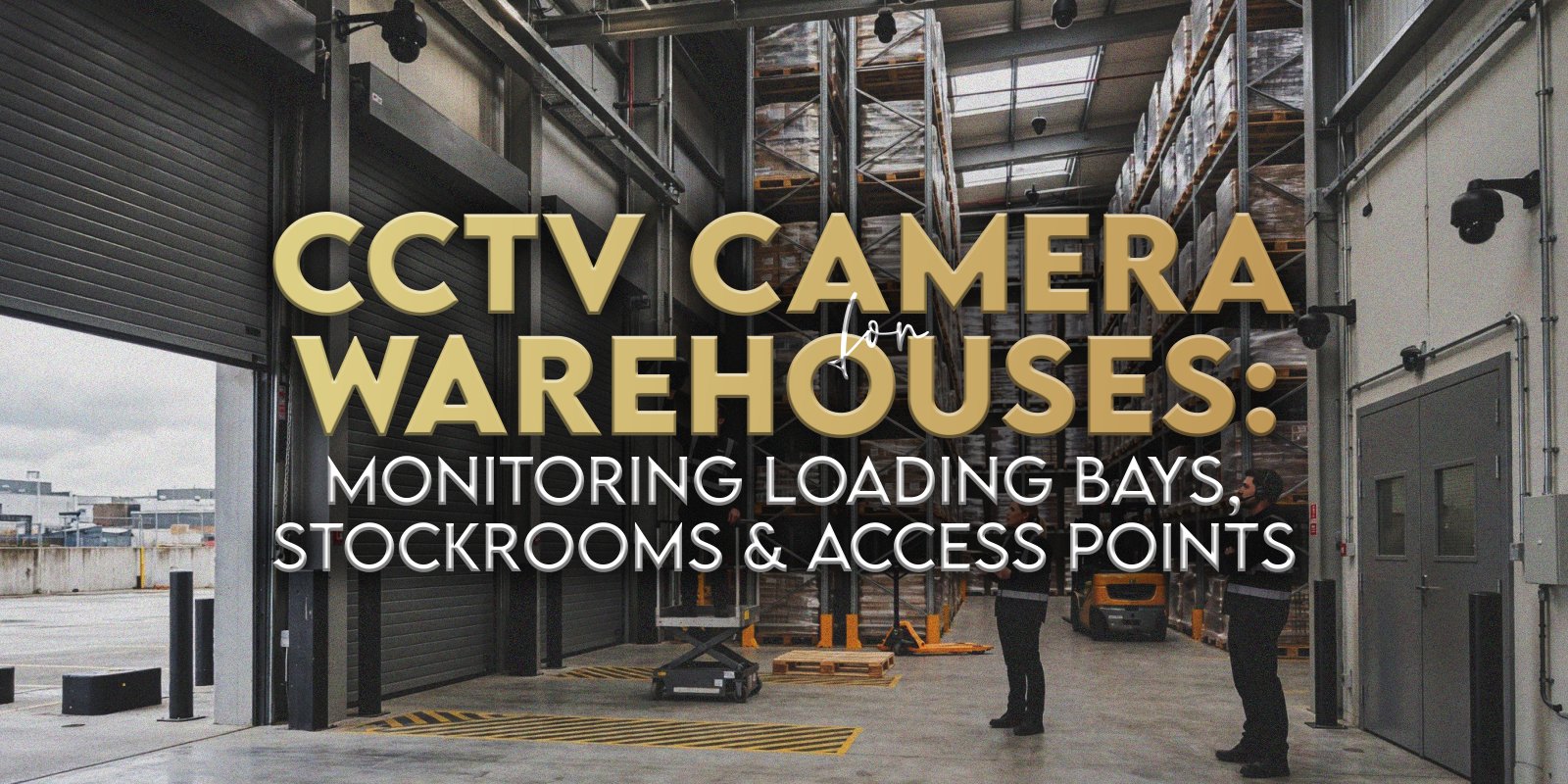
A delivery vehicle arrives while a second lorry leaves the yard, employees move stock between aisles and contractors wait at the gate. With activity happening simultaneously, warehouse managers need clear procedures for observing important areas and reviewing incidents. A CCTV camera can contribute useful footage, but the value depends on what it records, who can review it and how the site responds to concerns.
A thoughtful monitoring plan considers access points, operating hours and privacy, while separating equipment from professional monitoring and guarding.
Quick Answer: How Can CCTV Cameras Support Warehouse Monitoring?
A CCTV camera can record activity around loading bays, stockrooms, entrances and other appropriate warehouse areas. Recorded footage may help authorised teams review incidents, while live monitoring can support observation and agreed escalation procedures. Managers should coordinate camera coverage with access-control records, staff responsibilities and privacy requirements rather than treating surveillance as a substitute for on-site procedures.
Why Is CCTV Camera Monitoring Important for Warehouses?
Warehouse operations involve overlapping movements of stock, vehicles, employees and visitors. CCTV camera monitoring can create a visual record of relevant events, helping authorised managers establish what happened during a reported incident.
For example, a damaged delivery might prompt footage review. However, recordings cannot establish every fact.
A good monitoring plan therefore identifies its purpose before deciding where observation is appropriate. It also assigns responsibility for viewing footage and reporting concerns.
Which Warehouse Areas Should CCTV Camera Coverage Consider?
The right CCTV camera coverage depends on the warehouse layout, operations and documented risks. A site assessment should consider the following areas without assuming every location requires a device.
| Warehouse area | Monitoring purpose | Management consideration |
|---|---|---|
| Loading bays | Observe delivery and collection activity | Vehicle movement, drivers and authorised viewing |
| Goods-in | Review receipt and handling events | Consistency with delivery documentation |
| Stockrooms | Support appropriate stock oversight | Restricted access and employee privacy |
| Dispatch | Review movement towards goods-out | Shift changes and collection schedules |
| Staff entrances | Support access-event review | Proportionate coverage and transparency |
| Visitor gates | Coordinate entry procedures | Visitor registration and escalation |
| Vehicle yards | Observe relevant site activity | Lighting, boundaries and adjacent property |
Document what each proposed view achieves and whether monitoring is necessary, proportionate and compatible with data-protection obligations.
CCTV Camera Monitoring for Loading Bays
Loading bays bring together vehicles, drivers, warehouse personnel and goods movements. A CCTV camera overlooking an appropriate operational area may help managers review loading incidents, delivery disputes or reported damage.
However, footage cannot replace delivery records or traffic procedures.
When planning loading bay CCTV camera monitoring, establish which authorised person reviews footage, how a concern is recorded and when it should be escalated. Additionally, account for operating hours and changing lighting conditions as part of a professional system assessment.
CCTV Cameras for Stockrooms and Storage Areas
Stockrooms can contain high-value, controlled or frequently moved inventory. Appropriate CCTV camera coverage may support incident review and help managers understand movements involving designated storage areas.
Nevertheless, recordings should complement inventory controls and access records.
Before expanding stockroom CCTV camera use, consider whether the view captures employees unnecessarily or extends into private spaces. Set a clear purpose for the footage and limit access to people with a legitimate business need.
Monitoring Warehouse Entrances and Access Points
A CCTV camera near an appropriate warehouse entrance may support review of visitor arrivals, deliveries and incidents relating to authorised access. Meanwhile, a gatehouse or reception procedure can provide information that video alone cannot establish.
Camera footage should complement, not replace, visitor registration and permission checks.
Managers should define how staff report unusual access activity, who makes decisions and what action follows. A CCTV camera is one component of that process, not a complete access-control system.
Recorded CCTV vs Live Monitoring vs Control-Room Support
CCTV camera equipment and CCTV monitoring services are related but different. The table below distinguishes common approaches without assuming a particular provider supplies all of them.
| Monitoring approach | How it works | Main benefit | Important limitation | Suitable requirement |
|---|---|---|---|---|
| Recorded CCTV | Footage is stored for authorised later review | Supports retrospective enquiries | No automatic live intervention | Incident review and documentation |
| Live on-site monitoring | An authorised operator observes feeds during agreed hours | Allows relevant concerns to be noticed during observation | Depends on staffing, visibility and procedures | Busy operational periods |
| Remote monitoring | Authorised personnel view suitable feeds from another location | Can support agreed off-site observation | Depends on access, connectivity and service scope | Sites needing remote oversight |
| CCTV plus guarding | Monitoring informs personnel carrying out agreed site duties | Joins observation with on-site actions | Guarding must be arranged separately | Entrances, yards and controlled movements |
Confirm whether monitoring is continuous, scheduled or alert-based; recording does not guarantee live observation.
How Can CCTV Camera Monitoring Work With Security Guards?
CCTV camera monitoring provides visual information; a security guard may undertake authorised site duties such as visitor checks, patrols or incident reporting. Used together under clear procedures, these functions can complement one another.
For example, an operator can report a concern to designated site personnel under agreed procedures.
H&D Security describes CCTV monitoring alongside commercial guarding and access-control support. Businesses considering commercial site security guard services should confirm the monitoring and guarding scopes separately.
Where tasks require licensing, arrange appropriately authorised SIA security staff. Not every person viewing a CCTV camera performs the same licensable activity; the duties and context determine what requirements apply.
CCTV and Loss Prevention Support for Warehouse Stock
Loss prevention support involves more than reviewing footage after inventory goes missing. It may combine goods-receipt records, authorised stock access, dispatch documentation, exception reporting and proportionate camera monitoring.
Discrepancies call for a review of footage and relevant inventory records.
Importantly, footage should be accessed by authorised personnel for defined purposes. Do not circulate recordings casually or present a CCTV camera as a guarantee against loss.
Retail Security Guards vs Warehouse Security Personnel
Retail security guards and shop security guards often work in customer-facing environments where public interaction forms part of the role. Warehouse security personnel may instead focus on loading areas, delivery gates, contractors and controlled stock movement.
Both environments can use monitoring, but their operating conditions are different. For mixed sites, specify the actual duties; relevant licensing depends on the work.
CCTV Monitoring for Warehouses With Office Areas
Many sites include reception desks, administrative rooms and office corridors alongside warehouse floors. Their CCTV camera needs may differ because office activity creates different privacy expectations and access patterns.
Monitoring warehouse entrances does not justify intrusive observation of office desks.
Businesses coordinating mixed-use premises can also consider security services for commercial offices when planning the wider site arrangement.
What Should Warehouse Managers Check Before Planning CCTV Camera Coverage?
Start with a site plan and list the operational incidents or access concerns the organisation is trying to address. Next, review existing CCTV camera positions with an appropriately competent system professional, without assuming installation or maintenance forms part of a monitoring contract.
Review operating hours, lighting, privacy and who may view, maintain or disclose footage.
Finally, develop incident procedures. A useful CCTV camera plan states who receives an alert, who records the issue and when to contact management or emergency services as appropriate.
CCTV Privacy and UK Data Protection Considerations
A warehouse CCTV camera that records identifiable people can involve processing personal data. Organisations should consult current Information Commissioner’s Office guidance, identify a lawful basis and document why surveillance is necessary and proportionate.
Transparency matters. Clear CCTV signage and suitable privacy information help employees, contractors and visitors understand the purpose of observation and whom to contact. In addition, access to recorded footage should be limited to authorised people.
There is no universal UK GDPR retention period for every CCTV camera recording. The ICO advises organisations to set a justified retention policy based on their purpose and delete footage when it is no longer needed. Surveillance likely to create high risks, including certain workplace monitoring, requires appropriate data-protection impact assessment arrangements.
For up-to-date detail, consult the ICO guidance on video surveillance. Legal responsibilities depend on the actual surveillance arrangement and who controls the data.
Warehouse CCTV Monitoring in Hounslow and Near Heathrow
Warehouse sites in Hounslow, near Heathrow and across West London may operate with staggered deliveries, night shifts, contractor arrivals and changing vehicle traffic. Consequently, a CCTV camera monitoring plan should reflect the site schedule rather than assume that daytime arrangements cover every shift.
H&D Security serves relevant commercial security enquiries around Hounslow, Heathrow and Greater London. Managers should explain their layout and existing equipment when discussing CCTV monitoring or commercial guarding support.
How H&D Security Supports Commercial Warehouse Security
H&D Security provides relevant CCTV monitoring, CCTV operators, commercial guarding, access-control support, mobile patrols, control-room support and incident reporting services. Exact arrangements depend on the site and agreed scope.
Camera supply, installation and maintenance are separate services unless explicitly agreed.
To discuss your premises, you can request a warehouse CCTV monitoring quote with your location, operating hours and service requirements.
Common Warehouse CCTV Planning Mistakes
- Starting with equipment numbers instead of defining monitoring objectives.
- Overlooking loading bays, deliveries and shift changes during an assessment.
- Assuming every CCTV camera feed receives continuous human attention.
- Failing to assign incident reporting and escalation responsibilities.
- Neglecting staff privacy, CCTV signs or authorised footage access.
- Confusing system maintenance with CCTV monitoring services.
- Keeping recordings without a documented retention justification.
- Forgetting to review arrangements after layout or access changes.
Warehouse CCTV Camera Planning Checklist
- Define the purpose of each CCTV camera view.
- Review loading bays, stockrooms, dispatch, entrances and yards.
- Confirm existing equipment and any separate technical support needed.
- Identify monitoring hours and authorised operators.
- Agree incident escalation, reporting and response contacts.
- Review security personnel and access-control responsibilities.
- Assess privacy, notices, lawful basis and data-protection impacts.
- Document footage access, retention and deletion arrangements.
- Check how the monitoring plan will be reviewed after site changes.
Frequently Asked Questions
Where should a CCTV camera be placed in a warehouse?
A CCTV camera should serve a defined, legitimate monitoring purpose, such as observing an appropriate entrance, loading bay or stock movement area. Actual positioning depends on site layout, privacy, lighting and operational needs. Ask a competent system professional to assess coverage rather than relying on a generic placement diagram.
Why do loading bays need CCTV monitoring?
Loading bays combine vehicle deliveries, goods movement and contractor activity, making incident review and access procedures important. CCTV camera footage may help authorised managers understand a reported event. However, delivery documentation, traffic rules and a clear reporting process remain essential because surveillance cannot replace operational controls.
Can CCTV cameras help with stockroom oversight?
A CCTV camera may contribute to authorised review of stock movements or reported discrepancies in an appropriate storage area. Nevertheless, stock controls, access records and inventory reconciliation remain important. Managers should use footage only for justified purposes and ensure employees receive appropriate privacy information.
What is the difference between recording and live CCTV monitoring?
Recorded CCTV stores footage for later review; live monitoring involves authorised people observing feeds during agreed periods. Remote monitoring may take place from a different location, depending on the system and contract. A CCTV camera can record without anyone watching, so confirm the exact monitoring arrangement before booking.
Can CCTV work alongside warehouse security guards?
Yes. CCTV camera monitoring may provide information to security personnel who perform separately agreed duties, such as visitor access or incident reporting. However, a monitoring contract does not automatically include on-site guards. Discuss responsibilities, communication channels and any relevant SIA licensing requirements when arranging both services.
What should warehouse managers know about CCTV privacy requirements?
CCTV footage of identifiable people can be personal data under UK data-protection law. Managers should consider a lawful basis, transparency, proportionate camera views, appropriate signage, footage access and a justified retention policy. The ICO provides guidance, and the details depend on how the system is used.
Is CCTV useful for warehouse entrances?
A CCTV camera can help review relevant activity around entrances and delivery gates. However, it should complement visitor registration, staff authorisation and contractor procedures. Define who checks access records, responds to concerns and handles footage so the monitoring arrangement supports an established site process.
How do I request CCTV monitoring support in Hounslow?
Provide the warehouse location, site layout, existing CCTV camera arrangements and operating hours. Explain whether you need recorded footage review, live monitoring, guarding or access-control support. H&D Security can discuss relevant commercial services, with the exact scope confirmed through the enquiry and quotation process.
Building a Practical CCTV Monitoring Plan
A useful CCTV camera strategy starts with clear objectives and appropriate warehouse coverage, not a promise that surveillance will prevent every incident. Combine monitoring with sound delivery records, access procedures, privacy safeguards and a defined response plan.
Review monitoring purposes and responsibilities as operations change.
Discuss Your Warehouse CCTV and Security Requirements
Warehouse managers can discuss CCTV monitoring and relevant guarding arrangements with H&D Security. Share the site postcode, loading bay and stockroom requirements, entrances, operating hours, existing CCTV camera setup and any access-point concerns.
Request a warehouse CCTV and security quote from H&D Security or contact 0208 476 7676 and info@handdsecurity.co.uk to outline your needs.