
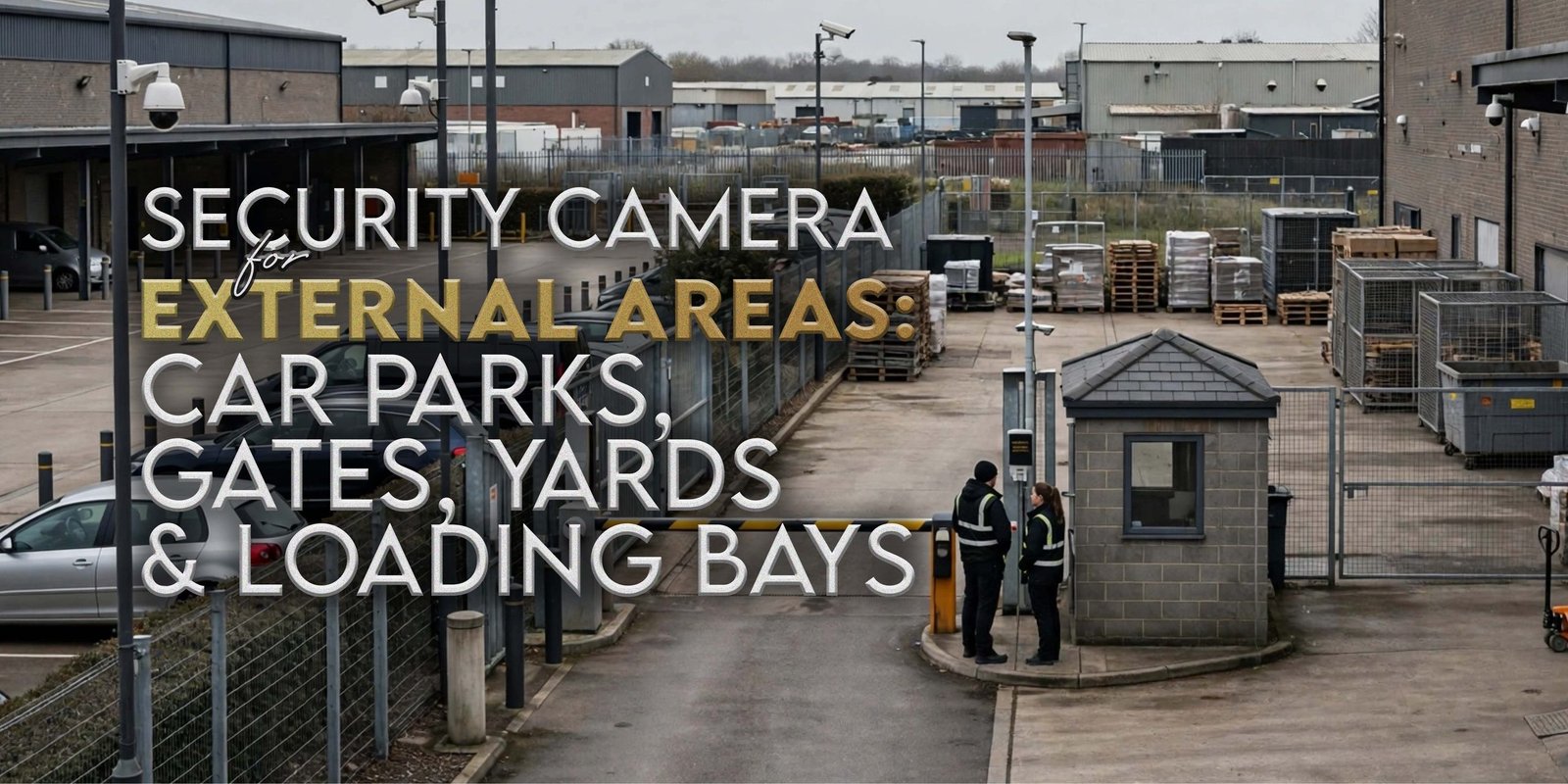
External commercial areas create different CCTV challenges from indoor spaces because vehicles, pedestrians, deliveries, changing light, weather and temporary obstructions can all affect the view. A well-planned security camera should therefore start with a clear purpose, the right position, an appropriate field of view and realistic operating conditions.
For businesses, the aim is not to place a camera wherever wall space is available. Instead, each view should support a defined operational need across car parks, gates, yards, loading bays or other external areas.
What Should Businesses Check Before Installing an External Security Camera?
Before installing an external security camera, define what the view needs to achieve, then assess placement, field of view, lighting, weather exposure, obstructions, vehicle and pedestrian movement, recording requirements and privacy considerations. The final position should reflect real operating conditions rather than a site drawing alone.
A practical external review should also consider how the area changes through the day. For example, parked vehicles, delivery activity or temporary equipment may alter a view that looked clear during an initial survey.
Why External CCTV Needs Different Planning
Outdoor CCTV has to cope with more changing conditions than many indoor environments. Daylight, darkness, headlights, glare, rain, dirt, long sight lines and moving vehicles can all affect whether a view remains useful.
Therefore, businesses should not simply copy an indoor security camera layout outside. External coverage should be planned around how the space actually operates, including busy periods, reduced occupancy and changing environmental conditions.
In addition, large external areas can tempt businesses to prioritise width over usefulness. A wide scene may provide context, but the camera still needs to capture the activity relevant to its purpose.
Outdoor CCTV Cameras: What Should Businesses Compare?
Outdoor CCTV cameras should be compared around intended purpose rather than one headline specification. Businesses should review the required field of view, mounting position, environmental suitability, lighting conditions, night-time use, recording compatibility, maintenance access and the surrounding site layout.
Before choosing equipment, define what each security camera needs to observe. A unit intended to cover a vehicle gate may need a different viewing objective from one used for a warehouse yard or building approach.
Similarly, the physical environment matters. Exposure to dirt, rain or changing light should form part of the selection and maintenance plan.
Security Camera Coverage for Car Parks
A car park can combine vehicle entrances, vehicle exits, pedestrian routes, building approaches, shared spaces and changing lighting. For that reason, each security camera should have a defined purpose within the wider car park plan.
For example, one view may support general vehicle movement, while another may focus on a designated entrance or pedestrian approach. Businesses should avoid assuming that one very wide view will answer every operational question.
Car park surveillance should also consider how parked vehicles alter visibility. A camera that appears to cover a route when the area is empty may lose useful sight lines when normal parking levels return.
Lighting deserves equal attention. Therefore, review car park views during relevant daytime and after-dark conditions before finalising positions.
What Should Car Park Surveillance Cover?
Car park surveillance should focus on the access routes, pedestrian movement, designated entrances, vehicle flow and building approaches that matter to the business. Each security camera should support a defined operational purpose and remain useful under normal parking levels and changing lighting conditions.
The aim should be proportionate coverage, not recording every possible part of the site. In practice, businesses should identify where activity needs to be reviewed, then position coverage around those objectives.
Security Camera Planning for Gates
Vehicle gates, pedestrian gates, service gates and delivery entrances can all require different views. A security camera at a gate should be planned around the type of movement taking place and the information the business needs from that point.
A broad situational overview may help show general movement around the entrance. By comparison, a closer access-point view may be more useful where the purpose is to review activity at a specific gate.
Gate cameras should also account for barriers, signs, posts, queues and vehicle positioning. Because these features can change the available sight line, businesses should assess the area during normal use.
Security Camera Coverage for Yards
Warehouse yards, industrial yards and logistics areas can contain parked vehicles, trailers, temporary equipment, containers and changing goods movement. These conditions can make external visibility more dynamic than a fixed drawing suggests.
For that reason, yard security cameras should be planned around real operating patterns. A security camera that works well during a quiet period may become partly obstructed once vehicles or equipment return.
Businesses should also distinguish between an overview and a specific operational view. One camera may support broad yard awareness, while another position may be needed for a defined access or loading area.
Security Camera Coverage for Loading Bays
Loading bays are active areas where delivery vehicles, goods, pedestrians and temporary obstructions frequently occupy the same space. A security camera position should therefore reflect normal loading and unloading conditions rather than an empty bay.
Vehicle size and positioning can affect sight lines. Likewise, open doors, stacked goods, cages or temporary equipment may interrupt a view during busy periods.
Lighting can also change significantly between an external yard and the inside of a loading area. Therefore, businesses should review each security camera position in realistic operating conditions and at the times when the area matters most.
A useful loading-bay plan may combine a broader operational view with coverage of specific access activity where justified. However, each view should have a clear purpose.
Camera Placement and Blind Spots in External Areas
External blind spots can be created by corners, parked vehicles, containers, structures, signs, temporary equipment or landscaping. During a site review, businesses should compare each security camera sight line against the activity they actually need to observe.
Site drawings are useful, but they cannot show every temporary obstruction. Therefore, an on-site review under normal operating conditions is essential.
For a broader framework on fields of view, overlapping coverage and placement decisions, see this guide to security camera coverage planning.
The aim is not to publish exploitable coverage gaps. Instead, businesses should identify and correct them internally as part of defensive planning.
How Lighting Affects an External Security Camera
Lighting can change the usefulness of an external security camera through glare, backlighting, shadows, headlights and reflective surfaces. A view that looks suitable during daylight may perform very differently after dark or when vehicles approach with lights on.
Therefore, review the area under the conditions that matter to the business. This may include daytime, evening and other relevant operating periods.
Reflective surfaces, glass, wet ground and bright signage can also affect the scene. A practical security camera plan should account for these conditions before installation rather than treating lighting as an afterthought.
Weather and External CCTV
External CCTV equipment can be exposed to rain, dust, dirt, wind and temperature changes. Businesses should choose equipment that is suitable for the intended environment and follow the manufacturer’s installation and maintenance guidance.
Do not assume that every camera is equally suitable for every exposed location. Environmental suitability can vary by product, enclosure and installation method.
Regular cleaning and inspection also matter because dirt or water on the viewing area can reduce image usefulness. Maintenance access should therefore form part of the original plan.
Security Camera Height and Viewing Angle
There is no single mounting height or angle that suits every external security camera. The correct position depends on the purpose, site layout, field of view, likely obstructions and maintenance requirements.
A higher position may provide broader context, while a different angle may better support a defined access point. However, wider coverage does not automatically mean more useful detail.
Before installation, businesses should test whether the planned security camera position still works when vehicles, signs or temporary equipment occupy the area.
Security Camera Coverage for Vehicle Access
Vehicle entrances and exits can involve employees, contractors, deliveries, service vehicles and queues. A security camera used around vehicle access should be planned according to whether the business needs a general overview, a defined access-point view or an operational record of movement.
Queueing can change the scene significantly. Therefore, assess whether stationary vehicles may block other relevant activity.
The same principle applies to service roads and delivery routes. Each camera should support a clear operational question rather than simply point towards traffic.
Security Camera Coverage for Pedestrian Routes
Staff entrances, visitor approaches, pedestrian gates and external walkways can all require a different approach from vehicle areas. A security camera should capture only what is necessary for the business purpose and should account for how people actually move through the site.
Where public or neighbouring areas enter the field of view, businesses should review whether the coverage remains necessary and proportionate. Current UK guidance also requires organisations using CCTV to provide appropriate transparency, control access to recordings and use footage for its stated purpose.
External CCTV and Mobile Patrols
External CCTV and physical patrols can complement each other when their roles are clearly defined. Cameras may provide recorded observation or remote visibility, while patrol officers can provide authorised physical attendance, site-condition checks, reporting and escalation.
This can be particularly relevant for reduced-occupancy commercial properties. Businesses considering that combination can review mobile patrol security for vacant sites.
Neither approach automatically replaces the other. The right balance depends on occupancy, site layout, operating hours and the purpose of each control.
External CCTV for Vacant or Reduced-Occupancy Sites
Vacant offices, empty warehouses, closed commercial premises and properties between tenants may have fewer legitimate visitors and less routine oversight. In those circumstances, security camera priorities may shift towards agreed external areas, building approaches and visible site condition.
However, the plan should still remain proportionate. Reduced occupancy does not justify unlimited monitoring, and businesses should continue to define each view around a clear purpose.
Recording and Monitoring External CCTV
A security camera can record footage without being watched continuously. Live monitoring, recorded review and incident escalation are separate operational decisions.
Businesses should decide who is authorised to view or export footage, how long recordings are needed for the defined purpose and whether live monitoring is required. Current ICO guidance says organisations should not retain surveillance data longer than needed for its purpose and should not choose retention simply because storage capacity allows it.
Where cameras capture identifiable people, the organisation should also review current data-protection obligations and ensure the system remains proportionate.
Privacy and External Camera Coverage
Commercial CCTV can process personal data when identifiable people appear in recorded footage. Businesses should therefore define a clear purpose, tell people that surveillance is operating through appropriate transparency measures such as signage, control access to recordings and retain footage only for as long as needed for that purpose.
External coverage may also capture public or neighbouring areas. In those cases, businesses should review current ICO guidance and consider whether the field of view can be limited while still meeting the operational purpose.
Audio recording requires additional caution and should not be enabled simply because equipment supports it. Businesses should assess necessity and proportionality before adopting more intrusive recording features.
Common External Security Camera Planning Mistakes
- Choosing a position before defining the purpose. Every view should answer a specific operational need.
- Ignoring night-time lighting. Daylight alone does not show how the scene behaves after dark.
- Allowing vehicles to block the view. Normal parking and deliveries can change sight lines.
- Ignoring changing yard layouts. Temporary equipment and containers can create new obstructions.
- Focusing only on wide coverage. A broad view is not always the most useful view.
- Forgetting pedestrian routes. Vehicle and pedestrian movement may require different planning.
- Failing to review loading-bay activity. Working bays can look very different from empty ones.
- Ignoring weather exposure. Equipment suitability and maintenance matter outside.
- Treating CCTV and patrols as unrelated. They can complement each other when responsibilities are clear.
- Ignoring privacy and data handling. External CCTV can capture personal data and requires appropriate governance.
External Security Camera Planning Checklist
Before installing an external security camera, review:
- Purpose of each camera
- Car parks
- Vehicle entrances
- Vehicle exits
- Pedestrian gates
- Loading bays
- Yards
- Service roads
- Building entrances
- External doors
- Vehicle movement
- Pedestrian movement
- Lighting
- Night conditions
- Glare
- Weather exposure
- Camera angle
- Camera height
- Field of view
- Temporary obstructions
- Blind spots
- Recording requirements
- Monitoring requirements
- Maintenance access
- Current privacy obligations
- Signage where applicable
- Whether the view extends beyond the premises boundary
Using one checklist for all proposed positions makes it easier to compare whether each security camera serves a genuine operational purpose.
External CCTV Comparison Table
| External Area | Main Planning Priority | Common Issue to Review |
|---|---|---|
| Car park | Vehicle and pedestrian movement | Lighting and large open areas |
| Main gate | Entry and exit activity | Viewing angle and glare |
| Yard | Vehicle and goods movement | Temporary obstructions |
| Loading bay | Deliveries and unloading | Vehicles blocking views |
| Service road | Vehicle movement | Long sight lines |
| Building entrance | People approaching | Backlighting |
| External walkway | Pedestrian movement | Proportionality |
| Vacant unit exterior | Visible site condition | Reduced routine activity |
The table provides a starting framework rather than a universal layout. Every security camera position should still be checked against real site conditions and the defined monitoring purpose.
How Often Should External CCTV Coverage Be Reviewed?
Businesses should review external CCTV whenever the site layout, traffic flow, parking pattern, loading activity, lighting or business purpose changes. New buildings, containers, barriers, signs or landscaping can alter a previously useful security camera view.
Periodic review also helps confirm that footage remains proportionate and that recording and access arrangements still match current business needs.
What should businesses check before installing an external security camera?
Before installing an external security camera, define its purpose and review placement, field of view, lighting, weather exposure, obstructions, vehicle movement, pedestrian movement, recording requirements and privacy considerations. The final position should be tested against normal operating conditions rather than chosen from a drawing alone.
Where should outdoor CCTV cameras be positioned?
Outdoor CCTV cameras should be positioned where they can support a defined business purpose without recording more than necessary. Businesses should assess access points, operating areas, lighting, obstructions and weather exposure before choosing the final security camera position.
What should car park surveillance cover?
Car park surveillance should focus on the vehicle and pedestrian activity that matters to the business, such as designated access routes, building approaches and shared movement areas. Each security camera should have a clear purpose and remain useful under normal parking and lighting conditions.
How should gate cameras be planned?
Gate cameras should be planned around the type of access point and the activity the business needs to review. A broad overview and a closer access view serve different purposes. The final security camera position should also account for barriers, queues, glare and normal vehicle movement.
Where should yard security cameras be positioned?
Yard security cameras should be positioned according to the activity that needs observation, not simply the largest available view. Businesses should consider parked vehicles, trailers, containers, equipment and changing goods movement before finalising each security camera position.
How does lighting affect outdoor CCTV?
Lighting can affect outdoor CCTV through glare, backlighting, shadows, headlights and reflections. Therefore, businesses should review each security camera view under relevant daytime and after-dark conditions rather than assume a position that works in daylight will perform identically at night.
Should loading bays have CCTV coverage?
Loading bays may benefit from CCTV where there is a defined operational need. Businesses should consider deliveries, unloading, vehicle positioning, pedestrian movement, lighting and temporary obstructions before deciding whether a security camera view is appropriate and proportionate.
Can external CCTV work alongside mobile patrols?
Yes. External CCTV can provide recorded or remote observation, while patrols can provide physical attendance, reporting and visible site-condition checks. A security camera and patrol service can complement each other when their responsibilities are clearly defined around the site’s needs.
Review Your External CCTV Requirements
A useful external CCTV plan starts with the areas that matter operationally. Review car parks, gates, yards, loading bays, pedestrian routes, lighting, weather exposure and temporary obstructions before deciding where each security camera should be positioned.
H&D Security can discuss external CCTV alongside wider commercial site-security requirements. To review your premises and planned coverage, request a tailored security quote.