
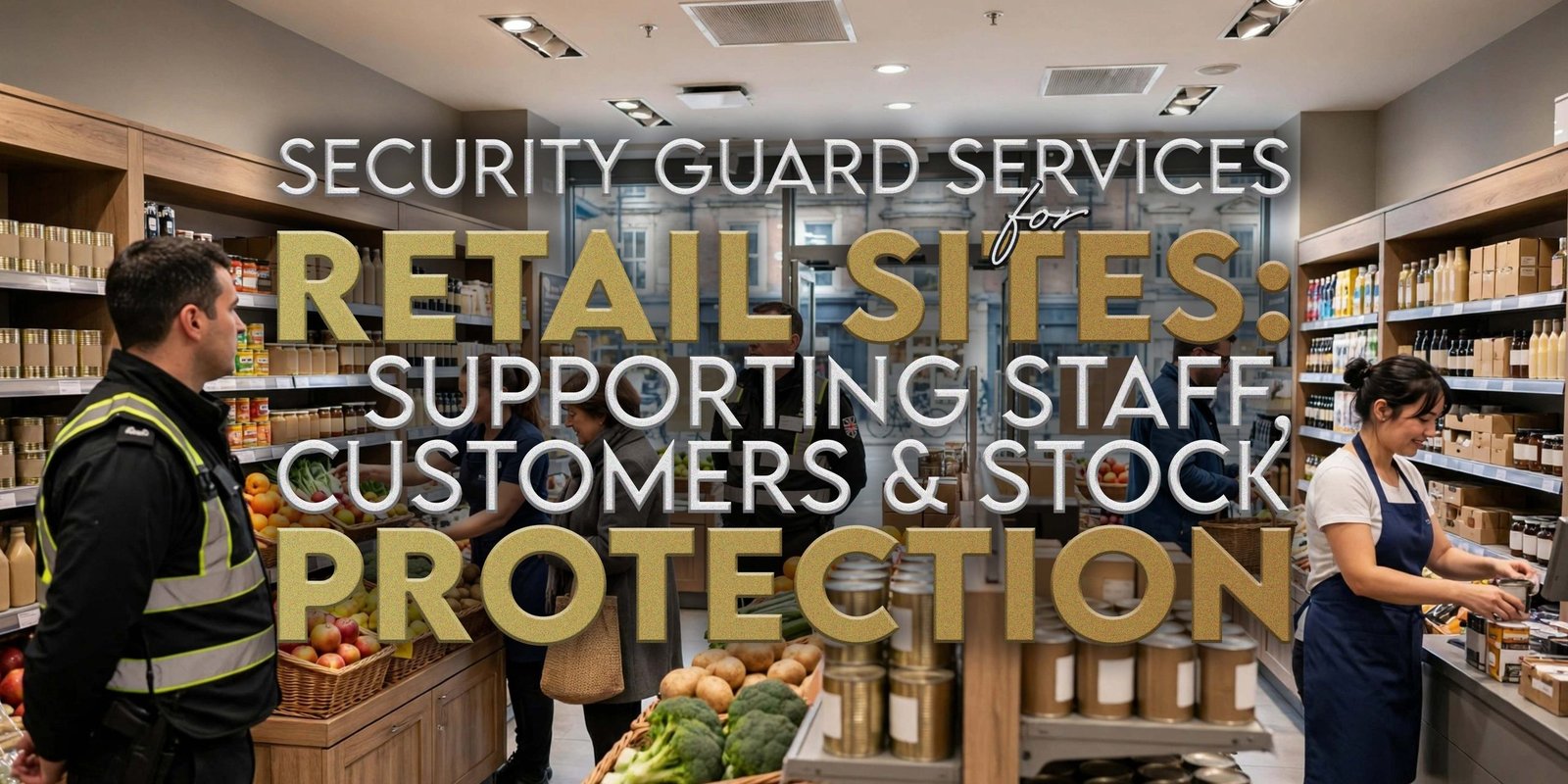
Retail sites combine public access, customer service, valuable stock, staff-only areas and frequent deliveries in one environment. Security guard services can add visible presence, support access procedures, assist staff during incidents and contribute to wider loss-prevention measures when duties are clearly defined.
For retailers, effective guarding is not simply about placing an officer near the door. The service should reflect the store layout, trading hours, stock areas, entrances, delivery points, customer flow, previous incident patterns and responsibilities agreed with the security provider.
What Do Security Guard Services Do at Retail Sites?
Security guard services at retail sites can support visible guarding, entrance and exit observation, patrols, customer-facing assistance, staff support, incident reporting, access management, loss-prevention procedures and escalation. Exact responsibilities depend on the retail format, risk assessment, site procedures, contracted duties and the officer’s relevant SIA licence.
The strongest retail arrangements connect the officer’s role to the store’s operating procedures. Therefore, security personnel should know what to observe, who receives an escalation and what falls outside their responsibilities.
What Are Security Guard Services for Retail Sites?
Security guard services for retail sites involve trained personnel carrying out agreed guarding duties such as visible presence, patrols, access management, customer-facing support, incident observation, reporting and escalation.
Guarding forms one part of a wider retail security approach. It does not replace store management, staff training, CCTV, emergency procedures or retail policies.
For example, a visible officer may support loss-prevention procedures on the shop floor while store managers still control staff decisions, stock procedures and customer-service policies.
What Do Retail Security Guards Do?
Retail security guards work in public-facing environments where observation, communication and professional behaviour matter alongside physical presence.
Depending on the site and contract, duties may include:
- Maintaining an entrance presence
- Observing exits
- Conducting floor patrols
- Supporting customers with basic directions
- Assisting staff during incidents
- Observing suspicious activity
- Recording incidents
- Supporting access-control procedures
- Monitoring approaches to stockrooms
- Assisting with opening or closing where contracted
- Coordinating with CCTV teams where applicable
Not every officer performs every duty. Retailers should define the post clearly before security guard services begin.
How Does Shop Security Work in Practice?
Effective shop security usually combines personnel, procedures and technology rather than relying on one measure.
A retailer may use:
- Guards
- CCTV
- Staff awareness
- Access rules
- Incident reporting
- Management escalation
- Store-layout controls
- Opening and closing procedures
The guarding plan should reflect the actual premises. A high-street shop with one public entrance requires a different approach from a multi-floor unit with several exits, stockrooms and delivery access.
Consequently, shop security should follow the site’s operating pattern rather than a generic guarding template.
How Can Guards Support Retail Loss Prevention?
Security officers can support retail loss prevention through visible presence, floor observation, entrance and exit awareness, incident escalation and reporting.
Their role may include:
- Increasing visibility in higher-risk areas
- Observing customer behaviour
- Identifying concerns for management
- Supporting store procedures
- Escalating suspicious activity
- Recording incidents
- Coordinating with relevant teams
These activities can help deter theft and support stock protection measures. However, no guarding arrangement can eliminate all losses, and security guard services should not be presented as a guarantee against shoplifting or shrinkage.
What Do Loss Prevention Guards Focus On?
Loss prevention guards focus more specifically on activities linked to stock loss, suspicious behaviour, high-risk merchandise areas, entrances, exits, stock movement and incident patterns.
That focus differs from general customer-facing guarding. A retail officer may spend much of a shift maintaining visible presence and assisting staff, while a loss-prevention-focused role may place greater emphasis on observation, recurring patterns, reporting and escalation.
Retailers should not assume that every officer is a specialist loss-prevention professional. The assignment instructions should clearly state which responsibilities apply.
How Can Security Guards Support Customers Without Disrupting Service?
Retail officers work inside a customer environment, not an isolated industrial site. Therefore, communication style and professional behaviour matter.
Customer-facing duties can include:
- Giving basic directions
- Helping manage queues
- Explaining entry procedures
- Directing concerns to store staff
- Maintaining a calm visible presence
- Escalating difficult situations appropriately
Security guard services should support the retail experience rather than create unnecessary friction.
The officer still needs to remain alert. However, the role should fit the brand, store environment and customer profile.
How Can Security Guard Services Support Retail Staff?
Security guard services can provide visible support when retail staff face difficult interactions, access concerns or suspicious behaviour.
Depending on the contract, officers may:
- Attend or observe difficult situations
- Follow store escalation procedures
- Support access-related controls
- Report incidents to management
- Assist during opening or closing
- Provide additional visibility when concerns arise
Security personnel do not replace management responsibilities. Instead, guarding should give staff a defined route for escalation and an additional trained presence where required.
Why Entrances and Exits Matter in Retail Security
Entrances and exits shape how customers, staff, deliveries and contractors move through a retail site.
The guarding brief should distinguish between:
- Public entrances
- Public exits
- Staff entrances
- Delivery access
- Emergency exits
- Loading areas
- Closing points
High footfall can also change how useful a fixed entrance post is compared with mobile floor patrols.
Therefore, security guard services should reflect customer flow as well as access-control requirements.
What Can Retail Patrols Cover?
Retail patrols can extend visibility beyond the main entrance.
Depending on the agreed scope, patrols may cover:
- Sales floors
- High-value product zones
- Customer areas
- Approaches to changing rooms where appropriate
- Staff-only corridors
- Stockroom approaches
- Delivery areas
- External areas where included
Patrols should follow lawful, proportionate site procedures. They should not encourage intrusive monitoring or treat ordinary customers as suspects.
How Can Guarding Support Stock and Back-of-House Areas?
Stock protection depends on operational controls as well as guarding.
Back-of-house security may involve:
- Restricted-access awareness
- Staff-only entrances
- Delivery access
- Stockroom doors
- Goods movement
- Closing procedures
- Suspicious-activity reporting
Security guard services can add observation and escalation around these areas. However, retailers still need clear authorisation rules, staff procedures and stock-management controls.
Why Delivery Areas Need Clear Security Procedures
Delivery points can connect public retail operations with stock handling, warehouses and service areas.
Useful controls may cover:
- Delivery schedules
- Driver access
- Loading bays
- Staff entrances
- Goods-in procedures
- Unauthorised access
- Escalation contacts
The guard’s role should be clear. For example, observing delivery access differs from managing warehouse staffing or carrying out goods-receipt duties.
What Does Commercial Guarding Add to a Retail Site?
Commercial guarding can extend beyond a single shop floor into wider premises.
For retail businesses, this may include areas such as:
- Retail parks
- Shopping centres
- Shared entrances
- Car parks
- Loading bays
- Service corridors
- Stock areas
- Offices linked to retail operations
Security guard services across a larger commercial environment may therefore require different patrol routes, reporting structures and coordination points from guarding one shop.
Retail Security Guard Duties by Area
| Retail Area | Potential Guarding Support | Key Consideration |
|---|---|---|
| Main Entrance | Visible presence, access observation | Customer-facing approach |
| Sales Floor | Patrols, suspicious-activity observation | Avoid disrupting customer experience |
| High-Value Area | Increased visibility | Site-specific procedures |
| Stockroom Access | Restricted-access awareness | Staff authorisation |
| Staff Entrance | Access checks where contracted | Clear staff procedure |
| Delivery Area | Delivery and access observation | Goods-in coordination |
| Car Park/External Area | Patrols where included | Site boundary and contract scope |
| Closing Period | Closing support where contracted | Clear responsibility split |
The table shows why retailers should define duties by location. Security guard services become more useful when officers understand the purpose of each post and patrol.
How Can Security Guards Respond to Shoplifting Concerns?
Retail officers should follow site policy, their training, the law and the specific instructions attached to their role.
A careful operational response may involve:
- Observing the situation.
- Following store procedures.
- Communicating with management or control.
- Preserving relevant information.
- Coordinating with CCTV where appropriate.
- Recording the incident.
- Escalating to police or other responders where appropriate.
Security officers do not have unlimited powers. Retailers should avoid briefs that encourage aggressive confrontation or unlawful detention.
For that reason, security guard services should include clear escalation instructions before an incident occurs.
What Happens When an Incident Occurs?
Exact steps depend on the incident, site policy, legal powers and emergency requirements.
A general process can include:
- Observe the situation.
- Follow site procedures.
- Contact management or control.
- Support immediate risk management.
- Escalate where necessary.
- Preserve relevant information.
- Record what happened.
- Complete required reporting.
Clear assignment instructions reduce uncertainty. In addition, officers should know who has authority to make operational decisions on behalf of the retailer.
Why Incident Reporting Matters
Incident reporting gives retail management a structured record of what happened.
A useful report may record:
- Time
- Location
- People involved
- Observations
- Action taken
- Escalation
- Supporting information where appropriate
Over time, consistent reporting can help management identify recurring locations, times or categories of concern.
It does not eliminate incidents. However, it can support reviews of retail procedures and guarding arrangements.
How Can Guards Work Alongside CCTV?
Guards and CCTV teams can support each other when roles and licences are appropriate.
Coordination may involve:
- Live observations
- Radio communication
- Incident verification
- Movement tracking where lawful
- Escalation
- Evidence preservation
Current SIA guidance states that public-space surveillance activity used for specified security purposes requires an appropriate CCTV licence. A security guard licence does not automatically make an officer a licensed CCTV operator.
Therefore, security guard services should distinguish between an officer coordinating with a CCTV team and a person whose assigned duties involve licensable CCTV operation.
How Can Guarding Support Opening and Closing Periods?
Opening and closing can create different operational requirements from normal trading hours.
Where contracted, officers may support:
- Staff arrival and departure
- Entrance checks
- External observations
- Access control
- Closing walk-throughs
- Escalation of concerns
- Lock or unlock procedures where included
Key holding should not be assumed to form part of every guarding contract. H&D Security lists key holding and alarm response separately among its broader commercial services.
When Might Retail Sites Need Additional Guarding?
Some retailers review guarding requirements when their operating environment changes.
Examples include:
- Seasonal retail peaks
- Sales events
- Product launches
- Christmas shopping periods
- Busy weekends
- Extended opening hours
- Known local events
- Repeated incident periods
- Temporary store changes
Additional security guard services may be considered when footfall, access points or operational pressures change.
However, the requirement should follow the actual site environment rather than a generic staffing ratio.
Does Security Planning Change Between a Shop and a Retail Park?
Yes. Layout and operating models can change the guarding brief significantly.
Individual Store
A single shop may focus on:
- Main entrance
- Sales floor
- Stockroom
- Staff access
Shopping Centre
A shopping-centre environment can add:
- Multiple entrances
- Shared public areas
- Tenant coordination
- Common corridors
Retail Park
A retail park may involve:
- Wider external areas
- Car parks
- Service roads
- Multiple units
- Delivery areas
- Out-of-hours activity
Consequently, security guard services should be based on actual site boundaries and responsibilities.
What Should Retailers Assess Before Hiring Security Guards?
Before requesting security guard services, retailers should review:
- Site layout
- Opening hours
- Previous incident patterns
- High-value stock areas
- Public access
- Delivery areas
- Entrances and exits
- Staff-only areas
- CCTV coverage
- Lone-working considerations
- Closing procedures
This assessment helps define what an officer is expected to do rather than simply how many officers the business thinks it requires.
How Many Retail Security Guards Does a Site Need?
There is no universal number.
A suitable guarding level depends on:
- Store size
- Floor layout
- Number of entrances
- Footfall
- Trading hours
- Risk profile
- Assigned duties
- Incident history
- High-value zones
- External areas
For example, a high-street shop with one entrance can have a very different requirement from a retail park containing several units and car parks.
Therefore, security guard services should follow site risk and operational scope rather than a fixed guard-to-customer ratio.
Why SIA Licensing Matters for Retail Security
Relevant licensable security activities require the appropriate SIA licence.
Current SIA guidance states that activities including guarding premises against unauthorised access and guarding property against damage or theft can fall within licensable security work. Public-space surveillance CCTV is treated separately when CCTV is used for specified security purposes.
Retailers should therefore define the duties before determining which licence category applies.
Licensing is role-specific. One SIA licence should not be assumed to authorise every possible security activity.
What Should You Tell a Security Company About Your Retail Site?
A detailed brief helps define security guard services correctly.
Provide:
- Site address and postcode
- Store type
- Trading hours
- Required guarding hours
- Number of entrances and exits
- Staff entrances
- Delivery areas
- High-value product zones
- Known incident concerns
- Public-facing duties
- Patrol requirements
- CCTV coordination requirements
- Opening or closing duties
- Reporting expectations
- Escalation contacts
- Required licence type where known
- Uniform expectations
- Shift pattern
The more specific the brief, the easier it becomes to distinguish general guarding, loss prevention, customer-facing support and any separate security services.
Questions to Ask Before Choosing Security Guard Services
Before selecting security guard services, ask:
- What retail experience do your officers have?
- Which SIA licences apply to the planned duties?
- How are officers briefed?
- How are incidents reported?
- How does escalation work?
- Can guards coordinate with CCTV teams?
- How is supervision handled?
- What happens if cover requirements change?
- How are multi-site instructions kept consistent?
- Which duties are included in the quoted scope?
These questions help retailers compare service scope without relying on vague promises.
Security guard services should match the site brief, agreed duties and relevant licensing.
Retailers should compare security guard services by scope, supervision, reporting and escalation rather than broad claims.
Retail Security Guard Services From H&D Security
H&D Security’s current website supports SIA-licensed officers for static and retail sites. Its published officer duties include site access control, visitor screening, patrolling, incident logging and customer service.
H&D Security also lists broader commercial services such as CCTV monitoring, mobile patrols, key holding, alarm response and control-room support. However, retailers should not assume that every service automatically forms part of every security guard services contract.
The exact package should depend on the site’s layout, operating hours, risk profile and agreed duties.
H&D Security currently supports retail alongside shopping centres and other commercial environments. Businesses can request retail security support after preparing the relevant site, shift and duty information.
When Retail Stock Operations Connect With Warehouse Staffing
Some retailers also operate stockrooms, fulfilment areas, warehouses, distribution functions, goods-in and dispatch operations.
Security and recruitment remain separate services:
H&D Security → security services
H&D Recruitment → staffing and recruitment
A retailer that needs additional personnel for warehouse operations can review warehouse staffing support separately from its guarding arrangements.
Likewise, businesses specifically recruiting stock-handling personnel can review warehouse operatives recruitment.
These recruitment requirements should not be confused with security guard services for stockrooms, delivery access or warehouse-related security areas.
Conclusion
Security guard services can support retail businesses through visible presence, patrols, access management, staff assistance, customer-facing duties, incident reporting and loss-prevention procedures.
However, effective retail guarding depends on a clear assignment rather than generic deployment. Retailers should define entrances, patrol areas, stock zones, delivery access, escalation routes, CCTV coordination and opening or closing duties before service begins.
For stock protection, the realistic aim is to support wider loss-prevention measures, increase visibility and provide clear observation and escalation.
No guarding arrangement can promise zero theft or eliminate every incident.
1. What do security guard services provide for retail sites?
Security guard services can provide visible presence, patrols, access support, customer-facing assistance, incident observation, reporting and escalation. Retail duties should reflect the store layout, trading hours, entrances, stock areas and procedures. Exact responsibilities depend on the agreed contract and relevant SIA licensing.
2. What do retail security guards do?
Retail security guards may monitor entrances, patrol sales floors, observe suspicious activity, assist staff, support customers, record incidents and follow access procedures. Some roles may also coordinate with CCTV teams or support opening and closing where contracted. Not every retail officer performs every duty.
3. Can security guards help deter shoplifting?
Yes. A visible security presence can support shoplifting deterrence and wider loss-prevention measures. Officers can also observe concerns, follow store procedures, escalate suspicious activity and record incidents. However, security guard services cannot guarantee that shoplifting or stock loss will not occur.
4. What is the difference between retail guards and loss prevention guards?
A general retail guard may combine visible guarding, customer-facing support, patrols and incident response. Loss prevention guards may focus more specifically on suspicious activity, high-risk merchandise areas, repeated incident patterns, stock movement and reporting. The exact distinction depends on the contracted duties.
5. Do retail security officers need an SIA licence?
Where the work falls within licensable security activity, an officer needs the appropriate SIA licence. Current SIA guidance covers activities such as guarding premises against unauthorised access and property against theft or damage. CCTV operation may require a separate public-space surveillance licence depending on the duties.
6. Can guards support customers as well as store staff?
Yes. Retail officers can work in customer-facing roles where their brief includes professional communication, directions, queue awareness and entry procedures. They can also support staff during incidents or access concerns. Their approach should remain consistent with the retail environment and agreed responsibilities.
7. Can security guards monitor stockrooms and delivery areas?
They can support observation, access procedures and incident escalation around stockrooms, goods-in points and delivery areas where those duties form part of the contract. However, security guard services do not replace the retailer’s own stock controls, staff authorisation processes or goods-handling procedures.
8. How many guards does a retail site need?
There is no universal number. Requirements depend on store size, entrances, layout, footfall, trading hours, risk profile, high-value areas, external spaces and assigned duties. A site assessment provides a more useful basis than applying a generic staffing ratio.
9. How can guards work with CCTV?
Retail guards can communicate observations to CCTV operators, receive information from monitoring teams and coordinate escalation where procedures allow. However, CCTV operation itself may require the appropriate SIA public-space surveillance licence. Retailers should distinguish coordination from active CCTV operation.
10. How can I request retail security support from H&D Security?
Prepare the site address, trading hours, guarding hours, entrances, patrol areas, stock concerns, delivery access, CCTV requirements, reporting expectations and shift pattern. You can then discuss the scope with H&D Security and request a quote based on the actual retail environment.
9. Discuss Security for Your Retail Site
Before requesting security guard services, prepare:
- Site address or postcode
- Retail format
- Trading hours
- Required guarding hours
- Number of entrances
- Known incident concerns
- Patrol areas
- Stock or high-value zones
- Delivery and loading areas
- CCTV coordination requirements
- Opening or closing duties
- Reporting expectations
- Escalation contacts
- Shift pattern
H&D Security currently provides SIA-licensed guarding for retail and static sites, with published duties including access control, visitor screening, patrolling, incident logging and customer service.
To define the right scope, discuss your retail security requirements with H&D Security.
Phone: 0208 476 7676
Email: info@handdsecurity.co.uk
Website: handdsecurity.co.uk