
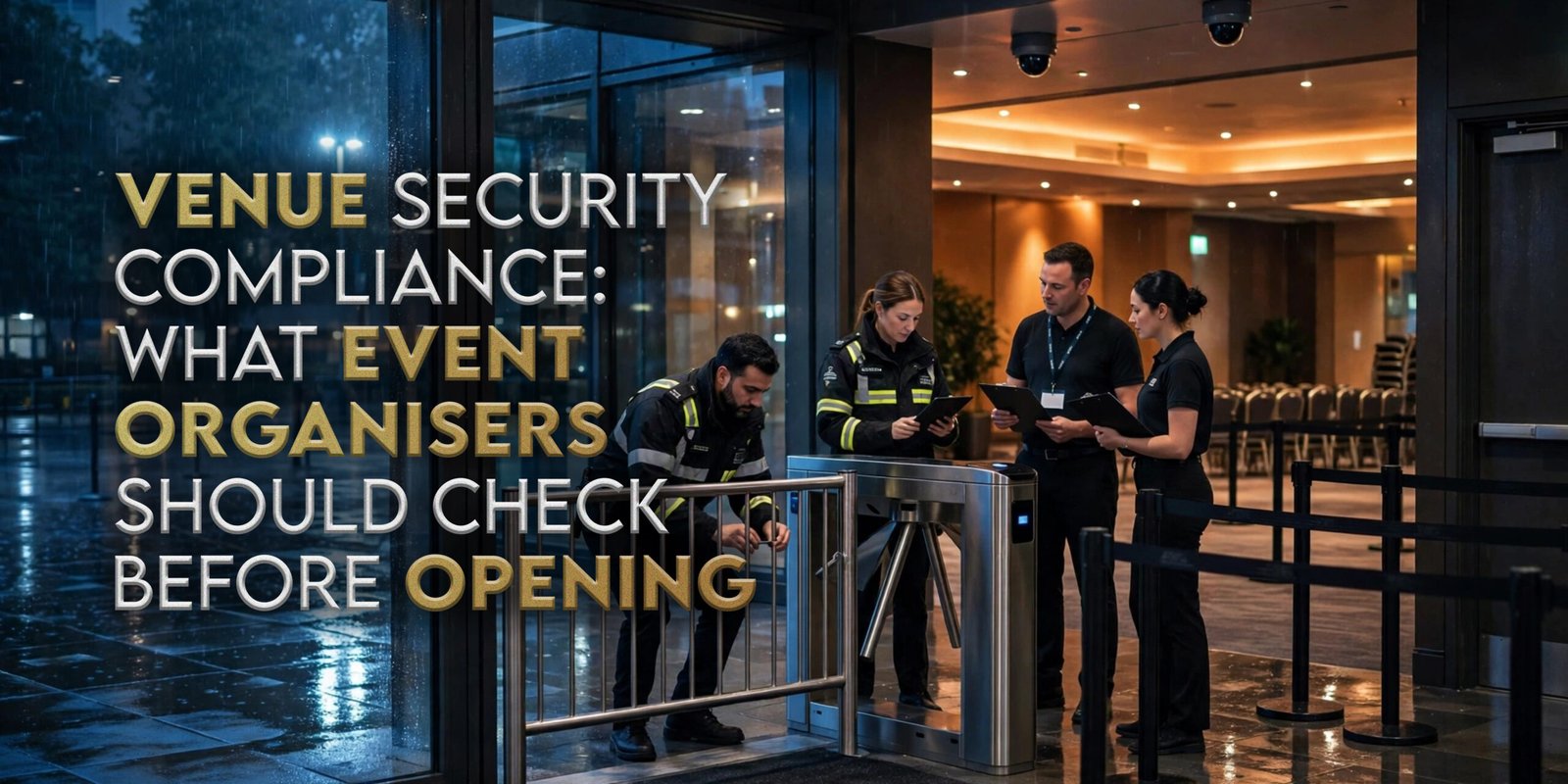
A venue is due to open in 90 minutes. Staff are booked and guests are expected, but nobody has confirmed whether licence conditions match the rota or escalation contacts are agreed. That is why venue security compliance starts before doors open.
A rota alone does not create venue security compliance. Organisers need the licence, risk assessment, staffing, entry procedures, crowd plan, communications and emergency arrangements to work together.
What Is Venue Security Compliance?
Venue security compliance means aligning the security plan with applicable premises-licence conditions, relevant SIA licensing requirements, the event risk assessment, entry procedures, crowd-management arrangements, staff roles, incident escalation and emergency planning. Exact requirements depend on the venue, event type and work being performed.
In practice, venue security compliance is a coordination task rather than a single document. Organisers should confirm who is responsible for each area and how changes are communicated before guests enter.
| Compliance Area | Organiser Check |
|---|---|
| Premises licence | Review applicable conditions |
| Risk assessment | Confirm current event risks |
| SIA licensing | Match licences to activities |
| Staffing | Confirm roles and numbers |
| Entry | Define ticket, ID and search procedures where applicable |
| Crowd plan | Review routes, queues and movement |
| Communications | Confirm supervisor and escalation route |
| Emergency arrangements | Brief relevant roles |
| Records | Define logs and incident reporting |
What Should Event Organisers Check Before Opening?
Before opening, organisers should check the premises licence, risk assessment, staff licences, staffing plan, entrances, exits, crowd routes, communications, escalation contacts, emergency arrangements and staff briefing. Venue security compliance works best when these checks relate to the actual event.
A pre-opening check should also capture late changes because they can affect venue security compliance.
Start With the Premises Licence
A premises licence can contain conditions relevant to door supervision. Organisers should review the actual licence, permitted hours and event-specific conditions before setting the rota.
For venue security compliance, do not rely on a generic assumption about staffing. The specific licence and applicable requirements matter.
Can the Premises Licence Specify Door-Supervisor Numbers?
Yes. An individual premises licence can contain conditions about door supervisors, including when they are required and, in some cases, numbers or deployment conditions.
There is no universal door-supervisor-to-guest ratio. Venue security compliance should follow the venue’s conditions and event risk assessment.
SIA Door Staff: Who Needs a Licence?
SIA door staff need the appropriate licence when they perform licensable door-supervision activity. Current SIA guidance states that a door-supervisor licence is required for relevant guarding work at licensed premises in specified circumstances.
However, not every event worker or steward automatically performs licensable activity. For venue security compliance, organisers should match the actual role to current SIA rules.
Door Supervisors at Licensed Premises
Door-supervision work at licensed premises commonly requires the relevant SIA door-supervisor licence. GOV.UK states that people working as door supervisors at licensed premises require SIA licensing for that work.
Therefore, venue security compliance should include a role-by-role licensing check instead of assuming every event role needs the same licence.
Check SIA Licences Before Deployment
Organisers should confirm that personnel assigned to licensable work hold the appropriate current licence. This verification forms part of venue security compliance.
Venue Risk Assessment: What Should Organisers Review?
A venue risk assessment should consider venue layout, expected attendance, crowd profile, entrances, exits, queues, pedestrian routes, contractors, event activity, outdoor conditions where relevant and emergency arrangements.
HSE advises organisers to assess crowd dynamics, venue suitability, expected attendance and audience profile before creating a crowd-management plan.
For venue security compliance, the risk assessment should inform staffing and operating arrangements rather than sit separately from the security plan.
Risk Assessment vs Security Plan
| Venue Risk Assessment | Security Plan |
|---|---|
| Identifies hazards and affected groups | Defines operational security roles |
| Reviews crowd and venue factors | Allocates staff and supervisors |
| Considers controls | Converts controls into assignments |
| Informs staffing requirements | Sets entry, communication and escalation |
| Reviewed when risks change | Updated when operations change |
The two should inform one another. A changed venue risk assessment may require updated venue security compliance.
Crowd Safety Planning Before Doors Open
Crowd safety planning should consider expected attendance, audience profile, arrival patterns, queues, capacity, entrances, exits, viewing areas, movement routes, barriers where relevant, staff roles and communications.
HSE specifically recommends assessing crowd dynamics, venue suitability and audience profile before creating a crowd-management plan.
Before allowing people into a venue, HSE also says exits should be unlocked, pedestrian routes clear and emergency arrangements in place.
Crowd Safety Planning Factors
| Factor | Pre-Opening Question |
|---|---|
| Attendance | What turnout is expected? |
| Crowd profile | What event and audience characteristics matter? |
| Entrances | Are entry arrangements ready? |
| Exits | Are routes usable and understood? |
| Queues | Where may arrivals accumulate? |
| Internal movement | Are pedestrian routes clear? |
| Viewing areas | Are planned arrangements suitable? |
| Staff | Are roles and supervisors clear? |
| Communications | Can information move quickly? |
| Emergencies | Are relevant arrangements understood? |
Who Is Responsible for Crowd Safety?
Crowd safety is primarily a management responsibility, and organisers retain core duties even when specialist contractors are appointed. HSE emphasises clear roles, communication and coordination between event management and staff managing crowds directly.
A security contractor supports venue security compliance without replacing organiser responsibilities.
Crowd Profile Matters
A seated conference, standing concert, nightclub event or corporate function can create different crowd patterns. Therefore, crowd safety planning should reflect the event and audience profile.
Entry Management and Venue Security Compliance
Entry management can include ticket checks, access conditions, age-related checks where applicable, venue search policies, queue management, refusal-of-entry procedures and escalation.
Venue security compliance requires these duties to match the premises licence, venue policy, staff licensing and crowd plan.
HSE also warns that security search procedures should not compromise crowd safety by creating overcrowding at entrances.
ID Checks at Licensed Venues
Where age verification applies, organisers should confirm the premises’ actual policy and licence conditions before briefing SIA door staff. This check supports venue security compliance.
Door staff should follow lawful procedures and clear escalation routes rather than assume unrestricted authority over identification.
Bag Searches and Consent
Searches should follow venue policy, assignment instructions and applicable law. Venue security compliance should define authorised roles and refusal procedures.
Organisers should avoid vague instructions such as simply telling staff to “search everyone” without checking the applicable venue policy and requirements.
Refusal of Entry
Licensed premises can refuse entry in line with venue policy and licensing objectives. Venue security compliance should define escalation and records.
Venue Capacity and Crowd Movement
Organisers should understand the venue’s safe capacity and how people will enter, circulate and leave.
HSE notes that venue capacity depends on available space and can be limited by factors such as emergency exits and circulation capacity.
For venue security compliance, capacity should remain an event-planning input rather than a number invented by the security contractor.
Entrances and Exits
Before doors open, organisers should confirm routes are clear, staff know their positions, queues are planned and exit arrangements are understood.
HSE also places duties on organisers, so far as reasonably practicable, to ensure visiting crowds can use the venue safely.
These checks connect crowd management directly with venue security compliance.
Queue Management Before Opening
Queue planning should consider expected arrival peaks, ticketing, entry lanes, accessible entry, barriers where appropriate and staff positions.
HSE recommends queuing systems, signage, suitable barriers and effective stewarding where these measures help manage crowd flow.
Staff Roles Must Be Clear
| Role | Primary Responsibility | Reports To | Typical Escalation |
|---|---|---|---|
| Event organiser | Overall event management | Relevant governance structure | Major event decisions |
| Venue manager | Venue operations | Organiser/licence-holder structure | Venue issues |
| Security supervisor | Security-team coordination | Venue/organiser contact | Security incidents |
| SIA door staff | Assigned licensable duties | Security supervisor | Entry or incident issues |
| Steward | Assigned non-licensable support | Supervisor | Crowd or guest issues |
| Ticketing staff | Ticket validation | Ticketing lead | Admission queries |
| Bar manager | Bar operations | Venue management | Alcohol-service issues |
| First-aid lead | First-aid coordination | Event management | Medical escalation |
This is not a universal allocation. Venue security compliance should use roles defined for the actual event.
Security Briefing Before Doors Open
The briefing should cover the schedule, attendance, entrances, exits, positions, access rules, escalation, communications, emergency procedures, reporting and closing arrangements.
This briefing is a practical venue security compliance check.
Pre-Opening Security Brief
- Event schedule
- Doors-open time
- Expected attendance
- Entrance assignments
- Exit arrangements
- Staff positions
- Access rules
- Search policy where applicable
- Refusal process
- Communications
- Escalation route
- Emergency arrangements
- Incident reporting
- Key contacts
- Closing responsibilities
Communications Plan
The communications plan should identify the supervisor, organiser contact, escalation hierarchy and control point where used.
Effective communication is part of venue security compliance in normal operations and emergencies.
Incident Escalation
Use a simple operational framework:
OBSERVE → COMMUNICATE → FOLLOW ASSIGNMENT INSTRUCTIONS → ESCALATE → RECORD
For venue security compliance, every relevant team member should know who receives an escalation and what record is expected.
Emergency Planning and Security Staff
Security personnel should understand their assigned role within emergency arrangements. Venue security compliance does not make security staff substitutes for fire-safety specialists, first-aid providers or emergency services.
HSE states that event organisers need proportionate arrangements to respond effectively to incidents and emergencies.
Event Security Compliance and First Aid Coordination
Event security compliance should include clear communication with first-aid provision where relevant.
Security staff need to know how to raise an incident and who coordinates the medical response. This coordination supports venue security compliance; it is not clinical advice.
Event Security Compliance for Licensed Venues
For licensed premises, event security compliance should connect licence conditions, SIA requirements, crowd planning, venue rules, staff briefing, communications and escalation.
Professional staffing forms one part of venue security compliance. It does not prove that every legal, licensing or safety requirement has been met.
Security Staffing Numbers: Avoid Generic Ratios
There is no single security-to-guest ratio for every event or venue.
Staffing can depend on:
- Premises-licence conditions
- Attendance
- Event type
- Crowd profile
- Number of entrances
- Venue layout
- Operating hours
- Risk assessment
- Local requirements
- Roles being performed
HSE also says staff numbers and command structures depend on event size, complexity and risks.
When Should Security Numbers Be Reviewed?
Review staffing when the event format, attendance, layout, hours, licence conditions, crowd profile or access points change.
This review supports venue security compliance.
Temporary Event Notices and Venue Security
In England and Wales, a Temporary Event Notice can apply to certain licensable activity on unlicensed premises or activity outside an existing licence.
Organisers should check current official requirements as part of venue security compliance planning.
Safety Advisory Groups: When Are They Relevant?
Safety Advisory Groups can provide a forum for public-safety advice and coordination, but they are non-statutory and do not transfer organisers’ legal duties.
Engagement may support venue security compliance planning where appropriate.
Before Doors Open: 30-Minute Venue Security Check
PRACTICAL OPERATIONAL CHECK — NOT A LEGAL TIME REQUIREMENT
People and Licensing
- Confirm supervisor, positions and relevant SIA licences.
- Check applicable premises-licence conditions and operating hours.
Access and Crowd
- Confirm entry points, queues, routes and exits.
- Confirm ID or search procedures where applicable.
- Check last-minute layout changes.
Communication and Emergency
- Test the agreed communication method.
- Confirm escalation and emergency roles.
Documentation
- Keep briefing and reporting arrangements ready.
- Record material changes.
This check supports venue security compliance but does not replace legal, licensing or health-and-safety advice.
Venue Security Compliance Checklist
Use this venue security compliance checklist before opening:
| # | Check |
|---|---|
| 1 | Confirm event type |
| 2 | Confirm the venue licence |
| 3 | Review relevant licence conditions |
| 4 | Confirm permitted operating hours |
| 5 | Confirm security staffing requirements |
| 6 | Confirm relevant SIA licence requirements |
| 7 | Verify personnel assigned to licensable roles |
| 8 | Confirm planned staff numbers |
| 9 | Confirm the security supervisor |
| 10 | Review the venue risk assessment |
| 11 | Review the crowd profile |
| 12 | Confirm expected attendance |
| 13 | Review entrances |
| 14 | Review exits |
| 15 | Review the queue plan |
| 16 | Confirm entry procedures |
| 17 | Confirm ticketing interface |
| 18 | Confirm ID policy where applicable |
| 19 | Confirm search policy where applicable |
| 20 | Confirm refusal-of-entry process |
| 21 | Confirm crowd routes |
| 22 | Confirm staff assignments |
| 23 | Confirm communications |
| 24 | Confirm escalation contact |
| 25 | Confirm emergency arrangements |
| 26 | Confirm first-aid coordination |
| 27 | Confirm incident-recording process |
| 28 | Confirm organiser contact |
| 29 | Brief the security team |
| 30 | Brief relevant venue staff |
| 31 | Check changes since approval |
| 32 | Complete a pre-opening walk-through |
| 33 | Confirm closing responsibilities |
| 34 | Plan a post-event review |
Common Venue Security Compliance Mistakes
| Mistake | Better Approach |
|---|---|
| Treating the rota as the whole plan | Link staffing to licence, risk and operations |
| Not checking the premises licence | Review actual conditions |
| Using a universal staffing ratio | Use licence and risk factors |
| Failing to check SIA requirements | Match licence to activity |
| Mixing steward and door duties | Check whether work is licensable |
| No current risk assessment | Review the actual event |
| No crowd plan | Plan arrivals, movement and exits |
| Unclear entrance duties | Allocate responsibilities |
| Unclear search policy | Confirm applicable venue policy |
| No refusal process | Define communication and escalation |
| No supervisor | Name operational leadership |
| No escalation chain | Confirm contacts |
| Weak venue-contractor communication | Share relevant information |
| No pre-opening briefing | Brief relevant staff |
| Layout change ignored | Update the plan |
| Closing arrangements unclear | Define responsibilities |
| No incident-recording process | Agree reporting |
| No post-event review | Debrief and improve |
How H&D Security Supports Event Organisers
H&D Security’s current event-security content says it supports organisers with SIA event personnel, door supervisors, crowd-management services, temporary event cover and wider venue-security arrangements.
H&D Security can support organisers with appropriately licensed personnel and operational planning. However, organisers remain responsible for their applicable legal, licensing and safety requirements, including venue security compliance decisions.
Reviewing Security Before Your Next Event?
Organisers can discuss venue type, event date, operating hours, expected attendance, entrances, door-supervisor requirements, crowd-management needs and recurring cover.
If you are reviewing venue security compliance, you can discuss your venue security requirements with H&D Security.
Professional Alarm Response Outside Event Hours
Alarm-response arrangements may form part of broader venue-security continuity outside event hours, depending on the premises and operating plan.
H&D Security’s current site includes keyholding and alarm response among its wider commercial-security offering.
Where relevant, venue operators can review professional alarm response separately from event door-supervision duties.
Security Contracts for Recurring Venues
Venues with regular programmes may prefer a structured service scope covering recurring shifts, responsibilities, supervision and communication.
A contract does not create venue security compliance by itself, but it can help document recurring operational expectations.
For recurring requirements, ongoing security contracts can support a defined staffing framework. Venues can also review contracted venue security where several events follow an agreed service scope.
Frequently Asked Questions
What is venue security compliance?
Venue security compliance aligns premises-licence conditions, SIA licensing, risk assessment, entry procedures, crowd management, staff roles, escalation and emergency planning. Exact requirements vary by venue and event, so hiring security personnel alone does not prove compliance.
What should event organisers check before opening?
Before opening, check the premises licence, relevant conditions, risk assessment, staff licences, staffing plan, entrances, exits, crowd routes, communications, escalation contacts, emergency arrangements and security briefing.
For venue security compliance, also confirm whether anything has changed since the plan was agreed.
What is event security compliance?
Event security compliance aligns event-security arrangements with applicable licensing, SIA, risk, crowd-management and operational requirements.
It covers roles, entry procedures, communication, escalation and emergency responsibilities, with exact requirements depending on the event and venue.
Do venue door staff need an SIA licence?
Door-supervision work at licensed premises commonly requires the relevant SIA door-supervisor licence. Current SIA guidance links the requirement to the activity performed and the relevant licensed-premises circumstances.
Organisers should check current SIA guidance for each assigned role.
What do SIA door staff do?
SIA door staff may perform licensed entrance-management and other assigned door-supervision duties, depending on the venue and event.
The role should be defined in the security plan and matched to the relevant licence rather than assumed from the job title alone.
How many security guards does a venue need?
There is no universal security-to-attendee ratio.
Numbers can depend on premises-licence conditions, attendance, crowd profile, venue layout, entrances, event type, operating hours, risk assessment and local requirements. HSE also says staff numbers and command arrangements depend on event size, complexity and risk.
What should a venue risk assessment include?
A venue risk assessment should consider the venue, expected attendance, crowd profile, entrances, exits, queues, movement routes, event activity and emergency arrangements.
HSE also recommends assessing venue suitability, crowd dynamics and existing precautions before creating a crowd-management plan.
What is crowd safety planning?
Crowd safety planning considers how people arrive, queue, enter, move through, leave and disperse from a venue.
It should consider attendance, audience profile, capacity, entrances, exits, pedestrian routes, viewing areas, staff roles and communications. HSE provides current crowd-management guidance for organisers.
Can a premises licence specify door-supervisor numbers?
Yes. Individual premises-licence conditions can specify requirements relating to door supervisors, including deployment or numbers in some cases.
There is no universal figure, so organisers should review the actual premises licence and relevant requirements.
Do event stewards need an SIA licence?
Not every steward automatically needs an SIA licence. The requirement depends on the activities performed and contractual circumstances.
Official guidance recognises that many stewards do not perform licensable activity, while searching and certain guarding activities can be licensable.
Who is responsible for crowd safety at an event?
Crowd safety remains primarily a management responsibility. Organisers and relevant duty holders retain their responsibilities even when specialist contractors are used.
HSE emphasises clear roles, competent supervision, communication and coordination throughout event management.
What should a pre-opening security briefing include?
The briefing should cover the event schedule, opening time, expected attendance, entrances, exits, assigned positions, access rules, applicable search policy, communications, escalation, emergency arrangements, incident reporting, key contacts and closing responsibilities.
It should also capture material changes since the plan was agreed.
What should organisers check at venue entrances?
Check ticketing, queue layout, accessible entry, staff positions, relevant ID and search procedures, refusal arrangements, escalation contacts and communication.
HSE also recommends keeping pedestrian routes clear and ensuring search procedures do not create crowd-management problems.
Can H&D Security provide ongoing venue security contracts?
H&D Security currently promotes event-security and wider commercial-security services, including recurring arrangements.
A structured contract can define staffing and responsibilities, but organisers must still review their own venue security compliance requirements.
How can an organiser request a venue-security quote?
Prepare the venue type, event date, operating hours, expected attendance, entrances, required roles and crowd-management requirements.
H&D Security can then discuss suitable personnel and service scope. This supports operational planning but does not replace the organiser’s responsibility for applicable legal, licensing and health-and-safety requirements.
Conclusion
Venue security compliance starts with the premises licence and event risk assessment, then connects SIA licensing, staffing, access procedures, crowd planning, communications, emergency arrangements and the pre-opening briefing.
Use this sequence:
LICENCE → RISK → SIA → STAFFING → ACCESS → CROWD → COMMUNICATION → EMERGENCY → BRIEFING → OPENING CHECK
The checklist supports planning but does not replace professional legal, licensing or health-and-safety advice.
Discuss Your Venue Security Requirements With H&D Security
H&D Security can discuss venue type, event date, operating hours, required SIA personnel, entrances, crowd-management requirements, recurring cover and wider venue-security needs. Professional staffing can support venue security compliance, while organisers remain responsible for confirming the requirements that apply to their venue and event.
When your event brief is ready, request a venue security quote.