
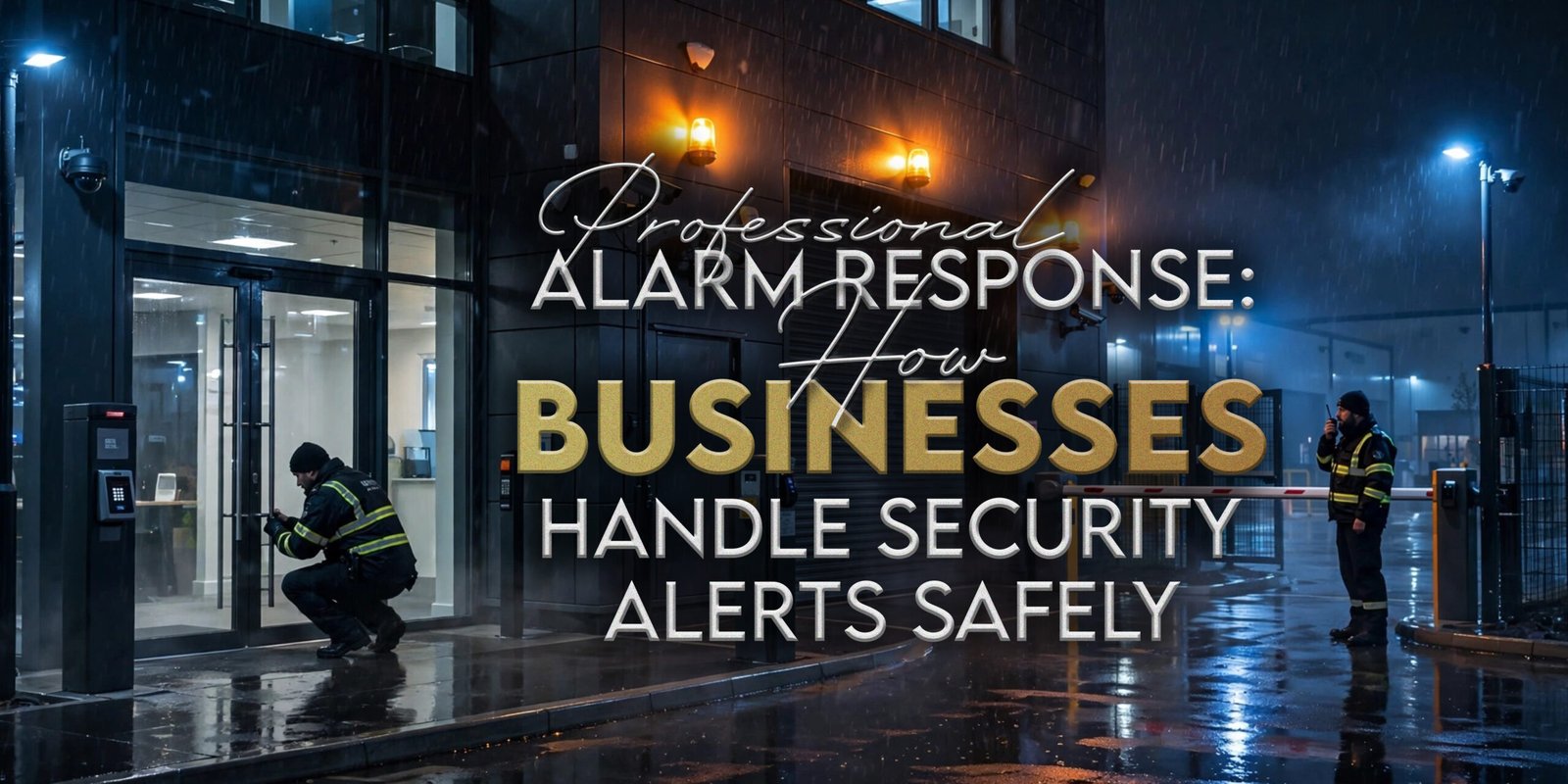
A commercial alarm can activate after normal working hours, when managers are away and employees may not be available. The cause may be authorised entry, user error, an equipment fault, an environmental trigger or an actual incident. A professional alarm response plan gives the business a defined way to verify the alert, arrange authorised attendance, use controlled key access, escalate findings and record what happened.
H&D Security provides keyholding and alarm-response arrangements from its West London base, including agreed 24/7 cover, SIA-licensed responders, site instructions, mobile patrol coordination and time-stamped reporting. Exact attendance expectations remain location-dependent and should be defined within the service agreement.
What Is Professional Alarm Response?
Professional alarm response involves an authorised, trained responder attending after an alarm activation, following pre-agreed site instructions, checking accessible areas, recording findings and escalating where required. The service may include keyholding, CCTV verification, control-room coordination, client updates and a written attendance report, depending on the agreed arrangement.
In professional alarm response, the provider may review available information, dispatch an authorised responder and use held keys where permitted. Exact procedures vary by premises, contract and operating hours, so the business should define them before the first activation.
Why Businesses Need a Defined Alarm-Response Plan
Professional alarm response planning helps people make consistent decisions. Without it, several employees may receive the same alert, keys may be unavailable and nobody may know who can attend or escalate.
HSE guidance requires employers to manage lone-working risks through suitable training, supervision, monitoring and incident-response arrangements.
A professional alarm response plan should identify contacts, key access, verification sources, responder instructions, escalation thresholds and the process for repeated false activations or faults.
How a Professional Alarm Response Process Works
A structured professional alarm response process commonly follows these stages:
- An alarm activation or alert is generated.
- The signal reaches the agreed monitoring or notification contact.
- Available CCTV, access-control or sensor information is reviewed.
- An authorised responder receives the latest site instructions.
- The responder attends under the agreed arrangement.
- Entry points and other authorised areas are checked.
- Findings are assessed without assuming criminal activity.
- The escalation matrix is followed.
- Authorised client contacts receive an update.
- A time-stamped attendance report records the outcome.
- An engineer or further attendance may be arranged where needed.
- Repeated or unresolved activations are reviewed.
Professional alarm response providers may use different workflows. However, every business should know who receives the alert, who can enter, who contacts emergency services and what evidence will be recorded.
At H&D Security, professional alarm response can include controlled keyholding, responder attendance, perimeter checks, escalation and digital reporting according to the agreed service.
What Is a Keyholding Response?
A keyholding response service allows an authorised provider to hold or control access to keys for a defined commercial site. When an activation occurs, an approved responder can use those keys according to the client’s instructions rather than waiting for an employee to travel to the premises.
The SIA states that keyholding is a front-line licensable activity when security work involves keeping, or controlling access to, a key or device used to operate a lock.
A useful keyholding response arrangement should identify authorised keys, requesters, code permissions, restricted areas, changes, lock and unlock routines, and escalation contacts.
Keyholding supports controlled access after an alert, while lock and unlock duties follow planned schedules. H&D Security lists both options where agreed.
Alarm Monitoring Versus Physical Attendance
Alarm monitoring and physical attendance perform different functions. Monitoring receives or assesses signals, while attendance places an authorised person at the site.
| Service | Main Function | Site Attendance | Information Produced | What to Confirm |
| Alarm monitoring | Receives and reviews signals or alerts | No, unless linked to response | Signal details, verification notes and escalation records | Monitored hours, signal types and escalation |
| Physical response | Sends an authorised responder | Yes | Attendance findings and actions | Coverage, attendance terms and site instructions |
| Combined arrangement | Links monitoring, verification and dispatch | Yes, when dispatch criteria are met | Alert, verification, attendance and final report | Who verifies, who dispatches and who updates the client |
A combined professional alarm response arrangement may use CCTV or sensor information before dispatch. Because remote information cannot explain every activation, the plan should state when attendance is required.
What Does an Alarm Responder Check?
An alarm responder checks the areas and information authorised in the site instructions. The scope may include main entrances, gates, loading-bay doors, accessible windows, perimeter areas, alarm panels and internal locations where entry is permitted.
Depending on the site, a professional alarm response check may review visible damage, door positions, environmental conditions, CCTV, access events, contractor schedules and possible equipment faults. The responder should not assume that an activation proves an offence.
What Happens If There Are Signs of Forced Entry?
Where there are signs of an immediate threat or forced entry, a responder should avoid unnecessary entry and follow the agreed escalation procedure. The appropriate emergency service should be contacted when current circumstances require it, and authorised client representatives should be informed.
A responsible professional alarm response procedure should preserve relevant information, record observations and follow emergency-service instructions. Nobody should enter when there are signs of immediate danger merely to confirm what happened.
Police attendance should never be presented as automatic. Current NPCC requirements distinguish compliant monitored systems and set conditions for police response, while individual circumstances and force procedures still matter.
Should Employees Attend Business Alarm Callouts?
Employees may attend some business alarm callout situations where the company has assessed the risks, provided suitable training and created a clear process. However, relying on informal availability can create uncertainty around lone working, travel, authority, keys and reporting.
HSE guidance says employers must assess and manage risks to lone workers and maintain suitable contact and response arrangements.
A professional business alarm callout arrangement may be more structured when the alert occurs overnight, site conditions are unknown, keys need controlled access or formal reporting is required. Employees may still attend where the business has assessed the situation and provided suitable support.
A formal professional alarm response process gives each business alarm callout clearer roles.
How CCTV Supports Alarm Verification
CCTV may help a monitoring team or business review the triggered area, check visible movement, identify authorised activity and determine which responder instructions apply. It may also support later reporting and preserve relevant footage.
Businesses considering professional alarm response can review CCTV camera packages for commercial premises when planning alarm verification around entrances, yards, loading bays or restricted areas.
However, CCTV cannot confirm every situation. Camera position, lighting, image quality, connectivity and user access all affect what can be seen.
Where footage contains identifiable people, organisations should consider access controls, retention and information-rights responsibilities. ICO guidance explains that people may request copies of personal data held in CCTV footage and that organisations may need to redact third-party information.
How Access Control Supports Alarm Investigation
Access-control information may show which credential was used, when a door opened, whether entry occurred outside approved hours or whether a former credential remains active.
Businesses can review commercial access control in Hounslow when linking entry records with professional alarm response procedures.
Useful information may include the credential, door, time, access denial, door-held-open alert and contractor period. Access logs need careful interpretation because a valid credential does not prove who physically entered.
Alarm Response Security for Different Business Sites
Alarm response security should reflect how the premises operates.
- Offices: account for cleaners, contractors, late-working staff and shared entrances.
- Warehouses and logistics sites: document yards, gates, loading bays, vehicles and night operations.
- Retail premises: cover shutters, rear deliveries, staff access and closing routines.
- Construction sites: update instructions as layouts, alarms and access routes change.
- Hotels and venues: separate guest, staff, delivery and event escalation contacts.
- Commercial estates: define landlord, tenant and facilities responsibilities.
A suitable professional alarm response arrangement should be specific to the site.
Commercial Alarm Support and Control-Room Coordination
Commercial alarm support may connect notification, CCTV verification, responder dispatch, mobile patrols, client updates and incident logging. Where a control room is included, the contract should state what it monitors and how it escalates.
H&D Security’s current website describes optional CCTV monitoring, 24/7 control-room support, responder dispatch, patrol coordination and digital incident reports within its keyholding and alarm-response offering.
Before appointing commercial alarm support, confirm monitored signals, operating hours, verification, dispatch criteria, contacts, emergency-service liaison, reporting and unresolved-alert procedures.
What Should a Site Response Plan Include?
A professional alarm response plan should include:
- Full site address and postcode
- Access and parking instructions
- Key and alarm-code permissions
- Alarm-panel location
- Alarm zones
- Restricted areas
- CCTV availability
- Access-control information
- Primary and backup contacts
- Alarm-engineer details
- Utility contacts where relevant
- Emergency contacts
- Escalation thresholds
- Staff and contractor schedules
- Known system faults
- Site hazards
- Lone-working considerations
- Reporting requirements
- Reopening procedure
What Affects Alarm-Response Time?
Attendance time can depend on the site location, distance to the available responder, traffic, weather, road closures, time of day, key arrangements and site access. Multiple simultaneous calls may also affect attendance.
For professional alarm response, exact expectations should be defined within the contract or service level. H&D Security states that attendance targets are location-dependent and agreed in the SLA rather than universally guaranteed.
Businesses should ask how dispatch starts, where coverage applies, how attendance is measured, how delays are communicated and what happens when access is blocked.
What Affects the Cost of Professional Alarm Response?
The cost of professional alarm response may depend on the number and location of sites, operating hours, keyholding requirements, callout frequency, patrol integration, monitoring, reporting and contract length.
When comparing professional alarm response, request a breakdown of fixed charges, callouts, additional time, monitoring, keyholding, reports, patrols, lock and unlock duties, VAT and exclusions.
Discuss an Alarm-Response Plan for Your Site
At H&D Security, we help businesses define verification, attendance, keyholding and escalation procedures before professional alarm response begins. Our current service information includes 24/7 arrangements where agreed, SIA-licensed responders, controlled keyholding, mobile patrols, CCTV support and time-stamped reporting.
Businesses can request a tailored alarm-response quotation by sharing the site, operating hours, alarm type, monitoring, CCTV, access control, contacts and reporting preferences. Availability, response expectations and pricing depend on the agreed service.
What Should an Attendance Report Include?
A useful professional alarm response report should explain what happened, what was checked and what follow-up remains.
A professional alarm response report may record activation, dispatch, arrival and departure times, areas checked, visible findings, alarm-panel details, CCTV or access information, people contacted, escalation actions, lawful photographs and unresolved issues.
How to Compare Alarm-Response Providers
For professional alarm response, compare providers through coverage, licensing, key control, verification, dispatch, escalation, reporting and pricing.
| Comparison Area | What to Review |
| Coverage | Sites, hours and location exclusions |
| Keyholding | Authorisation, changes and access records |
| Verification | CCTV, access logs and alarm information |
| Attendance | Dispatch rules and service-level wording |
| Escalation | Client and emergency-contact procedure |
| Reporting | Timings, findings, evidence and follow-up |
| Charges | Fixed, callout, additional time and add-ons |
| Review | Repeated activations and instruction updates |
Questions to Ask Before Appointing a Provider
Before appointing professional alarm response, ask:
- Which areas and hours do you cover?
- How is responder attendance initiated?
- Who may access our keys?
- How are key changes recorded?
- Can CCTV support verification?
- Can access-control information be reviewed?
- Which SIA licences are relevant?
- How are attendance expectations defined?
- What happens when forced entry is suspected?
- Who contacts emergency services?
- What appears in the attendance report?
- Which fixed and callout charges apply?
- Can lock and unlock routines be included?
- How are site instructions updated?
- How are repeated false activations reviewed?
Common Alarm-Response Mistakes
Poor professional alarm response planning often creates these mistakes:
- Relying on one employee
- Using outdated contact details
- Providing unclear site directions
- Failing to identify restricted areas
- Leaving keys without a formal record
- Sharing alarm codes too widely
- Failing to define escalation thresholds
- Ignoring repeated false activations
- Not updating instructions after building changes
- Omitting contractor schedules
- Failing to coordinate CCTV and access control
- Assuming every activation is an offence
- Assuming every activation is false
- Choosing only by callout price
- Failing to review attendance reports
- Not confirming who contacts emergency services
Professional Alarm Response Checklist
Use this checklist before appointing professional alarm response:
- Confirm the complete site address.
- Document parking and access instructions.
- Identify authorised contacts.
- Appoint backup contacts.
- Record alarm zones.
- Define restricted areas.
- Confirm keyholding arrangements.
- Review CCTV verification.
- Review access-control records.
- Set escalation thresholds.
- Provide emergency contacts.
- Provide alarm-engineer details.
- Explain known hazards.
- Define reporting requirements.
- Confirm attendance terms.
- Compare all fixed and callout charges.
- Review repeated activations.
- Update instructions regularly.
Frequently Asked Questions
What Is Professional Alarm Response?
Professional alarm response is an agreed service in which an authorised responder attends after an alarm activation, follows site instructions, checks permitted areas, communicates findings and escalates when required. It may include keyholding, CCTV verification, client updates and an attendance report.
What Happens After a Commercial Alarm Activates?
The alert reaches the agreed contact. Available information may be reviewed before a responder attends, checks authorised areas, updates contacts and records the outcome.
What Is a Keyholding Response Service?
A keyholding response service allows an authorised provider to keep or control access to site keys for security attendance. The arrangement should define key permissions, client contacts, restricted areas, code handling, changes and reporting.
Should Employees Attend Business Alarm Callouts?
Employees may attend where risks, instructions and contact arrangements have been assessed. However, a formal professional alarm response process gives each business alarm callout clearer roles.
What Does an Alarm Responder Check?
Checks depend on the premises and instructions. They may include entrances, gates, windows, perimeter areas, loading-bay doors, alarm panels, internal authorised areas, CCTV information, access logs, environmental conditions and signs of a system fault.
How Quickly Can an Alarm Responder Attend?
Attendance depends on location, responder availability, traffic, keys and access. Review the contract rather than relying on one universal time.
What Happens If Forced Entry Is Suspected?
The responder should avoid unnecessary entry, follow the agreed escalation plan, inform authorised contacts and contact the appropriate emergency service when circumstances require it. Nobody should enter where there are signs of immediate danger.
Can CCTV Help Verify an Alarm?
CCTV may show movement, authorised activity, environmental triggers or changes around the activated area. However, coverage, image quality, lighting and connectivity affect what can be confirmed.
Can Access-Control Records Support an Investigation?
Access records may show a credential, door and time connected with an event. They can support professional alarm response, but records should be interpreted carefully and handled under applicable data-protection procedures.
What Should an Alarm-Attendance Report Include?
A report may include times, areas checked, visible findings, panel or CCTV observations, contacts, actions, lawful photographs and unresolved issues.
What Affects the Cost of Commercial Alarm Support?
Commercial alarm support costs may depend on sites, hours, keyholding, callouts, monitoring, patrols, reporting and contract length. Compare fixed and callout-related charges.
What Information Should I Provide When Requesting a Quotation?
Provide the full site address, operating hours, alarm type, monitoring arrangements, keyholding needs, access instructions, restricted areas, CCTV, authorised contacts, escalation procedures, known hazards and reporting preferences.
Build the Response Around the Site
Effective professional alarm response begins with accurate instructions, controlled keyholding, authorised contacts and realistic escalation procedures. CCTV, access records and monitoring may support verification, but physical attendance still needs a defined scope.
Regular reviews help remove outdated contacts, repeated false activations and instructions that no longer match the premises.
Hounslow, Heathrow, West London and other supported businesses can request an alarm-response quote from H&D Security by sharing their keyholding, monitoring and callout requirements. A clear brief allows professional alarm response to be structured around the site rather than a generic promise.