A security system can look impressive on paper and still fail when something actually happens. Cameras may be installed, alarms may be live, and access points may appear controlled. However, if detection is weak, if alarm activations are not verified properly, or if no one attends quickly after an incident, the real level of protection can fall short.
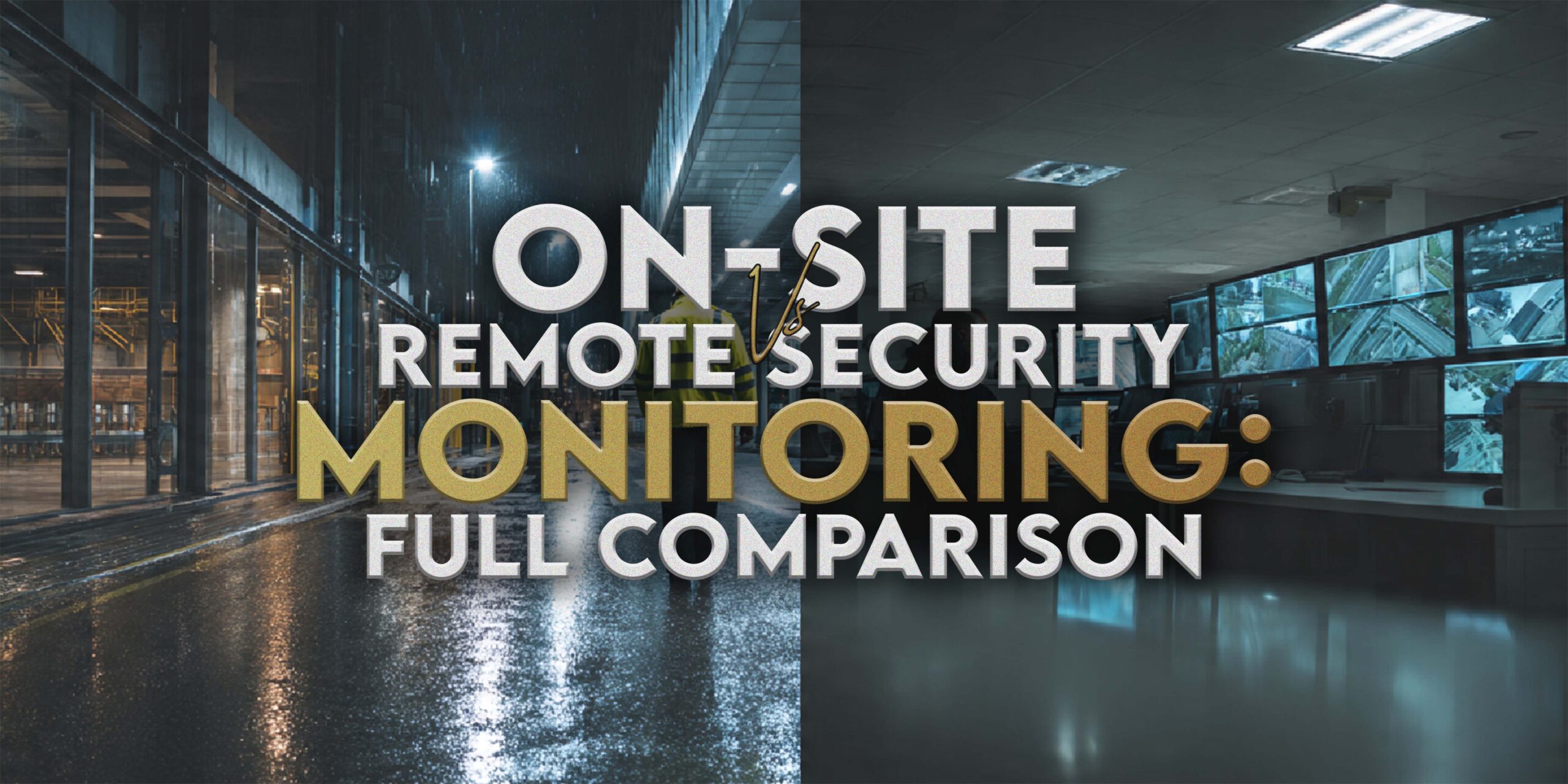
That is why on-site vs remote security monitoring is an important decision for UK businesses. The right option is not always the most visible one, and it is not always the cheapest either. Instead, the better choice depends on how the premises operate, when risks are highest, how much staff presence already exists, and what practical response looks like after detection.
For some sites, on-site monitoring offers stronger live presence and immediate intervention. For others, remote monitoring gives broader after-hours coverage, better scalability, and more cost-efficient oversight. In many cases, the best answer is not one model in isolation. It is a layered setup built around the site’s actual risk profile.
For business owners, landlords, facilities managers, and site leaders across the UK, the goal should be operational fit. Good monitoring supports business continuity, reduces avoidable disruption, and helps ensure that detection leads to meaningful action rather than just another alert.
Why Security Monitoring Choices Matter in the UK
Security monitoring choices matter because commercial risk in the UK varies widely by property type, area, and operating pattern. A city-centre office with daytime staff presence has different vulnerabilities from a warehouse on an industrial estate. Likewise, a retail unit with high footfall presents different challenges from a low-traffic yard, a vacant premises, or a multi-unit commercial building.
Out-of-hours risk is also a major factor. Many incidents happen when the site is quieter, when staff have left, or when there is no one immediately available to investigate suspicious activity. Therefore, monitoring is not simply about seeing what happens. It is about deciding how incidents are detected, who reviews them, and what follows next.
Costs matter too. Some businesses assume on-site presence is automatically better, while others assume remote monitoring is always enough. In reality, both approaches solve different problems. As a result, a useful comparison should look beyond headline price and focus on response quality, coverage, false alarm handling, and site suitability.
What On-Site Security Monitoring Means
On-site security monitoring usually means there is a physical security presence at or within the premises that can observe activity, respond to issues, and support access control or incident handling in real time. Depending on the site, that may involve a dedicated guard, reception-based security oversight, control room staff, or a wider guarding function with monitoring responsibilities.
This model can work well because presence changes behaviour. A visible officer may deter opportunistic issues, support visitor and contractor control, and intervene more quickly when suspicious behaviour appears. In addition, on-site personnel can often spot context that cameras alone may not show clearly, such as unusual staff behaviour, unsafe access patterns, or early signs of escalation.
However, on-site monitoring is not automatically the best answer everywhere. It usually comes with a higher staffing cost, and its value depends heavily on site use, shift pattern, training quality, and what the person is actually expected to do. A visible presence can be strong, but only if it is matched properly to the premises and the risk.
What Remote Security Monitoring Means
Remote security monitoring usually involves CCTV feeds, alarms, and detection systems being reviewed or managed away from the site by trained operators. That can include live observation, alarm verification, motion-trigger review, escalation handling, and coordinating a follow-up response when suspicious activity is confirmed.
This approach is particularly useful when premises are empty, quiet, low traffic, or spread across several sites. Because operators can review multiple locations, remote monitoring is often more scalable than static on-site coverage. Moreover, it can support after-hours protection without requiring a full-time officer at every location.
Remote monitoring works best when it is built around clear procedures. Detection alone is not enough. Operators need the right camera coverage, sensible alarm logic, and a practical response pathway. Otherwise, businesses may receive plenty of alerts without much real value.
Full Comparison Between On-Site and Remote Monitoring
The most useful comparison is not theoretical. It should focus on how each model performs under real commercial conditions.
Visibility
On-site security offers visible presence. That can improve deterrence and reassure staff, tenants, or visitors. By contrast, remote monitoring is less visible on the ground, although signage, CCTV coverage, and response capability can still influence behaviour.
Detection
Remote monitoring can be very effective for spotting out-of-hours movement, unauthorised access, or alarm activations, especially where good CCTV placement is in place. On-site monitoring can detect issues through physical observation as well, although the officer’s location and wider duties may affect what is noticed first.
Response
On-site teams can sometimes respond immediately because they are already present. However, their effectiveness depends on training, authority, and site layout. Remote monitoring relies on escalation, which means response needs to be planned carefully. Therefore, remote observation is strongest when paired with reliable attendance arrangements.
Cost
On-site presence is usually the higher-cost option because it depends on staffing hours and ongoing manned coverage. Remote monitoring can often be more cost-efficient, especially for quieter sites or businesses with multiple locations. Even so, lower headline cost does not always mean better value if response arrangements are weak.
Scalability
Remote monitoring usually scales better across different sites because one central monitoring model can cover several premises. On-site monitoring is harder to scale cheaply because each additional site may require more direct staffing.
False Alarms
False alarms affect cost, disruption, and confidence in the system. Remote monitoring can help reduce wasted call-outs when operators verify activity properly. This is one reason many businesses review how CCTV monitoring reduces false alarms before deciding whether remote observation is practical for their premises.
Staffing
On-site monitoring depends more directly on rota coverage, recruitment quality, and staffing continuity. Remote monitoring relies more on system quality, operator process, and escalation discipline. As a result, each model has different operational dependencies.
Reporting
Remote systems often provide structured logs, event records, and clearer review points when set up properly. On-site reporting can also be very strong, but it depends more on local discipline, handover standards, and incident-recording culture.
Site Suitability
On-site monitoring may suit high-activity locations, reception-heavy environments, sensitive premises, or sites where live access control matters throughout the day. Remote monitoring often suits warehouses, offices, empty units, low-traffic premises, and after-hours protection where full-time manned presence is not necessary.
When On-Site Security Monitoring Is the Better Option
On-site monitoring is often the better option where live human presence has operational value beyond observation alone. For example, a busy commercial premises with constant visitor movement, contractor access, delivery traffic, and customer-facing activity may benefit from someone who can assess, direct, and intervene in person.
It can also work well where the risk profile is higher and incidents are more likely to require immediate physical action, not just verification. Some retail sites, active depots, reception-led buildings, and complex industrial premises may fall into this category. In these settings, a strong on-site officer can support not only detection but also access control, escalation, welfare support, and first-line incident management.
Even so, on-site coverage should not be selected purely because it feels more substantial. The business still needs to ask whether the officer’s presence is required continuously, during key periods only, or as part of a wider layered model.
When Remote Monitoring Is the Better Option
Remote monitoring is often the better option where the site is quieter, more dispersed, or mainly at risk outside business hours. Empty offices, low-traffic units, warehouses after closing time, and commercial premises with limited overnight activity can all be strong candidates.
This model can also work well for UK landlords and multi-site operators who want local security support without funding full-time static coverage at every property. Because remote systems can oversee multiple locations, they often support better budget control while still giving businesses meaningful after-hours visibility.
However, remote monitoring is only genuinely effective when the system is well designed. Camera coverage, alarm logic, and escalation rules all matter. Without those, the business may get plenty of alerts but limited practical protection.
How Key Holding and Alarm Response Strengthen Remote Monitoring
Remote monitoring becomes much more practical when there is a clear plan for what happens after detection. That is where key holding and alarm response often make the difference.
If suspicious activity is verified remotely, someone still needs to attend, check the premises, and manage the immediate situation safely and professionally. Without that follow-up, remote monitoring may identify a problem but leave the business with a weak real-world response.
This is why many UK businesses combine monitoring with key holding and alarm response for faster practical follow-up. That kind of arrangement helps bridge the gap between remote detection and on-site attendance. As a result, businesses gain a more complete after-hours protection model without relying entirely on permanent manned coverage.
How False Alarm Reduction Affects Monitoring Performance and Cost Efficiency
False alarms are not just an inconvenience. They affect confidence in the system, waste time, create unnecessary attendances, and can distort how useful a monitoring setup really is. Therefore, businesses comparing security options should pay close attention to how false activations are handled.
Remote monitoring has a strong advantage here when operators can verify events before escalation. Instead of treating every activation as equal, trained teams can assess footage, review context, and decide whether attendance is genuinely justified. That usually improves cost efficiency and reduces disruption.
On-site teams may also filter alarms effectively, but this depends more on the person’s location, awareness, and wider duties at the time. In contrast, structured remote verification often creates a more consistent process, especially across multiple commercial premises in the UK.
Common Mistakes Businesses Make When Comparing Security Options
One common mistake is assuming that on-site security is always stronger because a person is physically present. Presence can be valuable, but it is not the same as coverage quality. A single officer cannot see everything at once, especially across large or awkwardly laid-out premises.
Another error is treating remote monitoring as a complete solution on its own. It can be highly effective, but only if response procedures are just as strong as detection. Otherwise, the business may know something happened without having a good plan for what follows.
Some organisations also focus too heavily on headline speed instead of response quality. A slightly slower but well-managed attendance can be more valuable than a faster but poorly coordinated reaction.
Finally, businesses often overlook local conditions. Commercial premises in the UK vary by area, property layout, operating hours, and local risk level. Therefore, business premises in your area may need a different model from similar-looking sites elsewhere.
How to Choose the Right Setup for Your Premises
The right monitoring setup depends on practical factors, not on a universal ranking. Start with the basics. Is the site busy or quiet? Are staff present overnight? Is the main concern trespass, theft, unauthorised access, alarm activations, or business continuity after hours?
Then review layout, access points, local risk, property type, and likely incident scenarios. A busy reception-led office may benefit from on-site oversight during operating hours and remote support after hours. A warehouse may rely more on remote CCTV monitoring paired with alarm response. A retail unit may need a more blended approach depending on trading hours and stock exposure.
For UK businesses, the better answer is often the one that fits the premises operationally while keeping costs sensible and response practical. In many cases, that leads to a layered monitoring strategy rather than a pure either-or decision.
Conclusion
Choosing between on-site vs remote security monitoring is not about picking the model that sounds more impressive. It is about selecting the one that fits the property, the hours, the risk level, and the likely incident pattern in a commercially sensible way.
On-site monitoring can offer stronger presence and immediate physical awareness. Remote monitoring can provide broader after-hours visibility, better scalability, and improved alarm verification. In many situations, the most effective setup is a layered one, especially when remote detection is supported by clear key holding and alarm response procedures.
If you want help deciding which monitoring model is right for your premises, H&D Security can help you assess your site, compare the practical options, and build a security setup that fits your risk profile and operating pattern.
People Also Ask Questions
1. Which is better, on-site or remote security monitoring?
Neither is always better in every case. On-site monitoring can offer stronger physical presence and immediate intervention, while remote monitoring often provides more scalable after-hours coverage. The right choice depends on property type, operating hours, staff presence, response arrangements, and local risk. Many businesses benefit from a layered setup rather than a strict one-or-the-other approach.
2. Is remote security monitoring effective for business premises?
Yes, remote security monitoring can be very effective for business premises, especially when the site is empty, low traffic, or mainly at risk outside working hours. However, its value depends on camera coverage, alarm verification quality, and what happens after detection. In practice, strong response procedures are essential to make remote monitoring genuinely useful.
3. Do on-site guards reduce risk more than CCTV monitoring?
Sometimes, but not automatically. On-site guards provide visible presence and can intervene directly, which may suit busy or higher-risk sites. CCTV monitoring, on the other hand, can offer broad coverage, structured review, and cost-efficient after-hours observation. The better option depends on whether the site needs constant presence, wider visibility, or stronger remote verification.
4. How do false alarms affect remote monitoring costs?
False alarms can increase unnecessary call-outs, waste management time, and reduce confidence in the system. That is why remote monitoring performs better when activations are verified properly before escalation. In many cases, better CCTV review and alarm logic reduce avoidable attendances and improve overall value for the business.
5. Why is key holding important with remote monitoring?
Key holding matters because remote detection alone does not resolve an incident. If a problem is verified, someone still needs to attend the site, check the premises, and manage the immediate response safely. Therefore, key holding and alarm response often turn remote monitoring into a much more practical and complete security solution.
6. What types of premises suit remote monitoring best?
Remote monitoring often suits warehouses, offices, empty units, low-traffic commercial sites, and multi-site properties where full-time on-site presence may not be necessary. It is especially useful where the main concern is after-hours activity. However, the site still needs proper camera coverage, detection logic, and a clear attendance plan.
7. When is on-site security monitoring worth the extra cost?
It is often worth the extra cost where the premises has high daily activity, live access issues, complex public interaction, or an operating model that benefits from immediate physical presence. Busy receptions, sensitive commercial environments, and some industrial premises may fall into this category, especially where physical intervention and local judgement matter.
8. How should businesses compare monitoring options properly?
Businesses should compare monitoring options by looking at risk profile, operating hours, staff presence, property layout, incident type, response quality, and total practical value rather than headline cost alone. A sensible comparison should also assess false alarm handling, scalability, and what follow-up happens once suspicious activity is detected.