
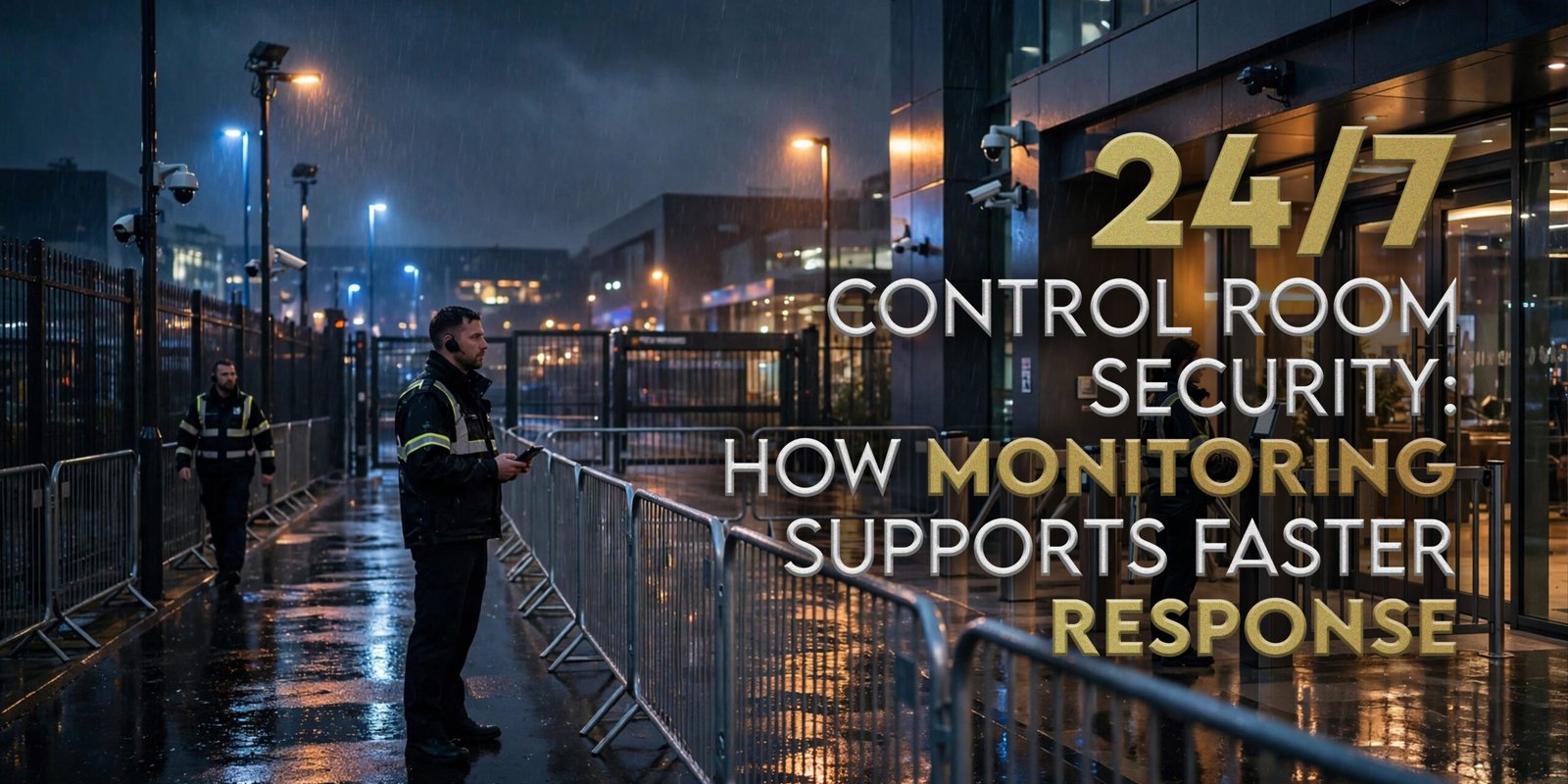
At 02:17, a warehouse system generates an alert. Who receives it, checks it, contacts the client, coordinates a responder and records the outcome?
24/7 control room security can centralise those decisions through monitoring, verification, triage, escalation, communication and reporting. It is most useful when systems, people and response procedures operate as one process.
What Is 24/7 Control Room Security?
24/7 control room security is an around-the-clock security operations function that can receive CCTV or alarm alerts, review available information, verify incidents where possible, follow site procedures, escalate events, coordinate responders and maintain incident records. The exact functions depend on the systems, site brief and service agreement.
H&D Security currently describes continuous CCTV monitoring, alarm verification, incident triage, responder coordination and time-stamped reporting.
24/7 Control Room Security Workflow
| Stage | Main Purpose | Typical Output |
|---|---|---|
| Monitor | Receive relevant alerts or live information | Alert received |
| Verify | Review available system information | Better incident context |
| Triage | Assess and prioritise | Agreed priority |
| Escalate | Follow site procedure | Contact or responder selected |
| Coordinate | Maintain communication | Response action arranged |
| Record | Log actions and outcome | Time-stamped incident record |
| Review | Identify follow-up | Client or operational review |
How Does Control Room Monitoring Support Faster Response?
Control room monitoring can support faster response coordination by centralising alert receipt, verification, triage, escalation and responder communication. This can reduce avoidable delays between detection and action because the next step follows a defined process rather than an improvised call chain.
For 24/7 control room security, the operating sequence is:
ALERT → VERIFY → TRIAGE → ESCALATE → DISPATCH → COMMUNICATE → RECORD
However, this process does not guarantee a fixed attendance time; actual response depends on the site, responder availability and service agreement.
What Does a Security Control Room Monitor?
A security control room can monitor agreed CCTV feeds, alarms, analytics alerts, access-control events and site check-ins where configured.
H&D Security currently supports CCTV, alarms, access control, analytics alerts, sensors and site check-ins, subject to system compatibility.
What Is a CCTV Control Room?
A CCTV control room lets authorised personnel review agreed camera feeds and alerts to support verification, escalation and reporting.
CCTV can add useful context before escalation, although not every alert can be visually verified.
Does a CCTV Control Room Need SIA-Licensed Operators?
The answer depends on the activity being performed. Current SIA guidance states that a Public Space Surveillance (CCTV) licence is required for specified licensable CCTV activity, including certain uses of CCTV to identify people or monitor their activities for guarding purposes. It does not mean that every person watching every private camera automatically needs the same licence.
Where personnel perform licensable public-space-surveillance activity, the appropriate SIA licence may be required. Check current SIA guidance against the actual activity.
What Is Remote Security Monitoring?
Remote security monitoring connects site systems to a remote control room so alerts can be received, reviewed and escalated off site.
SITE SYSTEM → REMOTE CONTROL ROOM → ALERT → VERIFICATION → ESCALATION
For suitable businesses, remote monitoring can support out-of-hours or multi-site operations when systems and procedures are properly configured.
Remote Monitoring vs On-Site Security
Remote monitoring and on-site personnel perform different functions.
| Factor | Remote Monitoring | On-Site Security |
|---|---|---|
| Presence | Remote | Physically at site |
| Alert handling | Centralised | Local |
| Visual oversight | Via connected systems | Direct observation plus systems |
| Access duties | Limited | Can perform agreed physical duties |
| Response coordination | Can coordinate | Can act on-site within brief |
| Reporting | Central incident records | Shift and incident records |
| Typical use | Multi-site/out-of-hours monitoring | Static posts, access and site duties |
For some operations, remote and on-site services work best together.
Can Businesses Use Both Remote Monitoring and On-Site Security?
Yes. With 24/7 control room security, a business can combine remote monitoring with on-site personnel where the two services support different parts of the same plan.
The control room can centralise alerts while on-site staff handle agreed physical duties.
What Is Alarm Verification?
Alarm verification reviews available information before the agreed escalation route, using CCTV, alarm or other connected data where available.
Verification can add context, but the SOP should also cover alerts that remain inconclusive.
Why Does Verification Matter?
Verification can improve context, prioritisation and the information shared with responders or clients.
H&D Security currently describes visual verification before responder dispatch as part of its workflow.
What Is Security Incident Triage?
Security incident triage assesses incoming information, applies agreed priorities and selects the next action:
RECEIVE → ASSESS → PRIORITISE → ACT
Triage helps avoid treating every alert as if it requires the same response.
How Should a Control Room Prioritise Alerts?
For 24/7 control room security, a control room should use the agreed site procedure, available verified information, client instructions, event type and escalation level. The article should not prescribe tactical thresholds because businesses and sites differ.
Most importantly, operators need a documented process with appropriate escalation routes.
What Is a Control-Room Escalation Matrix?
A control-room escalation matrix defines who to contact and what broad action follows different alert types.
| Trigger / Situation | Initial Action | Escalation Contact | Reporting Requirement |
|---|---|---|---|
| System alert | Review available information | Agreed client contact | Time and action logged |
| Verified site issue | Follow site SOP | Approved responder | Full incident record |
| Contact unavailable | Follow fallback route | Secondary authorised contact | Attempt recorded |
| Serious emergency | Follow agreed emergency procedure | Appropriate emergency route | Actions time-stamped |
The matrix provides structure without publishing sensitive operational detail.
Why Site-Specific SOPs Matter
Site-specific SOPs should define contacts, operating hours, response arrangements, escalation and reporting.
A warehouse, retail site and corporate office should not automatically use identical instructions.
What Does Security Response Support Mean?
Security response support coordinates agreed contacts or responders after an alert is assessed.
The control room does not replace emergency services or on-site responders; it coordinates agreed communication and escalation.
Control Room vs Responder: Who Does What?
| Control Room | Responder |
|---|---|
| Receives alerts | Attends site where dispatched |
| Reviews available information | Assesses site conditions |
| Applies agreed escalation | Follows assigned site duties |
| Coordinates dispatch | Carries out agreed on-site actions |
| Maintains communication | Provides updates |
| Records timeline | Supplies outcome information |
This division connects central decision-making with physical attendance.
How Control Room Monitoring and Alarm Response Work Together
The relationship can follow:
ALERT → CONTROL ROOM → VERIFY → FOLLOW SOP → ESCALATE → RESPONDER → SITE ATTENDANCE → REPORT
Where a site needs physical attendance after an agreed escalation, professional alarm response can complement the control-room function.
H&D Security currently describes SIA-licensed responders, location-based dispatch, escalation paths and digital reporting; attendance expectations depend on the agreed service.
Where responder attendance is required, both services should be scoped together.
What Should Control-Room Reporting Include?
Control-room reporting should show what was received, what action followed and the recorded outcome.
Useful fields include date and time, site, alert source, event category, verification and escalation actions, responder or contact, status, outcome and follow-up.
H&D Security currently describes time-stamped logs, clips, client updates and post-incident reporting within its control-room service.
Why Time-Stamped Incident Logs Matter?
For 24/7 control room security, time-stamped logs create a clear incident sequence for handover, client communication and review.
Consistent logs can also highlight recurring alert patterns for review.
Can 24/7 Control Room Security Support Multiple Sites?
Yes. 24/7 control room security can support multiple locations when systems, contacts and site-specific escalation procedures are properly configured.
H&D Security currently describes multi-site protocols and escalation matrices for retail, logistics, industrial and corporate estates. It does not publish a universal maximum site capacity.
Why Multi-Site Businesses Need Site-Specific Protocols
Different sites can have different hours, contacts, alarms and response arrangements, so one generic matrix may not fit all.
Therefore, central monitoring should not erase site-level differences.
24/7 Control Room Security for Warehouses and Logistics
24/7 control room security can support warehouses and logistics sites through agreed CCTV oversight, alerts, yard or loading-area monitoring where configured, out-of-hours coordination and incident reporting.
H&D Security currently identifies logistics and warehousing as control-room sectors and references perimeter alerts, bay or yard monitoring and responder dispatch.
24/7 Control Room Security for Construction Sites
For construction sites, 24/7 control room security can support out-of-hours alerts, connected systems, responder coordination and reporting. SOPs should be updated as operations change.
24/7 Control Room Security for Retail and Commercial Estates
For retail and commercial estates, 24/7 control room security can centralise agreed monitoring, escalation and reporting while retaining site-specific contacts.
24/7 Control Room Security for Offices and Corporate Premises
Corporate premises can use 24/7 control room security for out-of-hours alerts, CCTV oversight, alarm verification, escalation and reporting.
24/7 Control Room Security for Hospitality and Venues
Hospitality and venues can use 24/7 control room security for event-time oversight, communication, coordination and reporting without replacing on-site responsibilities.
When Might an Ongoing Control-Room Security Contract Make Sense?
An ongoing arrangement may suit 24-hour operations, recurring monitoring, multi-site estates, out-of-hours requirements or structured reporting.
Businesses with recurring 24/7 control room security can review ongoing security contracts where a longer-term agreement fits the operational requirement.
For multiple sites or recurring services, a structured security agreement can also define responsibilities, reporting and agreed service levels. A contract is not automatically necessary for every business.
What Should Businesses Ask About Response SLAs?
For 24/7 control room security, businesses should ask who receives alerts, how verification works, who is contacted, what responder arrangements apply, what targets are agreed and how exceptions work.
Exact times should sit in the service agreement. Response expectations can depend on location, responder availability, site instructions and wider circumstances.
What Systems Can Feed Into a Control Room?
Depending on compatibility, a control room can receive information from CCTV, VMS, alarms, access-control systems, analytics and sensors.
H&D Security states that its current control-room service integrates with CCTV, access control, alarms and IoT sensors. Its page also says it can work with most existing CCTV, VMS, alarm and access-control systems. Compatibility should still be confirmed for each proposed system before deployment.
Can H&D Security Integrate With Existing Systems?
H&D Security states that its service can work with many existing CCTV, VMS, alarm and access-control systems. Businesses should provide system details so compatibility can be checked.
Need Centralised Monitoring for Your Sites?
For businesses reviewing 24/7 control room security, the first step is defining the monitoring and response requirement.
Businesses reviewing 24/7 control room security should prepare the number of sites, locations, operating hours, CCTV systems, alarms, relevant access-control systems, responder arrangements, key-holder contacts, escalation requirements and reporting expectations.
You can discuss your control-room monitoring requirements with H&D Security using that information.
Common Control-Room Monitoring Mistakes
| Mistake | Better Approach |
|---|---|
| Monitoring without escalation | Create a written process |
| Outdated contacts | Test and update contacts |
| No site SOP | Define site-specific instructions |
| Treating every alert alike | Use agreed triage |
| No verification process | Define verification where possible |
| No responder arrangement | Confirm escalation destinations |
| No handover | Define shift handover |
| Inconsistent incident logs | Agree core fields |
| No client-update process | Define communication |
| Untested alert routing | Test integrations |
| Assuming identical SIA rules | Check the activity |
| Using outdated licensing guidance | Use current SIA information |
| Confusing monitoring with attendance | Define roles |
| No SLA discussion | Agree expectations |
| Assuming instant response | Use qualified targets |
| Same protocol for every site | Use site-specific SOPs |
| Not updating procedures | Review operational changes |
| No performance review | Review the service periodically |
24/7 Control Room Security Checklist
Use this 24/7 control room security checklist:
- Confirm each site.
- Confirm operating hours.
- Identify connected systems.
- Identify CCTV feeds.
- Identify alarm types.
- Identify access-control alerts where relevant.
- Define monitored events.
- Define verification methods.
- Define escalation levels.
- Confirm client contacts.
- Confirm responder contacts.
- Confirm key-holder contacts where relevant.
- Define emergency escalation.
- Write the site SOP.
- Define alert priorities.
- Define out-of-hours procedures.
- Confirm control-room hours.
- Confirm operator requirements.
- Check relevant SIA licensing requirements.
- Define reporting format.
- Define incident-log fields.
- Define client updates.
- Define handover.
- Define responder dispatch.
- Review response SLA.
- Confirm geographic coverage.
- Confirm system compatibility.
- Test alert routing.
- Test contact details.
- Define false-alert handling.
- Review applicable data-handling requirements.
- Review the escalation matrix.
- Review performance.
- Update SOPs when operations change.
Businesses handling footage, logs or personal data should follow applicable UK data-protection requirements and their own policies.
How H&D Security Supports 24/7 Control Room Operations
At H&D Security, our control-room support helps businesses centralise CCTV oversight, alarm verification, incident triage, escalation and responder coordination. Current first-party information also describes direct communication with on-site teams, key holders and mobile responders, plus digital time-stamped incident reporting.
For 24/7 control room security, each site can use agreed SOPs and escalation routes instead of treating every alert identically. Businesses with recurring monitoring can also explore commercial security contracts where a structured ongoing arrangement is suitable.
24/7 Control Room Security for Businesses in Hounslow and London
H&D Security is based in West London and currently lists Hounslow, Heathrow and surrounding West London locations within its control-room coverage, alongside London and wider UK regions.
For businesses in these areas, 24/7 control room security should still be scoped around the individual site, connected systems, escalation contacts and responder arrangements rather than a generic package.
Frequently Asked Questions
What is 24/7 control room security?
24/7 control room security is an around-the-clock operational function that can receive CCTV or alarm alerts, review available information, verify incidents where possible, follow agreed site procedures, escalate alerts, coordinate responders and maintain incident records. The precise service depends on the site, systems, monitoring scope and service agreement, so businesses should confirm what will actually be monitored.
How does control room monitoring support faster response?
Control room monitoring can support faster response coordination by bringing alert receipt, verification, triage, escalation and responder communication into one structured process. Within 24/7 control room security, this may reduce avoidable delays between detection and the agreed next step. However, it does not guarantee a fixed responder attendance time, which depends on the service agreement and circumstances.
What does a security control room monitor?
A security control room may monitor agreed CCTV feeds, alarms, analytics alerts, access-control events, site check-ins and selected system-health information where configured. With 24/7 control room security, the monitored inputs should be documented in the service scope so operators know which alerts require review, which contacts apply and what escalation route to follow.
What is a CCTV control room?
A CCTV control room is an operational environment where authorised personnel review agreed camera feeds or video alerts and support verification, escalation and reporting. Within 24/7 control room security, video may provide useful context during an incident. However, CCTV does not always confirm exactly what has happened, so the escalation plan should also cover uncertain or incomplete information.
Does a CCTV control-room operator need an SIA licence?
It depends on the activity. Current GOV.UK guidance defines circumstances in which Public Space Surveillance CCTV activity requires the relevant SIA licence. Not every person viewing every private camera automatically falls into the same licensing position. Businesses using 24/7 control room security should therefore assess the actual monitoring activity against current SIA guidance.
What is remote security monitoring?
Remote security monitoring connects agreed site systems to an off-site monitoring function that can receive alerts, review available information and follow escalation procedures. For 24/7 control room security, this can support out-of-hours operations or central monitoring across several premises. The systems, contacts, responder arrangements and site-specific instructions still need to be configured appropriately.
How does alarm verification work?
Alarm verification means reviewing available system information before the next agreed action. Where connected data allows it, operators may review CCTV, alarm-zone information, analytics or other relevant signals. Within 24/7 control room security, the aim is to improve context and select the correct escalation path, not to claim that every alarm can always be confirmed remotely.
What happens when a control room receives an alert?
A typical high-level process is to receive the alert, review relevant information, verify where possible, follow the site SOP, escalate through the agreed route, coordinate an appropriate responder and record the actions and outcome. In 24/7 control room security, exact procedures vary by site and agreement, so businesses should define those steps before monitoring begins.
What is security incident triage?
Security incident triage means assessing incoming alerts and applying agreed priorities before deciding what action follows. It can consider the available information, site instructions, client contacts and the type of event. For 24/7 control room security, triage helps avoid treating every alert identically and gives operators a clearer route from detection to escalation.
Can a control room monitor multiple sites?
Yes. 24/7 control room security can support multiple sites when the relevant systems, authorised contacts, SOPs and escalation procedures have been configured for each location. Central monitoring can create consistent reporting while preserving site-specific instructions. Businesses should not assume that one escalation matrix will suit every warehouse, office, retail unit or construction location.
How does professional alarm response work with a control room?
The control room receives and assesses the alert, then follows the agreed escalation route. Where responder attendance is required, a professional alarm-response service can be contacted according to the service plan. The responder attends the site and reports back. This complements 24/7 control room security, but attendance times depend on the agreed service and circumstances.
What should an escalation matrix include?
An escalation matrix should identify alert categories at a high level, initial actions, authorised contacts, fallback contacts, responder arrangements, emergency escalation and reporting requirements. For 24/7 control room security, the matrix should remain site-specific and should be reviewed whenever contacts, operating hours or site arrangements change. Sensitive internal response details should remain within operational documentation.
What reporting should a control room provide?
Reporting can include the date, time, site, alert source, event category, verification activity, escalation, responder or contact, status, outcome and follow-up. The exact format varies by provider and client. 24/7 control room security works best when reporting expectations are defined before service begins so both sides understand what information will be recorded and shared.
When does an ongoing security contract make sense?
An ongoing contract may suit businesses with recurring monitoring, 24-hour operations, multi-site estates, regular out-of-hours activity, repeated responder coordination or structured reporting requirements. For 24/7 control room security, a contract can formalise responsibilities, site procedures and service levels. However, organisations should choose the structure that fits their actual requirement rather than assume every site needs a long-term agreement.
How can H&D Security support 24/7 control-room requirements?
H&D Security currently offers continuous CCTV monitoring, alarm verification, incident triage, responder dispatch, client communication, site-specific SOPs, multi-site protocols and time-stamped reporting. For 24/7 control room security, businesses can discuss system compatibility, monitored sites, escalation arrangements, responder coordination and reporting before agreeing the service scope.
Conclusion
24/7 control room security creates the most operational value when monitoring, verification, triage, escalation, response coordination and reporting operate as one connected process.
MONITOR → ALERT → VERIFY → TRIAGE → ESCALATE → COORDINATE → RESPOND → REPORT → REVIEW
Ultimately, 24/7 control room security is not simply about watching systems. It is about combining technology, people, site procedures, responders, communication and reporting so alerts move through a clearer operational process.
Discuss Your Control Room Requirements With H&D Security
H&D Security can discuss CCTV monitoring, alarms, site-specific procedures, escalation, responder coordination, professional alarm response, multi-site monitoring, reporting and ongoing commercial arrangements.
For an assignment-specific discussion, request a 24/7 control-room security quote.