
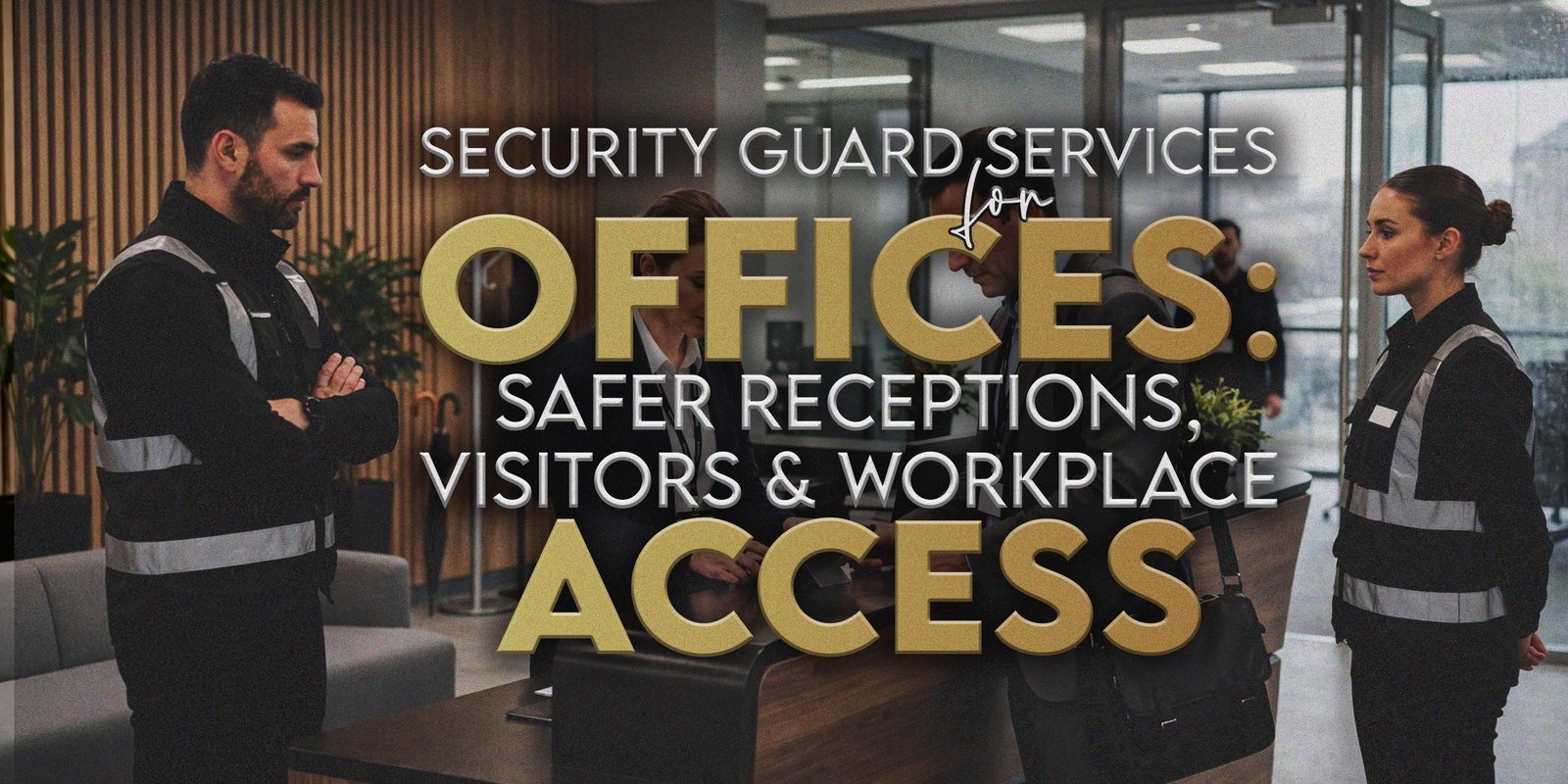
Modern offices can involve a constant flow of employees, visitors, contractors, delivery drivers and service providers. As a result, managing reception areas, entrances and workplace access can become an important operational responsibility.
Security guard services can support these activities by providing trained personnel who follow agreed site procedures. Depending on the building and requirements, their duties may include reception support, visitor management, access monitoring, patrols, contractor coordination and incident reporting.
However, every office operates differently. A corporate headquarters may have several entrances and a busy reception, while a smaller office may need support mainly during specific operating hours. Therefore, businesses should define their requirements before deciding what type of guarding arrangement they need.
What Do Security Guard Services Do in an Office?
Security guard services can support offices with reception duties, visitor management, access procedures, patrols, incident reporting and agreed workplace procedures. Exact responsibilities depend on the building, operating hours, access arrangements, visitor activity, client instructions and agreed duties.
In practice, guards can become part of an office’s established access and visitor procedures. They may greet visitors, check relevant information, direct people to the appropriate area, monitor designated entrances and report unusual situations according to agreed instructions.
Their role can also extend beyond reception. For example, an office may require patrols of selected areas, support with contractor arrivals or assistance with opening and closing procedures.
The key point is that security guard services should reflect the actual requirements of the premises rather than follow a generic list of duties.
Why Offices Use Security Guard Services
Businesses may consider security guard services when their buildings have complex access arrangements, regular visitor traffic or operational requirements that benefit from dedicated personnel.
Common considerations include:
- High visitor volumes
- Multiple entrances
- Contractor activity
- Frequent deliveries
- Shared commercial buildings
- Extended opening hours
- Out-of-hours access
- Reception requirements
- Large office buildings
- Multiple tenant areas
- Car park access
- Restricted workplace areas
For example, a business centre may have several organisations operating within one building. In that environment, reception procedures may need to distinguish between employees, visitors, contractors and delivery personnel.
Similarly, an office with extended operating hours may need different arrangements during daytime and evening periods.
Therefore, security guard services should be planned around how the workplace actually operates. The business should identify where access decisions, visitor procedures and physical presence are most relevant before determining staffing requirements.
Office Security Guards at Reception
Office security guards can support reception areas where businesses have defined visitor and access procedures.
Depending on the agreed duties, personnel may assist with:
- Visitor sign-in procedures
- Visitor verification
- Directing visitors
- Notifying employees of arrivals
- Contractor arrivals
- Delivery coordination
- Reception coverage
- Access instructions
- Incident reporting
- Escalation procedures
Reception can be the first point of contact between an organisation and people entering its premises. Consequently, clear procedures can help employees and visitors understand where they need to go and whom they need to contact.
However, guards should work according to the authority and instructions established by the client. They should not automatically make access decisions outside their agreed responsibilities.
For instance, an office may have a visitor policy requiring guests to be expected by an employee. The guard can follow that process, contact the relevant employee and record the visit where required.
This makes security guard services an operational extension of the office’s existing procedures rather than a replacement for workplace management.
Reception Security and Visitor Management
Reception security involves more than simply sitting at a desk. Depending on the assignment, personnel can support a structured process for receiving and directing visitors.
A typical process might involve:
- Greeting the visitor.
- Establishing who they are visiting.
- Checking the relevant visitor procedure.
- Contacting the host employee where required.
- Providing appropriate directions.
- Following visitor sign-in requirements.
- Recording relevant information where the procedure requires it.
- Escalating unusual situations according to site instructions.
The precise process should reflect the organisation’s own policies.
For example, an office may require contractors to present identification before entering a restricted area. Another workplace may have a pre-booked visitor system. Consequently, security guard services should be configured around the actual procedure rather than assumptions about how every reception operates.
Good communication between reception personnel, employees and management also matters. If procedures change, the security team should receive updated instructions through the agreed communication process.
Workplace Security and Employee Access
Workplace security can include support for employee access procedures, particularly where an office has several entrances or restricted areas.
Relevant considerations may include:
- Staff entrances
- Access cards
- Visitor entrances
- Contractor access
- Restricted rooms
- Delivery entrances
- Opening procedures
- Closing procedures
- Out-of-hours access
Security personnel can help monitor agreed access points and follow established instructions. However, the organisation remains responsible for defining its workplace policies.
For example, an office may have an employee entrance controlled by an access-card system while the main reception remains staffed during business hours. The guard’s role could involve observing the relevant access point, dealing with visitors and reporting issues according to the agreed procedure.
As a result, security guard services can complement technology and workplace policies rather than replace them.
Access Support Guards for Contractors and Deliveries
Access support guards can assist when contractors, engineers and delivery drivers arrive at commercial premises.
Office buildings can receive a wide range of visitors, including:
- Maintenance contractors
- IT engineers
- Cleaning teams
- Delivery drivers
- Building management contractors
- Service engineers
- Scheduled visitors
- Furniture suppliers
Clear instructions are particularly important when contractors need access to restricted areas or service entrances.
A useful process might identify who the contractor is visiting, whether the appointment is expected, where the person should report and which areas they can access.
Likewise, deliveries may require directions to a particular entrance or loading area. The security team can follow the client’s established procedure and communicate relevant information to office management.
Therefore, security guard services can help organise the physical movement of people and deliveries through a workplace, provided the business defines the relevant responsibilities clearly.
Office Security Guard Duties: What Can Be Included?
The exact duties of security guard services vary by site. The following table illustrates common areas that businesses may discuss when planning an office assignment.
| Duty | How It Can Support an Office |
|---|---|
| Reception coverage | Supports visitor and access procedures |
| Visitor management | Helps follow agreed visitor processes |
| Access monitoring | Supports established entry procedures |
| Contractor access | Helps manage scheduled contractor arrivals |
| Delivery management | Supports delivery access arrangements |
| Patrols | Allows agreed areas to receive physical checks |
| Incident reporting | Records and communicates relevant incidents |
| Opening and closing checks | Supports agreed start and end-of-day procedures |
| Out-of-hours coverage | Provides personnel outside standard office hours |
| Client communication | Keeps management informed according to agreed procedures |
Not every assignment will require all of these duties. Instead, businesses should identify the tasks that genuinely support their workplace.
For example, a small office may need reception and visitor support, while a larger multi-tenant building may require several access points, patrols and out-of-hours arrangements.
Daytime vs Out-of-Hours Office Security
The requirements for security guard services can change throughout the day.
During normal office hours, the focus may include:
- Reception activity
- Employee access
- Visitors
- Contractors
- Deliveries
- Meeting guests
- Access to shared facilities
Outside normal hours, the requirements may look different. A business might need support with closing procedures, authorised late access, patrols, restricted areas or unusual activity reporting.
Therefore, businesses should consider their operating pattern before defining staffing requirements.
For example, an office may have significant visitor activity between 8am and 6pm but only a small number of authorised employees working later. That difference can affect the duties, hours and staffing arrangement required.
The same principle applies to weekends and public holidays. A building’s access requirements can change considerably when normal office activity stops.
Security Guard Services for Offices With Multiple Access Points
A larger office can have several access points, each serving a different purpose.
These may include:
- Main reception
- Staff entrance
- Service entrance
- Delivery entrance
- Car park entrance
- Pedestrian entrance
- Restricted-access areas
Before arranging security guard services, businesses should map these access points and identify how each one operates.
For instance, the main entrance may remain open throughout business hours while a service entrance only opens for scheduled deliveries. A car park may also have separate access arrangements.
Mapping the building helps management understand where personnel may be needed and which areas require procedures rather than continuous physical presence.
This approach also makes it easier to explain the site’s requirements to a security provider before discussing staffing arrangements.
Office Security and External Areas
Office security does not stop at the reception desk. Depending on the property, external areas can include car parks, gates, pedestrian entrances, loading areas and other parts of the workplace.
Businesses should therefore consider:
- Car park access
- Vehicle entrances
- Pedestrian gates
- Loading areas
- External storage
- Building entrances
- Perimeter areas
- Service access points
CCTV can support visual monitoring of selected external areas, while physical personnel can perform agreed site duties.
Businesses reviewing their external coverage can explore security cameras for external areas as part of a broader workplace review.
However, CCTV and physical guarding perform different functions. A camera provides visual information from its position, while personnel can physically observe an area and follow agreed site procedures.
Consequently, security guard services can form part of a wider workplace arrangement that includes access technology, CCTV and established management procedures.
Office Security Compared With Construction Site Security
Different commercial environments can require different guarding arrangements.
For example, an office may focus heavily on reception, visitors and employee access, whereas a construction site may have different access points, contractors, equipment and site-specific procedures.
| Office Environment | Construction Environment |
|---|---|
| Reception and visitor management | Site access and contractor movement |
| Employee access | Site worker access |
| Office deliveries | Materials and machinery |
| Meeting visitors | Contractors and suppliers |
| Workplace access procedures | Site access procedures |
| Office car parks | Construction site vehicle areas |
Businesses can review security guard services for construction sites to understand how site-specific requirements can differ.
The comparison highlights an important point. Security guard services should reflect the environment, access arrangements and operational activity of the premises.
How to Choose Security Guard Services for an Office
Before selecting security guard services, businesses should define the actual requirements of the building.
Consider:
- Site location
Confirm the premises and relevant access arrangements. - Building size
Larger buildings may have more access points and areas requiring attention. - Access points
Identify main entrances, staff entrances, service entrances and other relevant locations. - Operating hours
Establish when the building has normal, extended and reduced activity. - Visitor volumes
Consider how many visitors the reception team handles. - Contractor activity
Identify how frequently contractors or engineers attend. - Delivery frequency
Establish whether deliveries require specific access procedures. - Car park requirements
Consider vehicle entrances, pedestrian routes and visitor parking. - Reception requirements
Define the duties expected at the front desk. - Out-of-hours requirements
Establish whether late access or closing procedures require support. - Patrol requirements
Identify areas that may require agreed physical checks. - Reporting requirements
Define how incidents and unusual observations should be communicated. - SIA requirements
Establish which licensed role is appropriate for the duties being considered. - Communication procedures
Identify who receives operational updates. - Escalation procedures
Define what personnel should do when an issue requires management attention.
This information gives both the business and the security provider a clearer understanding of the assignment.
Planning Office Security With H&D Security
Businesses considering security guard services can begin by documenting the practical requirements of their workplace.
Useful information includes:
- Office layout
- Number of access points
- Reception requirements
- Visitor volumes
- Operating hours
- Contractor activity
- Delivery arrangements
- Patrol requirements
- Out-of-hours activity
- Reporting expectations
- Communication arrangements
For example, a shared office building may have several tenants, regular visitors and separate service entrances. A single-occupier office may have a much simpler arrangement.
H&D Security can discuss the requirements of commercial workplaces and the duties businesses may need personnel to perform. Employers can discuss your office security requirements when they are ready to outline their site requirements.
The more clearly a business defines the workplace, access points and expected duties, the easier it becomes to discuss an appropriate guarding arrangement.
Common Office Security Planning Mistakes
Businesses can overlook important details when planning security guard services. Common mistakes include:
1. Focusing Only on the Reception Desk
Reception may be the most visible part of an office, but other entrances and operational areas can also require procedures.
2. Ignoring Secondary Entrances
Staff, service and delivery entrances can operate differently from the main reception.
3. Forgetting Contractor Access
Contractors may require different access arrangements from ordinary visitors.
4. Overlooking Delivery Areas
Delivery drivers may need specific instructions about where to report and where vehicles can enter.
5. Failing to Consider Office Car Parks
Vehicle access and pedestrian movement can form part of the wider workplace arrangement.
6. Not Defining Visitor Procedures
Guards need clear instructions about the process visitors should follow.
7. Ignoring Out-of-Hours Requirements
A building can operate differently after normal working hours. Businesses should explain authorised late access and closing procedures.
8. Failing to Define Reporting Procedures
Management should establish how relevant incidents and observations are communicated.
9. Not Reviewing Access Points After Office Changes
Office moves, extensions and layout changes can create new access requirements.
10. Choosing Staffing Arrangements Without Assessing the Site
A generic staffing model may not reflect the actual building. Businesses should assess their access points, operating pattern and operational activity first.
Security Guard Services for Offices: Planning Checklist
Use this checklist when preparing an office security requirement:
☐ Identify all access points
☐ Review reception requirements
☐ Review visitor volumes
☐ Identify contractor access procedures
☐ Review delivery arrangements
☐ Review staff entrances
☐ Review car park access
☐ Define out-of-hours requirements
☐ Identify patrol areas
☐ Define reporting procedures
☐ Establish communication channels
☐ Review escalation procedures
☐ Confirm required SIA roles
☐ Review the building layout
☐ Review future changes to the workplace
This information can help office management explain its requirements clearly before discussing security guard services.
It can also highlight areas where existing workplace procedures need clarification. For example, management may know that contractors use a side entrance but have not documented who should authorise access or receive arrival notifications.
When Should an Office Review Its Security Arrangements?
Businesses should review their office arrangements when the building, operating pattern or access requirements change. Common triggers include office moves, building extensions, additional entrances, increased visitor activity, new tenants or changes to reception procedures.
A review can also make sense when:
- Operating hours change
- Visitor volumes increase
- Contractor activity changes
- New car parks are added
- New entrances are created
- Reception arrangements change
- Workplace procedures change
- Multiple businesses begin sharing a building
- Out-of-hours activity increases
There is no universal review schedule for every office.
Instead, management should consider whether the current arrangement still reflects how the workplace operates. This is particularly relevant when the building has changed significantly since the original security guard services arrangement was established.
Security Guard Services for Offices: What Businesses Should Plan
Effective office guarding starts with clear requirements.
A business should understand:
Building → access points → visitors → employees → contractors → deliveries → operating hours → required duties → reporting procedures
This relationship helps management identify where personnel can contribute to day-to-day workplace procedures.
For example, reception requirements may involve visitors and contractors, while external areas may involve car parks and delivery entrances. Meanwhile, out-of-hours requirements may involve closing procedures, authorised access and patrols.
As a result, security guard services should be planned around actual workplace activity rather than simply selecting a standard list of duties.
Businesses should also review the arrangement when their workplace changes. New tenants, altered reception areas, additional entrances and different operating hours can all affect the original requirements.
What do security guard services do in an office?
Security guard services can support office reception, visitor management, access procedures, contractor arrivals, deliveries, patrols and incident reporting. The exact duties depend on the building, operating hours, client instructions and agreed responsibilities. Businesses should define their requirements clearly so personnel can follow the appropriate workplace procedures.
What does an office security guard do?
An office security guard may support reception, visitor procedures, access monitoring, contractor arrivals, deliveries, patrols and reporting. However, duties vary between premises. A guard should follow the responsibilities, access arrangements and escalation procedures agreed with the client rather than assume the same role applies to every office.
What does reception security involve?
Reception security can involve greeting visitors, checking relevant visitor information, notifying employees, directing guests and following agreed sign-in procedures. Personnel may also support contractor and delivery arrangements. The exact process depends on the organisation’s visitor policy and the duties assigned to the security team.
Can security guards manage office visitors?
Security guards can support visitor management where this forms part of their agreed duties. They may greet visitors, check relevant details, contact employees and follow sign-in procedures. However, access decisions should follow the organisation’s established policies and the guard’s agreed responsibilities.
Can office security guards support contractor access?
Yes, where contractor access forms part of the agreed assignment. Personnel may help verify scheduled arrivals, provide directions, communicate with the relevant employee and follow site access procedures. Businesses should define which areas contractors can access and who has authority to approve or manage access.
Do offices need security guards outside normal working hours?
Some offices may require out-of-hours guarding, while others may not. The decision depends on factors such as operating hours, building access, late-working arrangements, site layout and client requirements. Businesses should assess what happens when normal reception and management staff are no longer present.
How should businesses choose security guard services?
Businesses should start by assessing the building, access points, operating hours, visitor volumes, contractor activity, delivery arrangements, reporting requirements and required SIA roles. They should then discuss these requirements with potential providers and clarify duties, communication arrangements and escalation procedures before agreeing an assignment.
Can office security include CCTV and physical guarding?
Yes. CCTV and physical guarding can serve different operational functions. CCTV can provide visual information from selected areas, while personnel can support reception, access procedures, patrols and physical site duties. Businesses should consider how these functions fit together rather than treating one as an automatic replacement for the other.
Discuss Your Office Security Requirements
Every office has different access arrangements, visitor activity and operating patterns. Therefore, businesses should define their requirements before deciding which guarding duties they need.
When discussing security guard services, employers can outline:
- Office layout
- Main and secondary entrances
- Reception requirements
- Visitor volumes
- Contractor activity
- Delivery arrangements
- Staff access
- Car park requirements
- Operating hours
- Out-of-hours requirements
- Patrol areas
- Reporting procedures
- Communication arrangements
H&D Security can discuss the requirements of commercial workplaces and the duties businesses are considering.
If you are reviewing your office arrangements, you can request a security quotation based on your site requirements.
A clear discussion can help establish the relevant access procedures, reception responsibilities, patrol requirements and reporting arrangements for the workplace.