
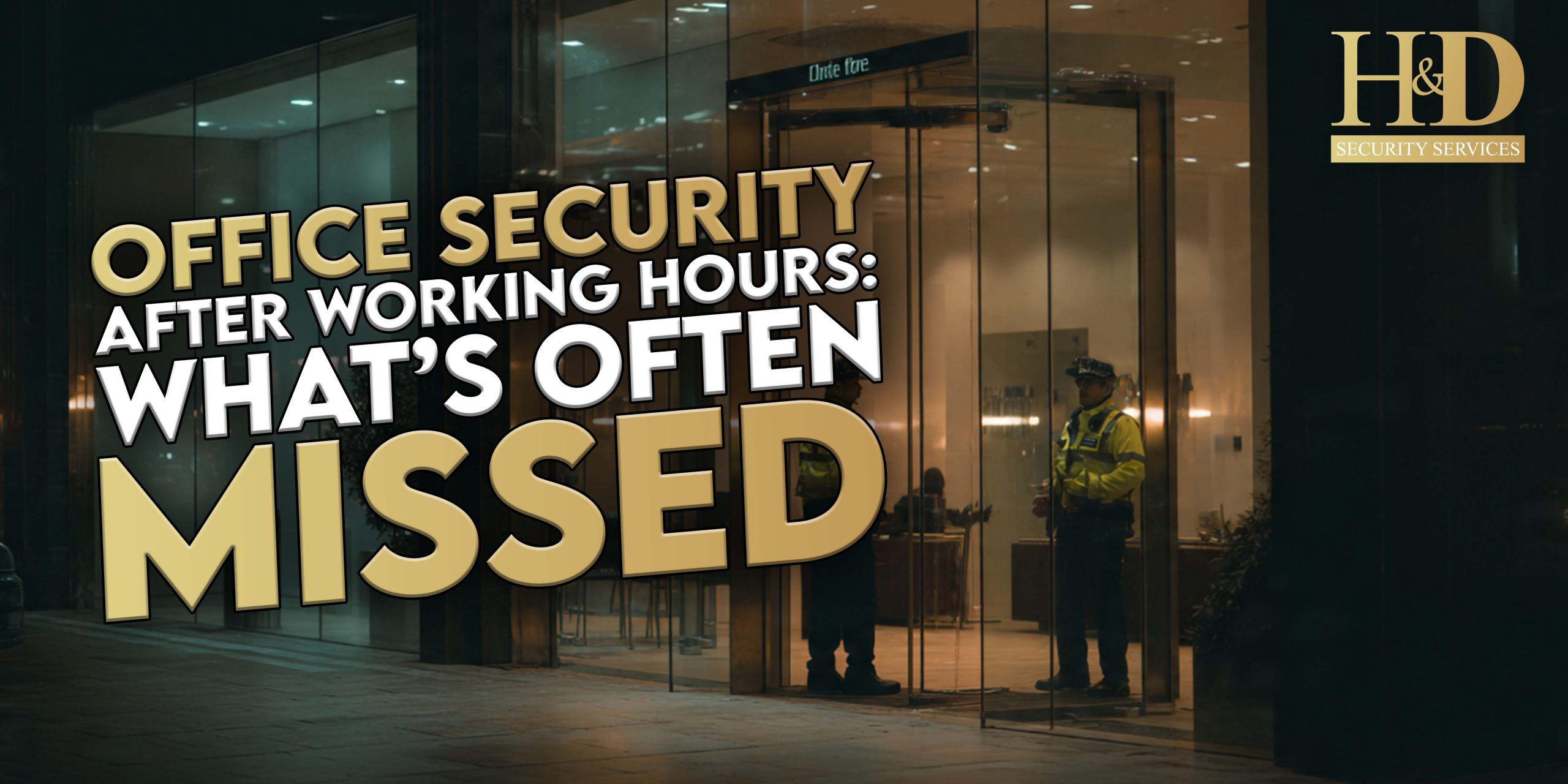
Office buildings appear calm after employees leave, but nighttime introduces a completely different risk environment. Reduced supervision, limited foot traffic, predictable schedules, and unattended assets create ideal conditions for theft, data breaches, vandalism, and internal misuse.
Many organisations assume alarms and cameras provide enough protection. Unfortunately, most office security failures happen precisely because critical vulnerabilities are overlooked after business hours.
This guide explores what companies frequently miss, how criminals exploit those gaps, and how professional after-hours office security prevents costly incidents.
Why After-Hours Office Security Matters More Than Ever
Modern offices contain valuable assets beyond physical equipment. Sensitive customer records, intellectual property, financial data, proprietary software, and access credentials often reside inside offices long after staff depart.
Criminal behaviour has also evolved. Rather than forcing entry during working hours, intruders target predictable night windows where response times slow and detection becomes easier.
Common consequences include:
- Stolen laptops and servers
- Data breaches triggering regulatory penalties
- Property damage
- Insurance disputes
- Business interruption
- Reputational damage
- Employee safety concerns
Strong after-hours security protects both physical and digital business continuity.
Common After-Hours Office Risks
Even well-managed offices expose multiple weaknesses once doors close.
Unauthorised entry
Tailgating, cloned access cards, shared credentials, unsecured fire exits, and propped doors enable silent access.
Insider threats
Contractors, cleaners, temporary staff, disgruntled employees, and former staff members often possess knowledge of layouts and systems.
Data theft
Unattended computers, unlocked filing cabinets, server rooms, and backup drives remain prime targets.
Equipment theft
Office electronics retain high resale value. Thieves prioritise easily transportable assets.
Vandalism
Buildings in low-traffic business parks or city centres attract vandalism without visible deterrence.
Delayed response
Alarm activation alone does not guarantee immediate investigation. Police response times vary significantly overnight.
Access Control Weaknesses
Access systems often become the weakest security link after hours.
Shared credentials
Employees frequently share key fobs or access cards for convenience, unintentionally eliminating accountability.
Lost cards
Many businesses fail to deactivate missing credentials promptly.
Outdated permissions
Former employees, contractors, or project staff sometimes retain access weeks or months after contracts end.
Over-permissioned access
Cleaners or contractors often receive broad building access instead of restricted zones.
Manual overrides
Emergency exit doors, loading bays, and service entrances remain unlocked during maintenance or forgotten afterward.
Strong access control requires:
- Regular audits
- Immediate deactivation policies
- Role-based access restrictions
- Visitor logging
- After-hours verification procedures
Without oversight, access systems quietly undermine office security.
CCTV and Alarm Blind Spots
Technology provides valuable support, but false confidence often creates vulnerability.
Camera placement gaps
Blind corners, poorly lit areas, stairwells, roof access points, loading docks, and parking entrances frequently remain uncovered.
Poor monitoring
Cameras record activity, but rarely receive real-time attention at night.
Alarm fatigue
False alarms cause delayed responses or reduced urgency from monitoring centres.
Power failures
Unprotected systems shut down during outages.
Tampering
Experienced intruders disable cameras or cut lines before entering.
Security technology requires human verification and rapid response to remain effective.
How to Secure Offices Overnight
True after-hours security relies on layered protection.
1. Risk assessment
Identify:
- Entry points
- Asset locations
- Data storage areas
- Staffing patterns
- Local crime statistics
- Previous incidents
2. Access control optimisation
- Restrict zones
- Enforce card audits
- Implement visitor logs
- Introduce two-factor authentication for sensitive areas
- Monitor access activity after hours
3. Physical patrols
Security patrols provide:
- Visible deterrence
- Immediate response
- Access verification
- Incident detection
- Environmental checks
- Staff monitoring
Patrols may be mobile or on-site depending on risk profile.
4. CCTV optimisation
- Cover blind spots
- Improve lighting
- Monitor live feeds
- Protect cabling
- Use motion alerts
5. Alarm response integration
Ensure alarms connect to:
- Monitoring centres
- Mobile patrol teams
- Key management protocols
6. Internal security policies
- Lockdown procedures
- Desk-clear policies
- Device encryption
- Staff training
- Incident reporting channels
The Hidden Risk of Cleaners and Contractors
Nighttime service providers play an essential role but also introduce risk.
Cleaners often:
- Work unsupervised
- Access multiple floors
- Enter restricted areas
- Handle sensitive spaces
Contractors may:
- Bring external staff
- Use shared access credentials
- Work irregular hours
- Operate heavy equipment
Mitigation strategies include:
- Identity verification
- Background checks
- Access logging
- Zone restrictions
- Security escort during high-risk projects
- Patrol verification of staff presence
Why Human Security Still Matters
Technology cannot replace human judgment.
Security officers provide:
- Immediate threat assessment
- De-escalation capability
- Incident containment
- Evidence documentation
- Emergency coordination
- Policy enforcement
Their presence alone deters opportunistic crime.
H&D Security After-Hours Office Protection
H&D Security provides tailored after-hours office security services for businesses across the UK, including:
- On-site night guards
- Mobile patrol services
- Access control monitoring
- Alarm response support
- Contractor oversight
- Incident reporting
- Risk assessments
- Compliance support
Their approach combines trained personnel, technology integration, and flexible coverage models to secure offices without disrupting daily operations.
After-hours protection reduces:
- Theft risk
- Data exposure
- Insurance complications
- Liability
- Operational disruption
Business Impact of Poor Night Security
Ignoring after-hours vulnerabilities leads to:
- Productivity losses
- Employee anxiety
- Customer distrust
- Regulatory investigations
- Contract termination
- Financial penalties
In contrast, strong security:
- Supports compliance
- Builds stakeholder confidence
- Lowers insurance risk
- Protects reputation
- Maintains continuity
Choosing the Right After-Hours Security Model
| Office Type | Recommended Security |
|---|---|
| Small offices | Mobile patrols + alarms |
| Medium offices | Regular patrols + CCTV |
| Corporate HQ | On-site guards |
| Financial firms | 24/7 on-site security |
| Tech companies | Access control + guards |
| Shared buildings | Zone-restricted patrols |
Final Thoughts
Office security does not end when employees clock out. In many cases, risk increases after sunset.
Criminals exploit predictable routines, technological blind spots, and weak access controls. Businesses that overlook after-hours protection often discover vulnerabilities only after losses occur.
Layered security, professional oversight, and continuous risk assessment remain the most effective defence.
Frequently Asked Questions
Do offices really need night security?
Yes. Most commercial theft and unauthorised access occurs after working hours when supervision drops and buildings remain empty.
Are CCTV cameras alone enough?
No. Cameras record incidents but do not prevent them. Without live monitoring or physical response, criminals operate quickly.
What about cleaners working overnight?
Cleaners require restricted access, identity verification, and monitoring to prevent accidental or intentional misuse of sensitive areas.
How often should office patrols occur?
Low-risk offices may require one or two patrols nightly. Medium-risk offices benefit from three to four patrols. High-risk offices require on-site security.
Can after-hours security reduce insurance premiums?
Yes. Insurers often view professional security coverage favourably and may lower risk assessments or claim disputes.
Is mobile patrol security effective for offices?
Yes, especially for small to medium offices where full-time guards are unnecessary.
How quickly can after-hours security be arranged?
Professional providers can usually deploy coverage within 24–48 hours in major cities.