
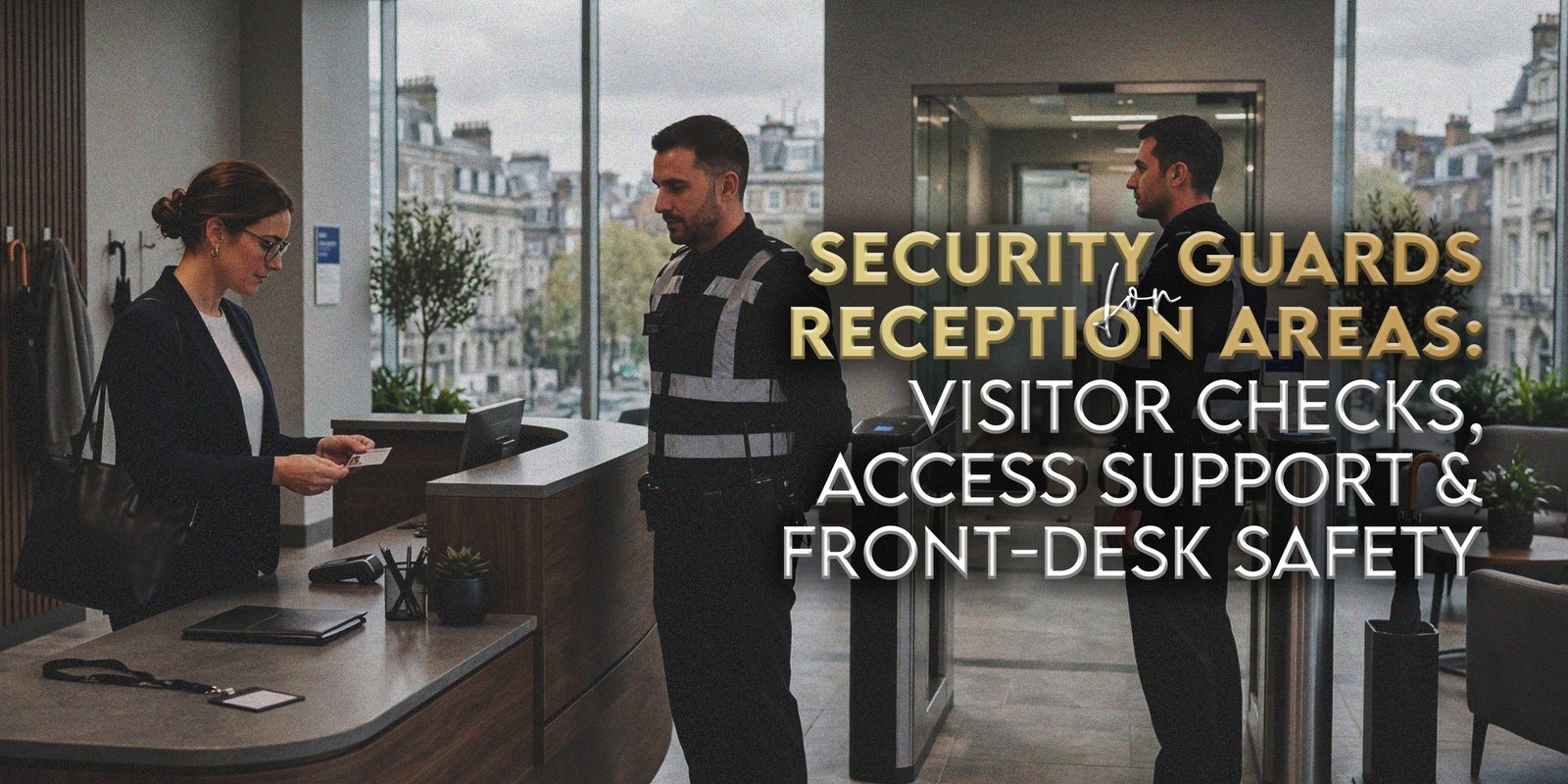
The reception desk is often where a business first discovers that its visitor procedures are unclear. A contractor arrives before their host, a courier needs access to a loading entrance, and several guests approach the desk while employees use access cards. Without clear instructions, even a well-run office can struggle to manage these movements consistently.
Security guards can support reception teams by applying agreed visitor checks, monitoring entry points and reporting unusual activity. For commercial premises in Hounslow and West London, H&D Security provides relevant guarding and related services. This guide explains responsibilities, the distinction between physical guarding and technology, and the information managers should prepare before arranging cover.
What Do Security Guards Do at Reception Desks?
Security guards at reception may greet visitors, check appointments, follow sign-in procedures, contact host employees and monitor authorised entry. They can also coordinate contractor arrivals, maintain agreed activity logs and report incidents to nominated contacts. However, their exact responsibilities depend on site instructions, the service agreement and applicable licensing requirements.
For security guards, a written assignment brief matters because the reception desk is not a single-purpose checkpoint. It is also a point of communication between employees, building managers and outside visitors. Therefore, security guards need clear authority to follow established procedures without making unauthorised decisions about access.
Why Businesses Use Security Guards for Reception Areas
For many offices, the challenge is not a constant stream of incidents. Instead, the difficulty lies in applying the same process to everyone entering the building. Security guards help maintain those agreed checks when reception teams face multiple arrivals, staff movements and time-sensitive deliveries.
Reception Security Guards and Visitor Verification
Reception security guards typically work with the site’s visitor policy rather than inventing a separate process. A visitor might present their name, appointment details and host contact before receiving directions or an authorised pass. Nevertheless, the level of verification should match the business’s own requirements and lawful procedures.
A Practical Visitor Arrival Sequence
- Greet the visitor and establish the purpose of the visit.
- Check the appointment or permitted access category using the approved process.
- Contact the relevant employee when authorisation needs confirmation.
- Record only the visitor details the business reasonably requires.
- Explain approved routes, escorts, passes and sign-out requirements.
- Escalate unexpected circumstances to the nominated manager rather than improvising.
Additionally, security guards should know what happens when a host cannot be reached or a visitor refuses a required check. A clear escalation route helps the business respond consistently while keeping reception interactions professional.
Front Desk Security for Corporate Offices
Front desk security involves more than standing beside a reception counter. A suitable assignment involving security guards may combine visitor communication, monitoring of entrances and coordination with facilities or building management. However, administrative tasks such as diary management, travel booking and general switchboard work should not automatically be assumed to form part of the guard’s duties.
In a busy office, security guards may answer access-related questions, direct guests to waiting areas and flag an unexpected delivery. Meanwhile, designated reception colleagues can continue handling general enquiries and office administration. Defining this division prevents gaps and duplication when both teams work at the same desk.
Access Control Support for Commercial Buildings
Access control support means helping a workplace apply its existing entry permissions and procedures. Security guards may check authorised visitors, monitor staff entrances, coordinate contractor arrival and report access-system problems. However, an officer should not grant access beyond the authority stated in the assignment.
Access Cards, Contractors and Restricted Areas
Access cards and electronic doors manage permissions through technology. In comparison, security guards can respond to questions, check the relevant instructions and direct people when a card fails or a visitor has no credential. The two functions complement one another but are not interchangeable.
Office Guarding for Multi-Tenant Commercial Buildings
A shared building can accommodate organisations with different visitor rules, delivery arrangements and opening hours. Consequently, security guards require one building-wide procedure alongside clearly documented tenant-specific instructions. Property managers should avoid leaving guards to reconcile conflicting policies during a busy reception shift.
Consider a hypothetical office block with three tenants. One receives guests by appointment, another uses visitor passes and the third expects contractor deliveries at the rear entrance. Security guards can follow those distinctions only when the property manager supplies accurate, accessible instructions.
Security Guards and Event Entrance Management: Key Differences
Reception and event access share several principles: checking authorisation, communicating instructions and referring concerns to a supervisor. Nevertheless, security guards at a corporate reception normally manage visitors entering a workplace, while event personnel may face ticket checks, timed admission and larger crowd movements.
When security guards support a corporate function, an office hosting a product launch, conference or client reception may need a temporary entrance plan. For more information, see security guards for events and crowd entry. Event arrangements should be scoped separately from the building’s normal reception contract.
When planning larger functions, review event entrance and crowd management alongside ordinary reception procedures. Similar checks do not mean that the roles carry identical responsibilities or SIA licensing requirements.
Reception Security and External Car Park Access
For security guards, a reception policy may begin outside the building. Visitors frequently arrive through car parks, vehicle gates or pedestrian pathways before reaching the desk. Therefore, security guards responsible for the lobby should understand how approved arrivals move between external access points and reception.
For example, an office might require drivers to report at a barrier before parking in a designated visitor bay. The arrangement may involve intercoms, reception communication and separate CCTV coverage. This is why CCTV cameras for car parks and vehicle gates are a relevant consideration alongside guarding.
How Reception and Vehicle Access Can Work Together
CCTV may help review activity at gates and parking areas, but camera recording does not necessarily mean live observation. For practical planning, the guide to car park CCTV and vehicle entrance monitoring explains related coverage considerations.
Comparing Reception Security, Access Control and CCTV
Security guards provide an on-site person who can follow instructions, communicate with visitors and report problems. Technology can support those duties, but each measure addresses a different need. As a result, office managers should compare services against the building’s actual access arrangements rather than assuming one solution covers everything.
| Security arrangement | Main responsibilities | Suitable requirement | Practical consideration | Question to ask |
|---|---|---|---|---|
| Reception security guards | Visitor checks and entry support | Busy corporate reception | Requires a defined assignment | Who authorises entry? |
| Front desk security | Guest communication and agreed monitoring | Client-facing offices | Separate guard and admin duties | What is included in the role? |
| Access control systems | Electronic permissions and door control | Staff and restricted entrances | Permissions need administration | Who changes access rights? |
| CCTV monitoring | Camera observation or footage review | Entrances and shared areas | Monitoring differs from recording | Who reviews footage and when? |
| Event entrance security | Agreed event admission procedures | Functions and conferences | Different flow and staffing needs | What event plan applies? |
| Out-of-hours office guarding | Site access and agreed checks | Evening or weekend operation | Procedures vary from daytime | Who handles exceptions? |
Review Your Office Reception and Access Requirements
Before contacting a guarding provider, record your office address, operating hours, main reception duties and typical visitor activity. Then identify employee entrances, contractor routes, access-control systems and incident reporting needs. Security guards can be assigned effectively only when the required responsibilities are clear.
If your facilities team wants to discuss personnel, shift patterns and complementary services with H&D Security, request a reception security quote. Include any unusual access arrangements and identify who will approve site instructions.
Daytime Reception Guarding vs Out-of-Hours Office Security
Daytime assignments for security guards usually involve appointments, employee arrivals, suppliers and client meetings. By contrast, evening work may centre on authorised cleaners, maintenance contractors, staff departures and closing procedures. Therefore, security guards require different instructions when the building moves from normal trading hours to restricted access.
Opening, Closing and Weekend Procedures
Security guards should also know what to do if a scheduled contractor does not arrive or an employee requests entry outside approved hours. As a result, a useful brief includes escalation contacts, shift handovers and reporting expectations rather than relying on verbal instructions alone.
Security Guards in Hounslow and West London
H&D Security is based in Hounslow and provides relevant commercial guarding and supporting services. Its business context is particularly relevant to offices and commercial properties around Hounslow, Heathrow and West London, where buildings may combine staff entrances, visitor reception, delivery access and shared parking.
Common Mistakes When Planning Reception Security
- Vague guard duties: identify which checks, patrols and reports form part of the assignment.
- Missing contractor rules: document arrival windows, host authorisation and service entrances.
- Unclear access permissions: specify who can approve visitors and override restrictions.
- Poor communication: establish contacts for reception staff, tenants and facilities managers.
- Overlooked external entrances: review visitor parking, delivery gates and pedestrian routes.
- Inconsistent reporting: set expectations for handovers, incident records and urgent escalation.
- Outdated opening hours: update instructions before events, holidays or office changes.
Additionally, businesses should review their privacy obligations when they process visitor records or CCTV footage. They should document an appropriate lawful basis, explain data use where required, control access and set retention periods suited to the purpose rather than assume one fixed period applies everywhere.
What Should Businesses Include in a Reception Security Brief?
- Building address, reception location and reporting entrance.
- Operating hours, required days and shift arrangements.
- Typical visitor volumes, appointments and host-verification process.
- Employee entrances, access cards and restricted areas.
- Contractor and delivery routes, including permitted hours.
- Visitor parking, vehicle gates and pedestrian access arrangements.
- Existing CCTV, intercoms and relevant access-control equipment.
- Required SIA-regulated security activities and licensing considerations.
- Incident reporting, escalation contacts and shift handovers.
- Any temporary event or out-of-hours changes to access procedures.
Where vehicle access is part of the specification, managers can also review CCTV coverage for commercial vehicle access. This supports a broader discussion of visibility without assuming that reception guards automatically monitor every camera.
How H&D Security Supports Commercial Reception Areas
H&D Security discusses reception guarding, SIA-licensed personnel and related commercial services based on client requirements. Depending on the agreed specification, security guards may support visitor management, building entrances, contractor access, reporting and appropriate office patrols. However, duties and coverage should be confirmed before any assignment begins.
For one-off office events, security personnel for event access may require a separate brief. Additionally, H&D Security offers CCTV, mobile patrol, keyholding and alarm response services where appropriate.
To explore an appropriate arrangement, employers can discuss their office guarding requirements. Share your building layout, access rules and staffing hours so the proposed service can be assessed accurately.
Frequently Asked Questions
What Do Security Guards Do in Reception Areas?
Security guards at reception can greet visitors, follow sign-in instructions, contact hosts, check approved access and record incidents. Their precise duties depend on the site agreement and visitor policy. Businesses should also establish who authorises exceptions, how the guard communicates with reception staff and which information belongs in the activity log.
How Can Reception Security Guards Support Office Visitors?
Reception security guards can help visitors follow an organised arrival process, from confirming an appointment to finding the correct host or waiting area. Additionally, they may explain approved entry routes and alert a manager when details do not match the booking. Visitors should receive clear instructions that reflect the building’s established policies.
What Is the Difference Between Front Desk Security and a Standard Receptionist?
A standard receptionist commonly handles administrative tasks, calls, bookings and general customer service. Front desk security focuses on authorised entry, visitor procedures and agreed monitoring responsibilities. However, the roles can overlap in communication and greeting visitors. Businesses should define duties explicitly rather than assume a security assignment includes every reception administration task.
Can Security Guards Provide Access Control Support?
Yes, security guards may support an employer’s approved access process by checking credentials, contacting authorised staff and observing entry points. Nevertheless, electronic systems determine permissions according to their configuration, while the guard follows agreed rules. Managers should clarify restricted areas, contractor permissions and escalation procedures before the assignment starts.
How Does Office Guarding Differ From Event Entrance Security?
Office guarding usually involves ongoing workplace access, tenant requirements and routine visitor arrivals. Event entrance security may involve guest lists, ticket checks, timed admission and crowd movement. Although both require communication and authorised entry decisions, they need different plans. Businesses should assess each service according to the activity and applicable licensing requirements.
How Can Businesses Request Reception Security From H&D Security?
Business owners can prepare the office location, required operating hours, visitor volumes, access-control arrangements and guard responsibilities. H&D Security can then discuss suitable commercial guarding options for the proposed site. Include contractor access, CCTV requirements, reporting expectations and any evening or weekend shifts to make the enquiry more useful.
Discuss Your Reception Security Requirements With H&D Security
A reception guarding arrangement should reflect how people actually enter, leave and move through your building. H&D Security, based in Hounslow, can discuss security guards for reception desks, visitor verification, office guarding and related access procedures with commercial property managers across West London.
Before enquiring, gather your site layout, operating hours, visitor arrangements and any CCTV or vehicle gate requirements. In addition, identify whether your building needs daytime cover, out-of-hours checks or separate event entrance support. These details help establish an appropriate scope without making assumptions about services or availability.