
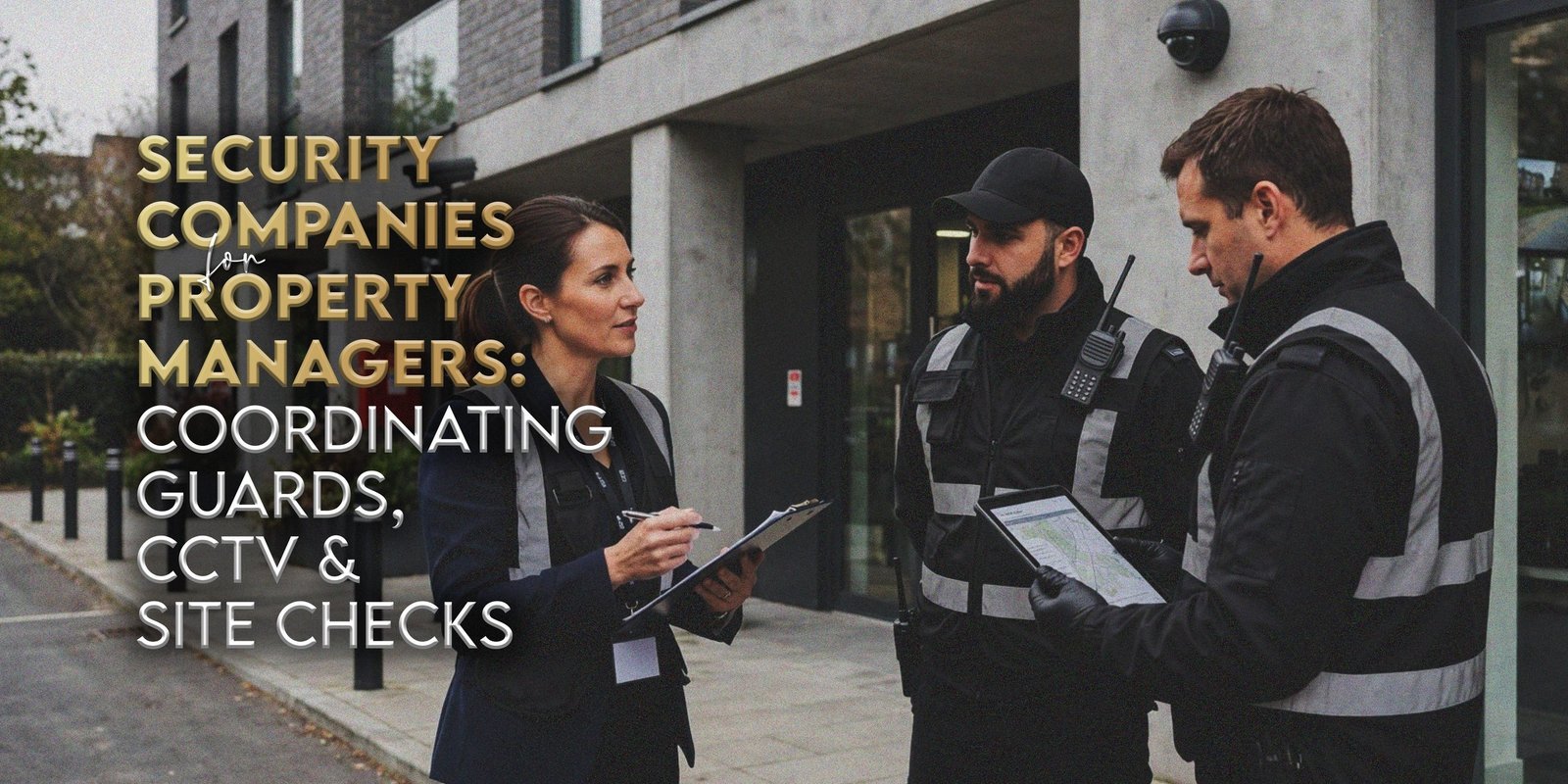
A commercial property rarely operates on one timetable. Office tenants arrive early, deliveries use gates, contractors visit plant rooms, and car parks remain active after reception closes. Without clear responsibilities, these movements can create gaps between guarding, CCTV coverage and site checks. Property managers comparing security companies should assess how each service fits the building rather than purchasing separate arrangements without a plan.
H&D Security, based in Hounslow, West London, provides commercial guarding, CCTV, mobile patrols, keyholding and alarm response services. This guide explains how security companies can support property teams, which information belongs in an effective security brief, and how to coordinate people, cameras and reporting across commercial premises.
How Do Security Companies Support Commercial Property Managers?
For property manager security, companies support managers by providing agreed guarding, access monitoring, CCTV services, patrols and incident reporting. Effective arrangements identify who controls entry, who observes relevant areas, how incidents reach the managing agent and what happens outside normal hours. The right combination depends on the property’s layout, tenants and operating pattern.
Importantly, security companies do not remove a property manager’s responsibility to establish site rules. Instead, the provider and client should agree instructions, contact details, service boundaries and reporting expectations beforehand. That creates a practical basis for reviewing performance and changing requirements as the property evolves.
Why Property Managers Need a Coordinated Security Plan
For property portfolios, security companies should account for the distinct hours of each building. a staffed reception, rear delivery doors, underground parking and a weekend cleaning team. Another property may contain several units with different opening hours. In either setting, security companies need a clear picture of entrances, authorised users and areas that remain active after closing.
A coordinated plan defines where guards operate, which CCTV views matter, when patrols take place and who approves access exceptions. For example, a contractor arriving at a service entrance should not depend on a receptionist who has already finished for the day. Documented procedures reduce confusion between tenants, facilities staff and the security team.
Commercial Property Security Starts With the Building’s Actual Use
When selecting security companies, begin with a site-specific review rather than a standard list of guards and cameras. with a site-specific review rather than a standard list of guards and cameras. Consider building size, shared areas, pedestrian routes, vehicle movement, tenant activity, emergency contacts and existing equipment. Each feature affects where security personnel can work and what CCTV can reasonably observe.
For example, security companies assessing a mixed office and warehouse estate may identify separate needs at public reception and goods-out gates. One involves visitors and identification; the other involves delivery schedules, loading movements and restricted stock areas. Treating those entrances identically can make instructions less useful.
Guarding Services for Reception, Entrances and Commercial Buildings
On-site guarding services from security companies can support visitor checks, contractor registration, staff entrances, internal patrols and agreed incident escalation. H&D Security describes SIA-licensed commercial security officers and reception guarding among its services. However, precise duties depend on the assignment instructions, site risks and applicable licence requirements.
Security companies should establish what the officer may approve independently and what requires tenant or management authorisation. A guard might check an appointment against a visitor list, contact the host and record entry where the site policy requires it. That does not mean the officer should decide which contractor can enter a restricted plant room without authorisation.
CCTV Support for Property Managers and Facilities Teams
Security companies providing commercial CCTV support may include installation, camera coverage planning, recording, remote viewing and separately agreed monitoring services. Security companies should explain which of these features the property actually needs. A recorded camera view provides footage for later review, but it does not establish that someone watches the feed continuously.
Camera placement should reflect entrance angles, lighting, obstructions and legitimate surveillance purposes. For example, a broad view of a shared courtyard may not provide the detail needed at a narrow vehicle gate. Likewise, the presence of a camera does not substitute for a documented procedure when an incident is observed.
Coordinating Guards and CCTV Across Commercial Properties
Security companies can provide more useful CCTV support when guard instructions and camera coverage describe the same site areas. security companies should identify monitoring responsibilities, priority entrances, reporting channels and escalation contacts. Otherwise, a camera alert may be noticed without anybody knowing who should act.
For example, an agreed procedure could direct a control-room operator to notify the on-site officer about a relevant vehicle entrance concern. The officer follows the property’s instructions and records the outcome. That scenario is illustrative; actual monitoring and response functions must be included in the contracted service.
Mobile Patrols and Commercial Site Checks
Not every property requires a continuously staffed entrance. Security companies may also discuss mobile patrols, agreed external inspections, keyholding and alarm response where these services fit the site. A scheduled patrol is a visit at an agreed interval or under agreed conditions, not uninterrupted on-site guarding.
Car Park CCTV and Vehicle Access for Commercial Properties
For security companies, shared car parks create requirements that differ from reception guarding. Visitors may arrive outside office hours, tenants may use different spaces and delivery vehicles may need separate gate arrangements. Security companies reviewing these areas should consider vehicle approaches, pedestrian routes, lighting, barrier controls and the reason for each camera view.
For a practical external coverage review, see commercial vehicle gate CCTV planning.
Camera coverage at a gate should not be confused with automatic number plate recognition or automatic access authorisation. Those functions depend on the selected technology and approved configuration. Property teams can explore
CCTV cameras for car parks and vehicle gates
when developing an appropriate specification.
Managing Visitor Access and Events at Commercial Sites
Security companies may be asked to support commercial buildings hosting tenant launches, conferences or large meetings. These activities increase visitor flow and can change reception staffing, queue management and entrance requirements. Security companies should first establish the event’s size, guest arrangements, public access and specific control responsibilities.
Security companies reviewing non-routine visitor flows can also consider entrance management for corporate events.
Routine reception guarding and event security share useful principles, including clear authorisation and escalation. However, crowd movement and event entry duties may require different planning, personnel and instructions. Managers considering
security guards for event entrances and crowd management
should treat that as a separate service decision.
Security Companies for Multi-Tenant Buildings and Business Parks
Multi-tenant estates create extra questions about who authorises entry, pays for shared services and receives incident reports. Security companies can follow a common estate procedure, but property managers must still identify tenant-specific access rules. The managing agent should maintain accurate contacts for each occupied unit.
For instance, cleaning contractors may have permission for shared corridors but not private offices. Meanwhile, a vacant retail unit may require separate keyholding instructions from the neighbouring occupied premises. These distinctions help security companies avoid treating every door or tenant as interchangeable.
Review Your Commercial Property Security Requirements
Before comparing security companies, prepare a short brief covering the property’s postcode, building layout, tenant mix, operating hours and entrances. Identify current guarding arrangements, CCTV equipment, monitoring preferences, patrol frequency, access-control systems and incident reporting expectations.
Then explain which duties are essential, which require separate agreement and who will approve instructions or changes. H&D Security can review the stated needs and discuss relevant services. Property managers can
request a commercial property security quote
using those details. A complete brief makes the proposed arrangements easier to compare.
Comparing Security Services for Commercial Properties
| Security service | Primary purpose | Suitable requirements | Operational considerations | Confirm before booking |
|---|---|---|---|---|
| Manned guarding | On-site presence and agreed checks | Busy buildings and controlled entrances | Shift coverage, handovers | Hours, duties, licence requirements |
| Reception security | Visitor and contractor procedures | Office lobbies and shared receptions | Tenant rules, sign-in | Access authority and reporting |
| Recorded CCTV | Footage for authorised review | Entrances and common areas | Visibility, storage, privacy | Access rights and retention |
| Live CCTV monitoring | Agreed active observation | Selected sites needing monitoring | Monitoring hours and escalation | Who watches and what follows an alert |
| Mobile patrols | Scheduled or agreed site checks | Vacant units and external estates | Visits are not constant presence | Patrol scope and visit pattern |
| Keyholding and alarm response | Agreed access and alarm procedures | After-hours commercial properties | Keys, authorisation, contacts | Response agreement and reporting |
| Access control | Manage permitted entry | Staff doors and vehicle gates | Permissions and system operation | Who changes access rights |
When evaluating security companies, use the table to test whether each proposal answers the property’s actual needs. Several services may complement each other, but capabilities, monitoring hours and responsibilities depend on what the client and provider agree.
Security Companies in Hounslow and West London
H&D Security is based in Hounslow and offers commercial guarding, CCTV installation and monitoring, mobile patrols, keyholding, alarm response and access control support. Property teams around Heathrow, Brentford, Feltham, Hayes and other West London business areas can discuss relevant site requirements without assuming identical arrangements suit every location.
Local security companies work with buildings ranging from office blocks and retail units to industrial estates and warehouse premises. Accordingly, security companies should examine the travel requirements of assigned personnel, access restrictions, opening times and existing systems when scoping a service.
Common Mistakes in Commercial Property Security Planning
For security companies and managing agents, the most frequent planning problems arise when several teams assume another party has responsibility. For example, a CCTV installer may configure recording while the property manager expects continuous monitoring. Security companies should explain that these are distinct arrangements and document who handles alerts.
Property managers should therefore ask security companies to review reporting arrangements and access permissions periodically. If a site runs tenant events, assess
access and crowd management for events
independently, because crowd activity creates duties beyond routine reception monitoring.
What Should Property Managers Include in a Security Brief?
A useful brief helps security companies assess the site and define the precise services under consideration. Start with the property address and a simple plan, then record essential operations and instructions:
- Building type, tenants, shared spaces and usual operating hours
- Main, secondary, pedestrian, vehicle and delivery entrances
- Reception guarding, site patrol and out-of-hours duties
- Existing CCTV cameras, recording and monitoring arrangements
- Visitor, contractor and staff access permissions
- Keyholding, alarm systems and agreed escalation contacts
- Incident log format, reporting frequency and shift handovers
- Vehicle parking rules and
CCTV coverage for commercial parking areas
How H&D Security Supports Commercial Property Managers
Security companies such as H&D Security offer relevant commercial guarding services using SIA-licensed personnel for applicable duties, along with reception support, CCTV services, mobile patrols, keyholding and alarm response. For property managers, the main task is to specify which services apply to each entrance, building and operating period.
To explore an appropriate combination, facilities teams can
discuss property security requirements with H&D Security
. Availability and final arrangements depend on the agreed specification.
Frequently Asked Questions
What services do security companies provide for property managers?
Security companies may provide on-site guarding, reception support, CCTV installation or monitoring, mobile patrols, keyholding, alarm response and access-control assistance. The appropriate services depend on the building’s occupants, entrances and operational hours. Property managers should agree the duties, reporting processes and response arrangements rather than assuming a fixed package covers every requirement.
How can property managers coordinate guards and CCTV monitoring?
Start by mapping camera coverage against guard posts and access points. Next, identify who watches any live feeds, who receives alerts and which site contact authorises action. Written instructions should address shift handovers, recording access and incident reporting. Security companies can then describe the specific monitoring and guarding responsibilities included in their proposal.
What does commercial property security typically include?
Commercial property security may involve entrance procedures, visitor and contractor checks, internal or external patrols, CCTV systems, car park arrangements and incident records. However, requirements differ between busy offices, vacant premises and warehouse estates. A property manager should select services after examining site use, current equipment, tenant obligations and out-of-hours activity.
When should property managers consider mobile patrols?
Mobile patrols may suit sites needing scheduled external checks rather than a permanent officer at one post. They can be relevant to vacant units, business parks and properties with defined inspection routes. However, a patrol visit is not continuous guarding. Confirm the proposed visit schedule, inspection duties, access permissions and reporting requirements in advance.
How can CCTV support car parks and vehicle entrances?
CCTV can provide recorded visibility at selected vehicle approaches, parking areas and gates, subject to camera positions and lighting. It does not automatically identify number plates, grant entry or provide live monitoring. Property managers should review their desired purpose, privacy obligations and arrangements for authorised footage access before agreeing a camera specification.
How can property managers request security services from H&D Security?
Share the site postcode, property type, operating hours, current security equipment and duties under consideration. Include visitor arrangements, vehicle access, patrol expectations and relevant contacts. H&D Security can discuss commercial guarding, CCTV, mobile patrols and associated services based on that brief. Confirm the required coverage and reporting arrangements before agreeing a specification.
Discuss Your Property Security Requirements With H&D Security
Commercial property managers assessing security companies need practical coordination across guards, cameras, entrances and site checks. H&D Security, based in Hounslow, West London, can discuss relevant guarding services, CCTV options, mobile patrols, keyholding and alarm response for different commercial environments.
When contacting security companies, provide your building layout, tenant activity, visitor and vehicle arrangements, operating hours and preferred reporting procedures. Explain whether you require an on-site officer, monitored cameras, scheduled inspections or a combination. This information helps identify which services need separate agreement and gives your team a clearer basis for comparing proposals.