
Retail Security Guards for Shopping Centres: Coordinating Store Entrances and Shared Public Areas
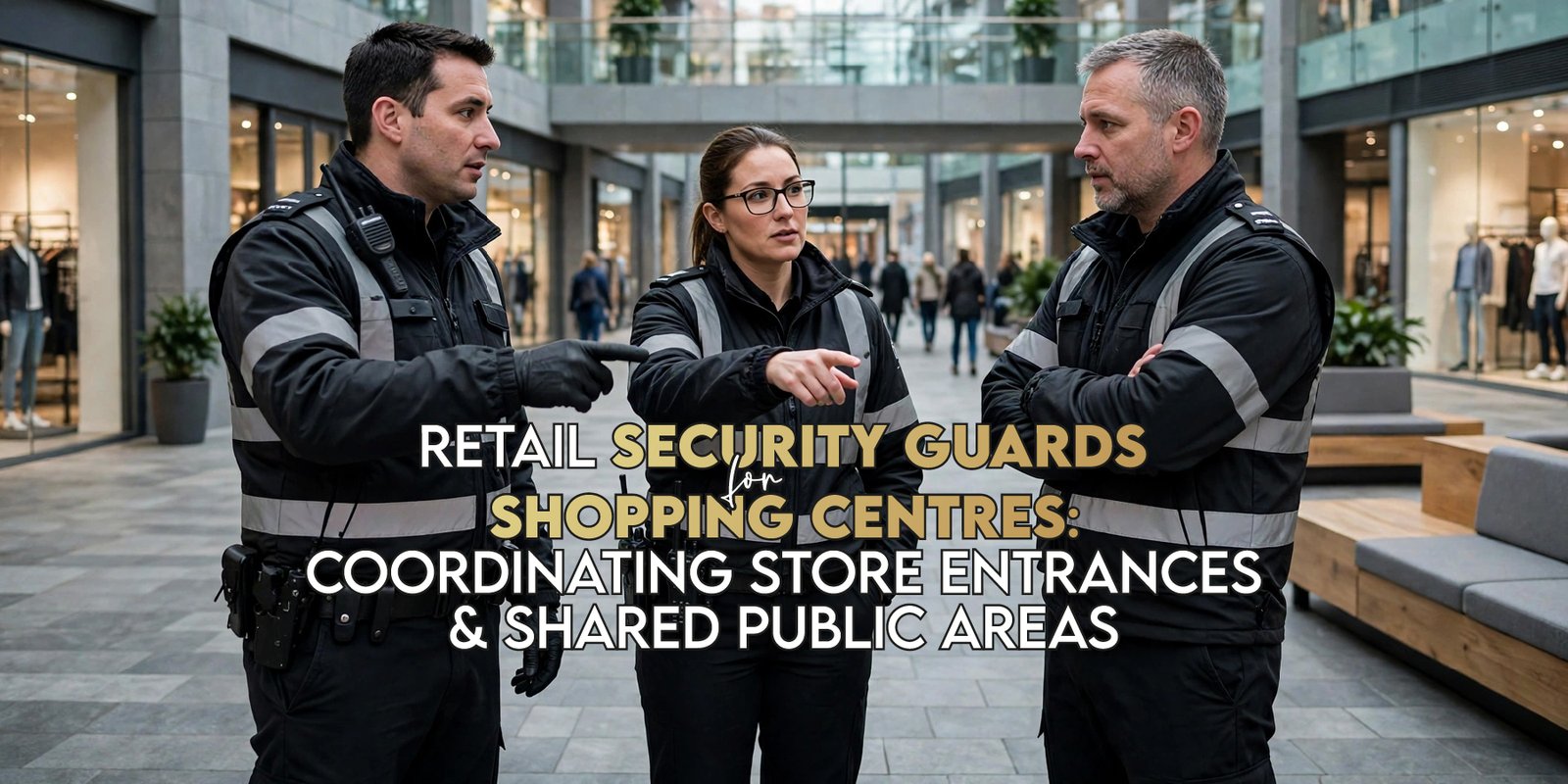
Retail security guards working in a shopping centre need a clear understanding of where each assignment begins and ends. A shop entrance, shared concourse and service corridor may have different managers. For London centre operators, effective retail complex security depends on joining those responsibilities into a practical daily plan.
Agree responsibility at every boundary
Start with a marked site plan showing tenant premises, public walkways, staff doors and loading access. Identify who controls each area and which team receives reports. Shopping centre guards should know when to contact a retailer, the centre control room or the duty manager. A concern moving from a store into a shared space should not disappear between reporting systems.
Record arrangements for opening and closing, including tenants trading outside normal centre hours. A late-opening restaurant or early delivery can change access requirements even when most shutters are closed.
Coordinate entrances without obstructing public routes
Promotional queues can extend beyond a shop frontage. Agree queue locations, accessible routes and the point at which staff ask management to change the arrangement. Guards can observe developing congestion and communicate it promptly; decisions about capacity and trading should follow the centre plan.
Shared area monitoring should include routes to lifts, stairs and exits. Temporary displays and delivery cages can alter circulation. Report obstructions rather than moving equipment without the relevant authority or training.
Give teams a consistent incident handover
Use agreed location names, radio channels and escalation contacts. An incident report should distinguish what the officer observed from what another person reported. Include the time, location, immediate actions and the manager notified. Share information only through authorised channels.
- Confirm which team responds and which maintains its assigned position.
- Identify how retail staff request urgent assistance.
- Set a handover process for unresolved concerns.
- Agree how centre CCTV staff receive a specific incident reference.
Compare shopping mall security services by scope
A quotation should explain the posts, patrol areas, supervisor arrangements and cover during breaks. Compare the same hours and responsibilities across providers. A visible entrance position cannot also provide continuous coverage of a distant service yard.
Check the SIA licence register for personnel carrying out licensable duties, and confirm that the licence suits the actual work. Related guidance on security guards for retail premises can help frame the tenant-level brief.
Build a centre-wide responsibility map
A useful responsibility map describes decisions as well as locations. At a tenant entrance, the retailer may decide whether a customer can enter the shop, while centre management controls the queue occupying the concourse. At a service door, facilities staff may authorise maintenance access while the guarding team checks that the approved process has been followed. Write down these relationships so that an officer does not have to negotiate them during a busy shift.
Include situations in which several teams become involved. For example, a customer complaint inside a shop may lead to an argument outside its frontage. The shop manager still has information about the original issue, but the centre team may now be responsible for the shared area. Agree who coordinates the response, who records the incident and how information is passed between them. This practical map should be available at the control point and explained during induction, with a named person responsible for keeping it current when tenants or contractors change.
Review the busiest moments, not just average footfall
An average daily visitor figure can hide short periods of concentrated movement. A promotion starting at opening time, several stores closing together or a cinema audience leaving after a screening may create demands in different places. Ask tenants for the timings that affect their frontage. Review where people are likely to pause, which routes they share and whether deliveries take place at the same time. The resulting deployment should reflect these overlapping activities.
Use ordinary operating records and observations to identify recurring problems. A queue repeatedly crossing a lift lobby deserves attention even if no serious incident has occurred. Discuss practical changes such as better queue information or a revised collection point before assuming an additional guard is the only answer. After a change, observe whether the problem has moved elsewhere. The purpose of the review is to improve the whole route through the centre, not simply to clear one shop doorway at the expense of another tenant.
Prepare an opening routine that supports tenants
Before public opening, guards need to understand the approved route for early staff, cleaners and contractors. A locked customer entrance may sit close to a staff door, and visitors can follow someone who appears to know the way. Establish how authorised arrivals are checked, how unexpected workers are referred to management and what happens if a tenant's responsible person has not arrived. Keep the instructions workable for the people actually staffing the entrance.
The opening handover should also cover changes from the previous evening. These may include a door awaiting repair, an area temporarily closed for cleaning or a display moved near a walkway. Record who is dealing with each issue and any interim arrangements already approved. This prevents the incoming team from treating a known fault as a new emergency or overlooking it because another shift supposedly reported it. Give tenants a clear channel for raising concerns before their shop begins trading, rather than relying on informal conversations during the morning rush.
Manage contractor and delivery interfaces
Shopping centres often have service activities that customers rarely see. Contractors may use shared corridors, deliveries may serve several retailers, and waste collections may coincide with store replenishment. The security brief should distinguish a person's permission to enter the centre from permission to enter a particular unit or technical room. A valid contractor booking is useful evidence, but it does not necessarily authorise access to every part of the building.
Agree who checks the booking, issues any temporary access credential and confirms departure. Where a contractor needs an escort, identify who provides it before allowing the visit to proceed. Guards should not leave an essential public-area post simply because an unplanned escort is requested. Refer the request to the appropriate manager and explain the available options. Keep access information current across shift changes so that an outgoing officer's knowledge is not the only record of who remains inside the premises after trading.
Make radio messages useful to other teams
A message such as “there is a problem near the shop” gives the receiving team little basis for action. Agree a short reporting structure covering the exact location, observed issue, immediate risk and assistance requested. Use centre-approved names for entrances and levels. Similar shop names, renamed units and separate east or west doors can otherwise lead officers to the wrong place. A briefing should resolve these naming differences before the shift starts.
Decide which information belongs on an open radio channel and which should be passed through a more restricted route. Do not broadcast unnecessary personal details when a location and incident reference are sufficient. Give officers a way to confirm that an urgent message has been received, and identify the fallback if a radio or control-room contact is unavailable. Test communications in the relevant working areas, including service corridors where reception may differ from the public concourse. Record gaps and agree a practical response before deployment.
Support accessibility and customer assistance
Shared public areas need to remain usable by people with different mobility, sensory and communication needs. An apparently generous queue route may become difficult for a wheelchair user when customers gather around a promotional stand. A change of entrance may be confusing for someone who relies on familiar wayfinding. Brief guards on accessible entrances, lifts, assistance points and the contact responsible for resolving an access problem.
Officers should offer clear directions and ask what assistance is useful rather than make assumptions about a visitor. Keep welfare or safeguarding concerns within the centre's approved procedure, with the relevant trained staff involved. If a lift is unavailable or a route is closed, management should provide an agreed alternative and suitable information. Security teams can help communicate that arrangement and report where it is not working. They should not improvise physical assistance or move a person in a way that falls outside their training and the person's wishes.
Coordinate closing without leaving gaps
Closing is a sequence, not a single time on a roster. Some tenants finish serving customers while others are securing stock or waiting for contractors. Confirm which doors remain available, who checks the shared areas and how staff leave after customer access ends. If evening hospitality or entertainment operates within the centre, explain how its visitors are separated from parts of the building that have already closed.
Give the team a clear completion process. A closing report might record unresolved access issues, the areas checked and the person receiving the final handover. Avoid a checklist that implies every door has been tested when the officer only observed part of the route. Describe what was actually done and escalate anything that could not be completed. Changes to the closing routine should be authorised and communicated to affected tenants; otherwise, staff can find themselves relying on an exit or collection arrangement that has changed without their knowledge.
Use an illustrative queue scenario in the briefing
Consider a fictional Saturday promotion in which a shop's queue extends towards a shared escalator landing. The tenant's officer sees the congestion but is assigned to the entrance. The useful response is to report the exact location, contact the store manager and centre control, and follow the agreed queue plan. Leaving the entrance without cover could create another problem, while simply instructing everyone to move may obstruct a different route.
The centre manager can coordinate any change that affects the concourse, with store staff communicating it to waiting customers. After the queue settles, the teams should record what triggered the problem and whether the planned layout was adequate. This is an exercise rather than a claim about a real H&D assignment. Its value is in exposing decisions that need owners: who changes the route, who explains the change and who continues watching the original entrance while the other teams act.
Review service quality with meaningful evidence
Measure the service against the agreed assignment. Useful review points include whether required posts were covered, handovers were complete and reported faults reached the responsible manager. A high number of incident reports does not automatically mean poor guarding; it may reflect better reporting or a particularly busy period. Likewise, an absence of reports does not establish that every part of the plan worked.
Ask for a short review of recurring issues and actions still outstanding. Distinguish matters the guarding provider can resolve from building repairs, tenant procedures or layout decisions that belong to others. Agree an owner and review date for each improvement. This makes a monthly discussion more useful than a general assurance that the centre was quiet. When comparing shopping mall security services, look for a provider willing to define these responsibilities and discuss the evidence behind proposed staffing changes.
## Questions for a tenant coordination meeting
Before a busy trading period, ask each tenant whether its opening hours, entrance arrangements or promotional activity will change. Confirm the person who will be present to make decisions and the route for contacting centre management. Ask whether a queue, delivery or contractor visit could affect a shared area. These questions turn a general security discussion into a practical review of the activities that officers will encounter.
Keep the meeting record focused on actions. A tenant may need to move a display, facilities may need to review a door fault and the security supervisor may need to update a post instruction. Give each action an owner and confirm completion before the affected period begins. Where an issue remains unresolved, explain the interim arrangement and its limits. This helps retail security guards work from one current plan and reduces the chance that an informal promise made in a meeting becomes an instruction that nobody has actually implemented.
Frequently asked questions
Does every shop need its own guard?
The answer depends on the site assessment, tenant responsibilities and existing centre coverage. Shared guarding does not automatically include continuous protection inside every unit.
What should a centre manager provide before mobilisation?
Provide the current plan, trading hours, contact list, access rules, reporting procedure and emergency instructions. Arrange an induction before officers take up their posts.
Discuss your London security requirements
When choosing a security company in London, provide the site address, operating hours, required duties and the person responsible for decisions. H&D Security can discuss a suitable scope and personnel availability. Request a security quotation with your dates, site layout and reporting requirements so that the proposed cover reflects the work involved.