
Retail Security Guards and CCTV Monitoring: How Supermarkets Coordinate Incident Response
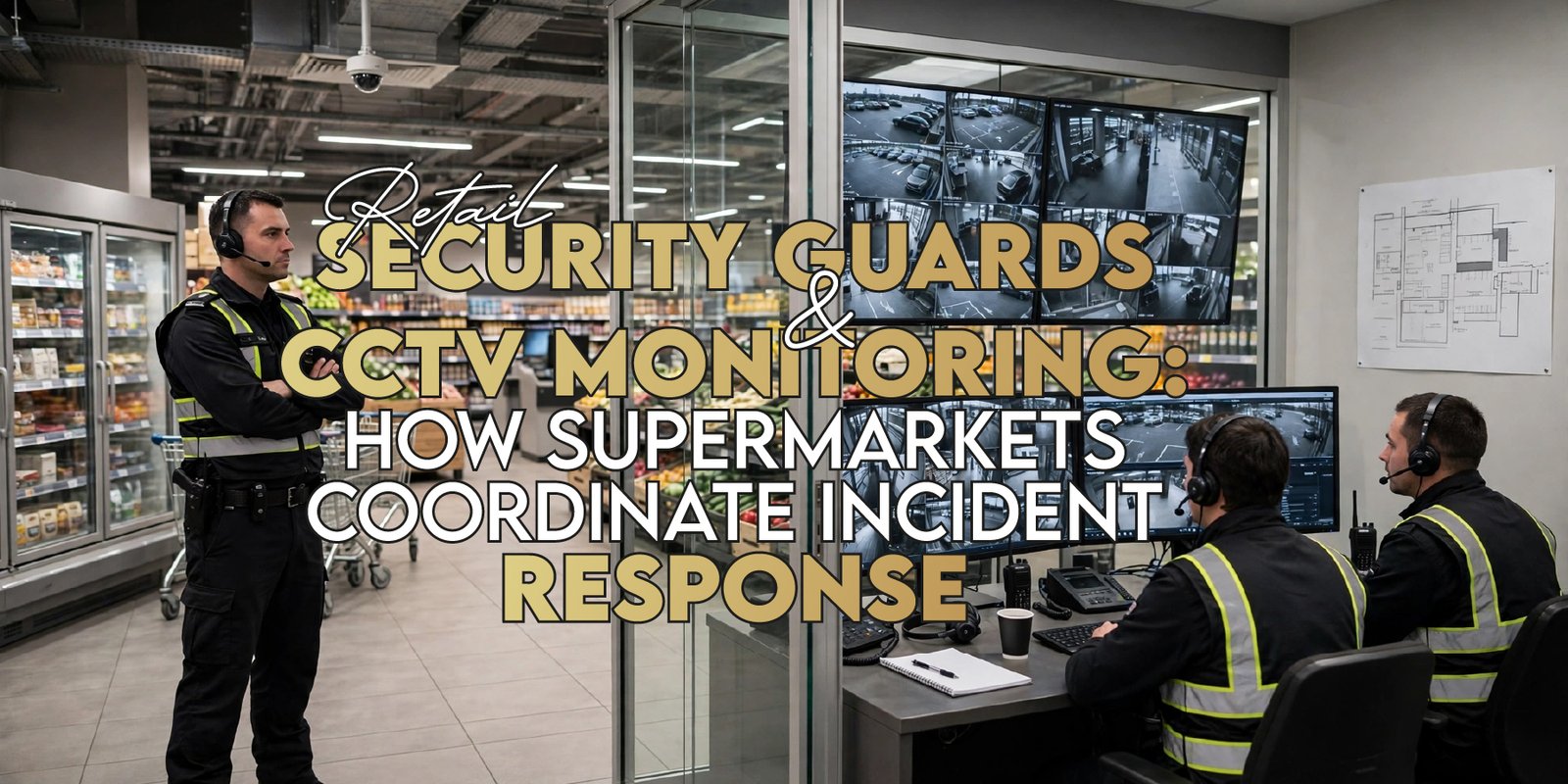
A busy supermarket in Hounslow has customers moving through its aisles while employees manage checkouts, deliveries and stock replenishment. Suddenly, a disagreement near the tills requires attention from store management and the security team.
In this situation, retail security guards and CCTV operators may have different responsibilities. Cameras provide relevant visual information, while on-site personnel can assess the circumstances and follow agreed incident procedures.
However, neither CCTV monitoring nor physical guarding should operate without clear communication and management oversight.
Effective supermarket security depends on properly defined duties, appropriate SIA licensing, accurate reporting and professional customer interaction.
H&D Security is a commercial security provider based in Hounslow, West London, offering retail guarding, CCTV monitoring and related services.
This guide explains how supermarkets can coordinate their security personnel, CCTV operators and management teams during everyday incidents.
How Do Retail Security Guards and CCTV Monitoring Work Together?
Retail security guards and CCTV operators work together by communicating relevant observations through agreed reporting procedures. CCTV personnel may identify activity requiring attention, while on-site officers assess the situation and respond within their training and authorised duties. Store managers remain responsible for relevant operational decisions and incident escalation.
However, the exact coordination process depends on the supermarket's service arrangements.
For example, one store may have a dedicated CCTV operator, while another may rely on recorded footage without continuous live monitoring.
Therefore, managers must clarify which services operate before establishing incident procedures.
Retail CCTV Monitoring: What Can Operators Observe?
Retail CCTV monitoring involves authorised observation through camera systems installed for defined purposes.
Depending on the available equipment, camera coverage may include:
Customer entrances and exits
Checkout areas
Supermarket aisles
Stockroom access points
Delivery entrances
Loading areas
Relevant external spaces
However, the existence of a camera does not necessarily mean a person continuously monitors its footage.
Some premises use recorded CCTV, while others arrange live monitoring or control-room support.
Furthermore, operators must follow the relevant monitoring purpose, lawful access arrangements and applicable data protection requirements.
Retail security guards should know how the supermarket communicates monitoring concerns to on-site personnel when this service forms part of the contract.
CCTV Incident Response: From Observation to Reporting
CCTV incident response should connect monitoring information with suitable on-site action and management communication.
Although every supermarket may follow different procedures, the following framework provides a practical starting point.
Seven Stages of Supermarket Incident Coordination
Observation: An authorised officer or CCTV operator identifies activity requiring attention.
Information review: The observer considers the available information without making assumptions.
Communication: Relevant details reach the designated security officer or supervisor.
On-site assessment: The responsible officer assesses the situation according to site procedures.
Appropriate response: Personnel act within the law, their training and contracted responsibilities.
Incident recording: Relevant observations, notifications and actions are documented.
Management review: The store manager reviews the incident and determines any necessary follow-up.
This is an illustrative coordination framework rather than a mandatory procedure used by every supermarket.
For example, a disagreement at a checkout may initially require customer service assistance rather than a physical security response.
Consequently, retail security guards should assess circumstances carefully and involve relevant management personnel.
Shop Surveillance Services for Tills and Checkout Areas
Shop surveillance services can include relevant CCTV observation around tills, payment points and customer checkout areas.
These locations often involve customer interaction, payments and queues.
However, monitoring must follow legitimate purposes and relevant privacy requirements.
For example, an incident involving a checkout disagreement may require communication between customer service staff, the duty manager and security personnel.
Retail security guards can assist according to their assigned duties, while CCTV operators may provide relevant observations where authorised.
For more information, review CCTV planning for shops, tills and stockrooms.
Why CCTV Footage Needs Context
A recording may show part of an incident without explaining everything that happened beforehand.
Therefore, personnel should avoid drawing unsupported conclusions from an isolated observation.
Accurate reporting should distinguish confirmed information from assumptions.
Guarding Responsibilities vs CCTV Operator Responsibilities
Understanding the division of responsibilities helps supermarkets establish effective communication.
Retail security guards normally undertake agreed on-site duties, which may include entrance observation, relevant patrols, customer-facing assistance and incident reporting.
CCTV personnel perform authorised monitoring activities according to the applicable contract and licensing requirements.
Meanwhile, store managers oversee wider operational decisions.
What Should Managers Clarify?
Before arranging combined guarding and monitoring, identify:
Who receives CCTV notifications
Who assesses incidents on site
Who contacts the duty manager
Who records observations
Who may access recorded footage
Who authorises relevant disclosures
Who handles shift handovers
Furthermore, the supermarket should establish appropriate communication channels between these roles.
How Retail Security Guards Coordinate With Store Managers
Effective coordination begins with clear site instructions.
Retail security guards should understand the supermarket's reporting expectations, relevant management contacts and escalation procedures.
For example, an officer may need to distinguish an ordinary customer complaint from an incident requiring additional attention.
Therefore, communication arrangements should identify when to involve customer service staff, supervisors or emergency services.
Practical Management Procedures
Relevant arrangements may include:
Pre-shift briefings
Designated supervisor contacts
Incident notification procedures
Agreed communication equipment
Staff and contractor access instructions
Written incident reports
Shift handover notes
However, security officers should not automatically assume responsibility for every store management decision.
The scope of authority must follow the agreed duties and applicable law.
Incident Reporting in Busy Supermarkets
Accurate reporting helps supermarket managers understand what occurred and how employees responded.
Retail security guards may document relevant observations within the agreed reporting process.
A useful incident record may include the date, approximate time, general location, nature of the concern, relevant personnel, actions taken and management notifications.
Where appropriate, CCTV references may support a later authorised review.
However, reports should remain factual and avoid unsupported allegations.
Why Reporting Matters
Consistent documentation can support management review and help identify whether procedures need clarification.
Furthermore, personnel should handle any associated recordings according to approved access, disclosure and retention arrangements.
Security officers should not independently distribute footage outside authorised procedures.
Can Retail Security Guards Monitor CCTV Cameras?
Retail security guards may undertake certain CCTV activities where their SIA licence covers the actual work.
However, not every Security Guarding licence permits every surveillance activity.
Current SIA guidance distinguishes CCTV monitoring for specified property-guarding purposes from activities that require Public Space Surveillance authorisation.
When Does CCTV Licensing Matter?
Under relevant contracted arrangements, a Security Guarding licence can cover certain CCTV activities intended to guard premises against unauthorised access or property against damage or theft.
However, monitoring people to guard against disorder or protect them against assault may require a Public Space Surveillance licence.
Therefore, employers should assess the actual activity rather than relying solely on the officer's job title.
The applicable licence category and contractual circumstances must be considered before assigning monitoring duties.
Retail CCTV Monitoring and UK Data Protection Requirements
Supermarket CCTV can capture personal data relating to customers, employees and visitors.
Consequently, relevant monitoring must comply with applicable UK data protection requirements, including the UK GDPR and Data Protection Act 2018.
The Information Commissioner's Office provides guidance on appropriate surveillance arrangements.
What Should Supermarkets Consider?
Relevant responsibilities include:
Establishing a legitimate purpose for monitoring
Identifying an appropriate lawful basis
Providing clear CCTV notices
Limiting footage access to authorised personnel
Maintaining suitable recording procedures
Establishing proportionate retention periods
Handling incident information appropriately
Managing lawful disclosure requests
However, UK data protection law does not prescribe one universal CCTV retention period for all supermarkets.
The appropriate period depends on why the organisation records the information and how long it remains necessary.
Retail security guards and CCTV operators should follow their employer's approved information-handling procedures.
How Many Retail Security Guards Does a Supermarket Need?
There is no universal number of retail security guards required for every supermarket.
The appropriate staffing level depends on the premises, trading hours, access points and agreed duties.
For example, a supermarket with several entrances and extensive external areas may require a different arrangement from a compact store.
Factors That Influence Guarding Requirements
Managers should consider:
Number of customer entrances
Store layout
Trading hours
Customer activity
Existing CCTV arrangements
Whether live monitoring operates
Relevant site risks
Incident reporting requirements
Staff and contractor access
Delivery entrances
External premises
Shift handovers
Therefore, a suitable staffing proposal should follow a site-specific assessment rather than an assumed guard-to-camera ratio.
Supermarket Security Incident Coordination: Practical Examples
Different supermarket situations require different responses.
The following table demonstrates how guarding, CCTV monitoring and store management may coordinate during ordinary incidents.
Supermarket Security Incident Coordination
| Incident Category | Potential CCTV Contribution | Potential Guarding Contribution | Management Responsibility |
|---|---|---|---|
| Entrance access concern | Relevant camera observations | On-site assessment | Confirm access procedures |
| Checkout disagreement | Review authorised footage | Support appropriate communication | Manage customer service response |
| Stockroom access exception | Observe covered entrances | Follow agreed access instructions | Confirm permissions |
| Delivery entrance concern | Provide relevant monitoring details | Contact designated personnel | Coordinate delivery operations |
| Customer disturbance | Communicate authorised observations | Assess the situation and follow procedures | Determine escalation |
| Out-of-hours alarm | Support contracted monitoring | Respond only where agreed | Coordinate responsible contacts |
For example, during a hypothetical checkout disagreement, the CCTV operator may provide relevant observations while an on-site officer communicates with the duty manager.
However, this does not automatically establish that an offence occurred or require a particular enforcement response.
Personnel should follow the law, relevant training and approved procedures.
Common Supermarket Security Coordination Mistakes
Several avoidable mistakes can affect communication between guarding personnel, CCTV operators and store management.
Unclear Reporting Responsibilities
Retail security guards should know which manager receives incident information.
Assuming CCTV Replaces On-Site Personnel
Cameras provide surveillance information but cannot perform every physical guarding responsibility.
Incomplete Incident Records
Reports should distinguish factual observations from assumptions.
Confusing CCTV Licence Requirements
Employers should verify that an officer's authorisation covers their actual monitoring duties.
Missing Management Contacts
Personnel should know who can approve relevant decisions and receive notifications.
Inconsistent Shift Handovers
Incoming staff need appropriate information about outstanding operational concerns.
Unclear Access Permissions
Managers should establish relevant staff, contractor and visitor procedures.
Inappropriate Footage Handling
Recorded information should only be accessed, retained or disclosed through authorised arrangements.
Therefore, clear procedures and regular management reviews can improve coordination.
What Should Supermarket Managers Prepare Before Booking Security?
A clear employer brief helps define the duties of retail security guards and monitoring personnel.
Before contacting a provider, prepare:
Supermarket name and address
Trading hours
Number of entrances
Required guarding shifts
Existing CCTV arrangements
Monitoring purposes
Relevant SIA licence requirements
Checkout and stockroom areas
Staff and contractor access procedures
Delivery requirements
External premises
Incident reporting expectations
Management contacts
Required starting date
Additionally, assess whether the supermarket requires CCTV monitoring, installation or control-room services.
For related monitoring information, explore monitoring considerations for retail checkout areas.
Businesses reviewing visitor access can also consult security procedures for reception and visitor access.
Frequently Asked Questions
1. How do retail security guards and CCTV operators coordinate in supermarkets?
Retail security guards and CCTV operators communicate relevant observations through agreed reporting channels.
Monitoring personnel may identify activity requiring attention, while officers assess the situation on site and follow appropriate procedures.
However, store management remains involved in relevant operational decisions, incident escalation and reporting arrangements.
2. What is retail CCTV monitoring?
Retail CCTV monitoring involves authorised observation of camera information for defined commercial purposes.
Depending on the equipment and service agreement, monitoring may cover entrances, checkout areas, stockrooms and other relevant locations.
However, cameras do not necessarily receive continuous live observation, and actual coverage depends on the installed system.
3. Can supermarket security cameras replace on-site security guards?
CCTV can provide useful visual information, but it cannot complete every physical guarding task.
Retail security guards may provide customer-facing assistance, follow access procedures and assess relevant circumstances on site.
Therefore, supermarket managers should compare actual duties before deciding whether guarding, CCTV monitoring or both are appropriate.
4. Can an SIA Security Guard monitor CCTV footage?
A Security Guarding licence can permit certain CCTV activities involving property or premises protection.
However, activities such as monitoring people to guard against disorder or assault may require Public Space Surveillance authorisation.
The correct licence depends on the actual monitoring purpose and working arrangement, so employers should verify the requirements before assigning duties.
5. What does CCTV incident response involve?
CCTV incident response may involve observing activity, communicating with relevant personnel, assessing available information and recording appropriate details.
However, the process depends on the supermarket's operating procedures and monitoring agreement.
On-site actions should remain within the security officer's lawful responsibilities, training and site instructions.
6. How should supermarkets handle CCTV recordings after an incident?
Supermarkets should follow applicable data protection requirements and approved CCTV procedures.
Only authorised personnel should access relevant recordings, and retention should reflect the legitimate monitoring purpose.
Additionally, incident reports should distinguish confirmed observations from assumptions and record appropriate references to footage when necessary.
7. How many retail security guards does a supermarket need?
There is no universal number of retail security guards for every supermarket.
The appropriate requirement depends on the number of entrances, store layout, operating hours, monitoring arrangements and relevant guarding duties.
Managers should review the premises and define the required responsibilities before requesting a staffing proposal.
8. How can supermarket operators request guarding and CCTV services from H&D Security?
Supermarket managers can contact H&D Security with their store address, operating hours, guarding requirements and existing CCTV arrangements.
The company can then discuss relevant commercial security services according to the premises and proposed duties.
However, the final arrangement depends on the agreed contract and service availability.
Discuss Retail Security Guards and CCTV With H&D Security
Effective supermarket security requires coordination between on-site guarding personnel, CCTV operators and store management.
H&D Security, based in Hounslow, West London, supports commercial security enquiries from supermarket managers, retail operators, loss-prevention teams and facilities managers.
Businesses can discuss retail security guards, CCTV monitoring, incident reporting, access control and relevant commercial security requirements.
However, the suitable arrangement depends on the store layout, trading hours, monitoring needs and agreed responsibilities.
Share your premises information, required shifts, CCTV arrangements and incident reporting expectations to discuss an appropriate service proposal.