
Event Security Services for Community Festivals: Planning Entrances, Public Areas and Emergency Access
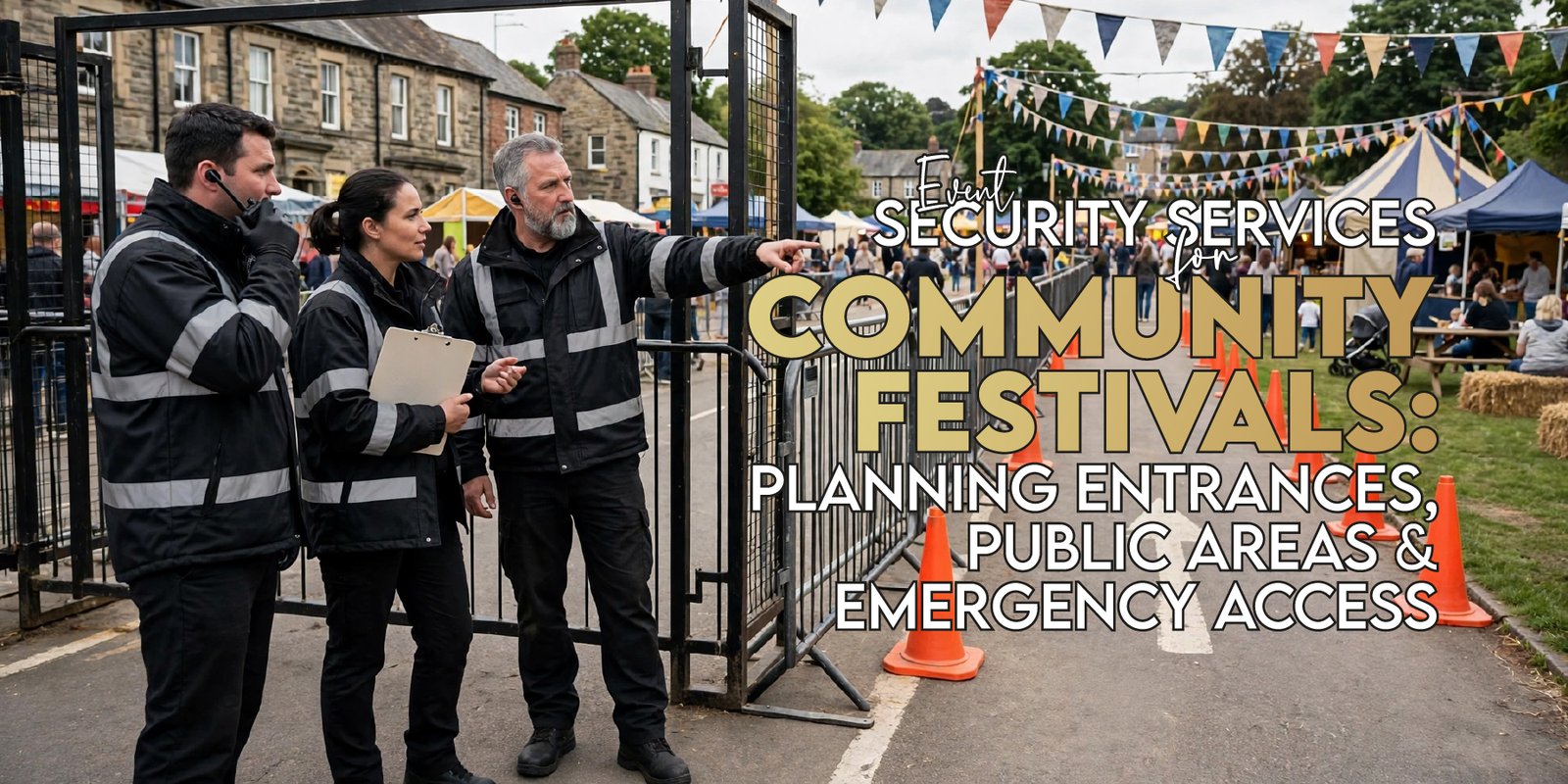
Event security services for a community festival should fit the venue, programme and expected visitor movement. Open spaces and free admission still require an organised plan. London organisers need to connect festival entrance control with public circulation, staff communications and access for emergency services.
Build the plan around the site
Mark entrances, exits, stages, stalls, welfare points and restricted working areas. Consider where arrivals may concentrate and how queues interact with pavements or neighbouring premises. Outdoor event guarding should account for changing light, weather and the build-up and breakdown periods as well as public opening hours.
Agree responsibilities with the landowner, event manager and other contractors. Security teams need one current version of the layout rather than conflicting instructions from several suppliers.
Separate welcoming visitors from security duties
Stewards may provide directions and information, while licensed security personnel perform the security activities within their assignment. Define the roles before booking. The SIA licence guidance can help organisers identify which activities require a licence.
Community festival security should use clear entry information, agreed admission rules and respectful communication. Provide an escalation contact for disputed entry rather than leaving each team member to invent a response.
Protect emergency access throughout the event
Event emergency access must remain usable during deliveries, public opening and departure. Identify who monitors the designated route and who has authority to arrange the removal of an obstruction. Do not use an emergency route as overflow queue space.
The HSE crowd control guidance says queuing should not block emergency access. Include a pre-opening route check and further checks after layout changes, supplier arrivals or periods of heavy footfall.
Brief the team and rehearse communications
Use location names that all teams understand. Confirm the control point, radio channels, emergency contacts and the process for reporting a developing crowd concern. A radio check is useful only if the receiving person also understands what action to take.
- Confirm staffing posts and break cover.
- Share the lost-person and welfare procedures.
- Brief staff on accessible routes and assistance points.
- Agree who makes decisions about pausing admission.
- Review the departure plan before the final performance.
See H&D’s related guide to event entry and crowd movement when preparing your operational brief.
Start with the festival programme and audience journey
The running order can reveal pressures that are not obvious from the site plan. A popular performance may bring a concentrated arrival shortly before it begins, while a family activity may produce a different pattern of movement and welfare needs. Review how people arrive, where they pause and what happens between programme items. Include the end of the day, when many visitors may leave at the same time.
Discuss these patterns with the event manager and the people responsible for ticketing, transport and visitor information. Security planning should use the same assumptions as those teams. If the programme changes, review the staffing and circulation implications rather than treating the change as a purely promotional matter. The aim is to understand where visitors are likely to move and which decisions need to be made if actual attendance differs from expectations. A written plan should identify who can approve those decisions during the event.
Coordinate with the venue owner and neighbouring activities
A community festival may share boundaries with homes, shops, a public park or another event. Establish which areas the organiser controls and which remain outside the event's authority. Identify any shared entrance, delivery route or access needed by neighbouring occupiers. Officers should know the agreed boundaries and the correct contact for concerns that arise beyond them.
The organiser should coordinate relevant arrangements with the landowner and other appropriate stakeholders. Guards can report congestion or an obstruction, but they should not invent restrictions on surrounding roads or public space. Where traffic arrangements form part of the plan, ensure they have been developed and agreed through the appropriate process. Keep the resulting instructions available to supervisors and explain how they connect with the festival entrances. This helps avoid a situation in which the internal layout works well but the approach to it creates confusion for visitors and neighbouring businesses.
Define entrance procedures that people can understand
Visitors should receive consistent information about tickets, re-entry and any published entry conditions. Place the information where people can see it before reaching the checking point. Agree how staff handle an unreadable ticket, a disputed booking or a visitor who needs assistance. A separate escalation contact can prevent a complex enquiry from holding up the entire arrival process.
Any screening or search arrangements should be planned, communicated and carried out by appropriately instructed personnel within lawful procedures. Do not leave the scope to individual improvisation at the entrance. Explain what happens if a visitor declines a condition of entry and who makes the relevant decision. The briefing should also identify accessible options for people who cannot use the standard route. Good festival entrance control is a coordinated process involving information, staffing and space; it is not simply a request for guards to move a queue faster.
Give public areas named owners and reporting routes
Large open spaces can create uncertainty about who is watching a particular area. Divide the operational plan into recognisable locations, such as the main audience area, food stalls, welfare point and entrance approach. Assign observation and reporting responsibilities without implying that an officer can continuously see an entire zone from one position. Identify the supervisor who receives concerns from each area.
Officers and stewards need a way to describe changes in crowd movement before those changes become urgent. Reports should explain the location and observed issue, such as a queue blocking a walkway or visitors gathering around a closed route. The event manager can then consider the appropriate response with the relevant teams. Encourage factual reporting rather than waiting for a dramatic incident. A small problem that is easy to address early can become harder to manage if every team assumes another person is responsible for it.
Include welfare and lost-person procedures in the briefing
Community festivals can attract families, older visitors and people unfamiliar with the venue. Staff should know the location of the welfare point and the approved process for a lost child or vulnerable person. Explain who takes responsibility, how information is communicated and what details should not be broadcast widely. These arrangements should be coordinated with the event's safeguarding and welfare leads.
Security personnel should not improvise a separate process because an incident reaches them first. Their initial role may be to remain with the person where appropriate, contact the designated lead and follow instructions within their training. Make the escalation route available to every working area, including temporary entrances and remote parts of the site. Brief staff on accessible facilities and assistance points so that they can provide useful directions. Welfare arrangements are more effective when visitors can reach help without being passed repeatedly between teams who do not know who is responsible.
Protect emergency access during supplier movements
Emergency routes can be affected before visitors arrive. A catering vehicle waiting to unload, a stack of equipment or a late supplier may occupy space that the plan expects to remain clear. Include these routes in the build-up briefing and identify who checks them before public opening. Suppliers should receive the same route information as the event team, with a clear contact for arrival problems.
During the festival, changes may be needed for replenishment or equipment repair. Refer them through the authorised event contact rather than allowing each supplier to choose a convenient route. Security staff can report obstructions and help implement agreed access arrangements, but the overall plan must remain coordinated. After a significant movement or layout change, confirm that the route is usable again. At breakdown, maintain the same discipline until visitors have departed and the responsible manager has formally changed the operational arrangements for the site.
Prepare for weather and changes in site conditions
An outdoor festival can experience conditions that affect visibility, ground surfaces and visitor behaviour. The organiser should identify who monitors relevant conditions and who decides when a planned change is needed. Guards need to understand the instructions that affect their posts, such as a revised entrance route or a temporary closure of a particular area. They should not be expected to make technical judgments outside their competence.
Consider how a change will be communicated to visitors and contractors. A route that is closed by management needs consistent signage and staff directions; otherwise, people may continue using it because it still appears to be the normal entrance. Confirm how the security team receives the latest decision and acknowledges it. Keep the plan flexible enough to respond to conditions while preserving clear authority. The useful question is not whether the team can improvise under pressure, but whether it knows who decides and how to implement the agreed response.
Use a simple exercise before the public arrives
An exercise can test the communications plan without staging a complicated simulation. For example, ask the entrance supervisor what they would report if a fictional queue began blocking the route to a welfare point. Ask the control lead who would assess the problem, who could change the queue arrangement and which team would communicate with visitors. Check that the answers agree with the written plan.
Repeat the exercise for an unavailable radio contact or a late delivery arriving after public opening. These are illustrative planning situations, not accounts of actual H&D operations. Their purpose is to expose missing contacts, unclear authority or conflicting instructions while there is time to correct them. Record the agreed answer and brief any staff who were not present. A short practical discussion often reveals details that are easy to miss when everyone merely confirms they have received the event plan by email.
Review the day and capture changes for the next event
After the festival, gather concise feedback from the entrance team, supervisors, welfare staff and event manager. Ask where the plan was difficult to apply, which locations needed additional attention and whether incident reports reached the right people. Separate equipment problems from staffing issues and distinguish visitor information gaps from guarding performance. This makes the review more useful than a general statement that the event was busy.
Assign actions to named owners and retain the updated plan for future use. The next festival may have a different programme or layout, so previous arrangements should be a reference rather than an automatic template. When discussing community festival security with a London provider, share the relevant learning and explain what has changed. A quotation based on current entrances, working hours and duties is more informative than a request to repeat last year's staffing without reviewing what that staffing was expected to do.
## What to include in the organiser’s final briefing pack
A final briefing pack should contain the current site plan, working timetable, key contacts and the instructions relevant to each role. Highlight changes from earlier versions so that experienced staff do not continue using an arrangement that has been replaced. Include the location names used on the radio and the route for raising an urgent concern. Keep sensitive information restricted to those who need it for their work.
Check that temporary staff and contractors receive the relevant information before taking up their positions. A document stored in an office is not useful to a supervisor who needs to resolve an entrance query at the other end of the site. Confirm how updates will be communicated during the festival and who records them. The pack should support the live briefing, not replace it. Give team members an opportunity to clarify their duties and make sure the event manager knows which operational questions remain open before public admission begins.
Frequently asked questions
Does a free festival need a security plan?
Yes. Free admission does not remove the need to assess the site and organise safe movement. The staffing and controls should reflect the event’s circumstances.
Is there a fixed number of guards per visitor?
A single ratio cannot account for entrances, layout, programme and assigned duties. Base the staffing proposal on the event assessment and discuss it with the relevant venue and planning stakeholders.
Discuss your London security requirements
When choosing a security company in London, provide the site address, operating hours, required duties and the person responsible for decisions. H&D Security can discuss a suitable scope and personnel availability. Request a security quotation with your dates, site layout and reporting requirements so that the proposed cover reflects the work involved.