
Event Security Services with CCTV Monitoring: Managing Crowd Movement and Venue Incidents
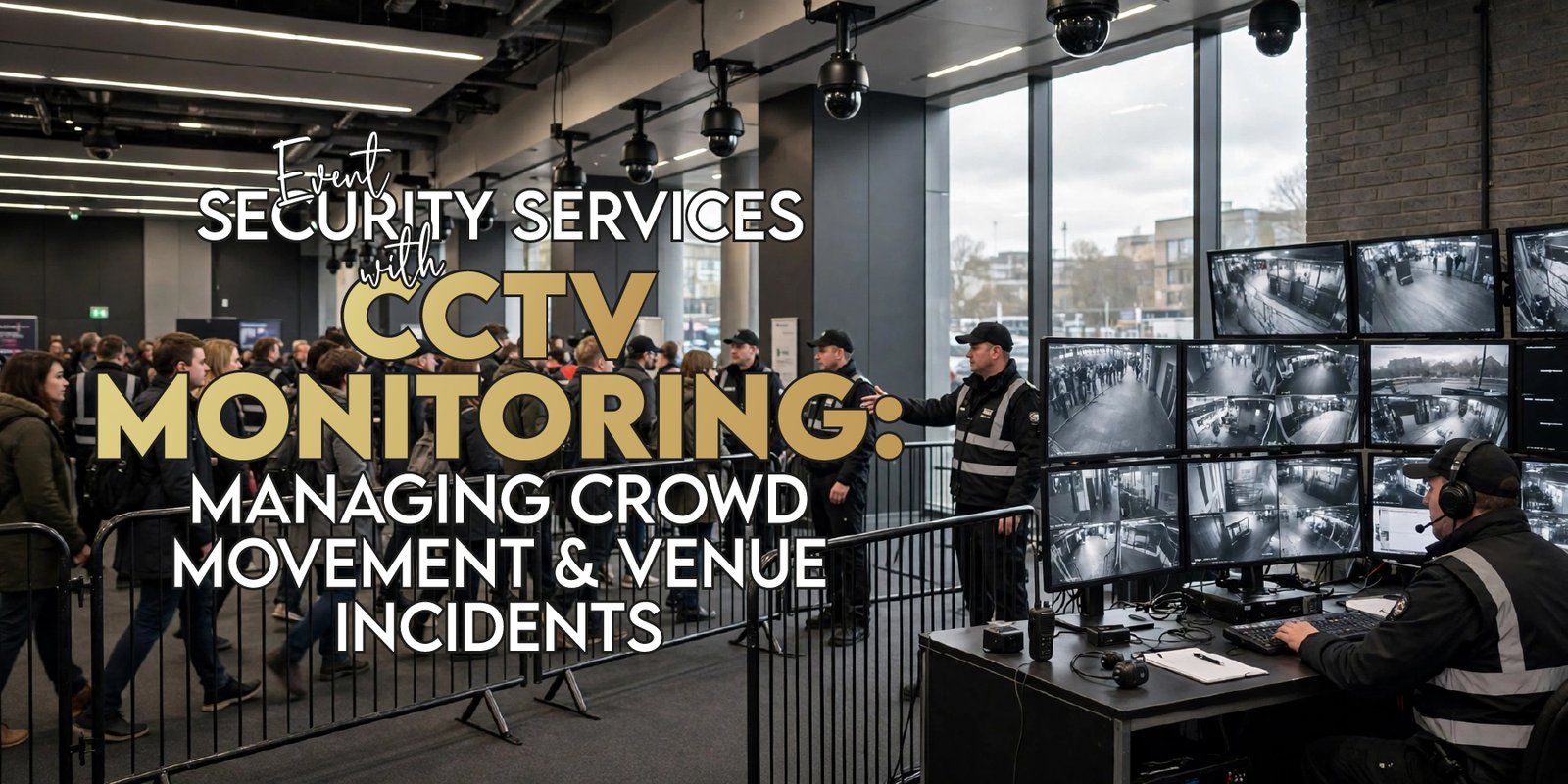
A corporate event venue in Hounslow is hosting a large evening function. Guests arrive through different entrances, queues develop around reception, and visitors move between the main hall, refreshment areas and restricted sections.
Meanwhile, the event programme changes as speeches, entertainment and guest departures take place throughout the evening.
Professional event security services can support venue operations by coordinating appropriately licensed officers, event stewards and relevant CCTV monitoring arrangements.
However, cameras cannot independently manage crowds or replace the responsibilities of event organisers.
Effective planning requires clear communication, defined staff duties, appropriate surveillance and agreed incident procedures.
H&D Security is a commercial security provider based in Hounslow, West London, offering event guarding, CCTV monitoring and related services.
This guide explains how event organisers can coordinate on-site personnel and venue monitoring across different stages of an event.
How Do Event Security Services Work With CCTV Monitoring?
Event security services can combine on-site personnel with authorised CCTV monitoring to support crowd observation, access arrangements and incident communication. CCTV operators may report relevant activity, while appropriately licensed officers follow agreed on-site procedures. Event supervisors and venue management coordinate decisions according to the event plan, assigned duties and relevant legal requirements.
However, the exact arrangement depends on the venue, existing equipment and services included in the contract.
For example, some venues use recorded CCTV without continuous live monitoring.
Therefore, organisers should establish what information is available and who receives notifications before guests arrive.
Event CCTV Monitoring: What Can Venue Cameras Support?
Event CCTV monitoring involves authorised observation of relevant areas through the venue's installed surveillance systems.
Depending on camera placement and monitoring arrangements, operators may observe entrances, queues, circulation routes and designated external areas.
However, the presence of cameras does not automatically mean live monitoring operates continuously.
Event security services may incorporate CCTV where the client specifically requests and agrees to that provision.
Potential Uses of Venue CCTV
CCTV may support:
Observation of entrance activity
Visibility of relevant queue areas
Monitoring of designated circulation routes
Review of restricted access locations
Communication of concerns to supervisors
Authorised incident review
Relevant event reporting
Furthermore, monitoring must remain consistent with the venue's legitimate purposes and applicable data protection obligations.
Organisers should confirm camera coverage, operator responsibilities and relevant escalation procedures.
Venue Security Cameras and Crowd Movement
Venue security cameras may provide useful information about crowd movement within designated areas.
For example, authorised monitoring personnel might observe an increase in visitors gathering near a particular entrance.
However, the footage alone may not explain the reason for the gathering or establish the complete circumstances.
Therefore, CCTV observations should be considered alongside information from stewards, supervisors and venue management.
Crowd Movement Planning
Organisers should consider:
Expected guest arrival patterns
Queue arrangements
Venue entrances and exits
Internal circulation
Accessible routes
Popular gathering areas
Scheduled programme changes
Guest departure arrangements
Event security services can support this planning through agreed guarding and communication duties.
Nevertheless, the organiser remains responsible for appropriate venue planning and management.
Event Security Services for Entry, Queues and Guest Flow
Venue entrance management requires a clear distinction between ordinary guest assistance and licensable security activities.
Event Stewards may help guests find entrances, seats or facilities.
However, certain guarding duties and admission-related activities can require appropriately licensed personnel.
Event security services should therefore reflect the actual responsibilities assigned to each position.
Managing Arrival Periods
Before guests arrive, organisers should establish the relevant entrance arrangements, ticket procedures and staffing responsibilities.
For example, a corporate reception may involve checking guest invitations and providing directions.
Meanwhile, a venue with licensed security duties may require appropriately authorised SIA Door Supervisors.
Furthermore, accessible routes and emergency arrangements must remain part of the venue's wider event plan.
CCTV Incident Management: From Observation to Response
CCTV incident management involves more than identifying activity on a screen.
Effective coordination requires communication between authorised monitoring personnel, event supervisors and relevant on-site officers.
Although every venue operates differently, the following framework provides a useful planning example.
Seven Stages of Incident Coordination
Observation: An authorised operator identifies activity that requires attention.
Communication: Relevant information reaches the designated supervisor.
Assessment: The responsible team considers the available information.
On-site response: Appropriate personnel follow the venue's agreed procedures.
Escalation: Significant concerns reach relevant management or emergency services where necessary.
Documentation: Personnel record appropriate observations and actions.
Review: Venue management considers the incident and any required follow-up.
This is an illustrative approach rather than a universal operating procedure.
Furthermore, event security services must operate within the law, relevant training and contractual responsibilities.
Security officers should not be assumed to possess police powers.
How On-Site SIA Officers Coordinate With Venue CCTV
On-site officers and CCTV personnel need clear reporting responsibilities.
For example, a monitoring operator may report a concern near an entrance while an authorised officer assesses the situation in person.
However, the CCTV observation should not automatically determine the response without appropriate assessment.
Event security services may include communication between officers, supervisors and control-room personnel where contracted.
Communication Arrangements
Venue managers should identify:
Relevant reporting channels
Event supervisor contacts
Control-room responsibilities
Incident notification arrangements
Shift handover procedures
Management escalation contacts
Relevant emergency communication procedures
Furthermore, the team should distinguish routine operational messages from incidents requiring management attention.
Clear responsibilities can make communication more consistent across the event.
Event Security During High-Attendance Periods
Crowd movement changes throughout an event.
Guest arrivals may create queue pressure, while programme intervals can increase movement around refreshment areas and circulation routes.
Similarly, departures may concentrate activity near exits and transport areas.
Event security services should consider the different stages of the event rather than relying on one static staffing assumption.
Important Event Phases
Arrival: Consider entrance availability, queues and guest information.
During the event: Review circulation routes, popular facilities and changes in movement patterns.
Departure: Plan exits, dispersal routes and relevant communication.
Furthermore, venue management should consider accessible routes and emergency arrangements.
CCTV can provide additional observation, but it does not independently establish whether venue capacity requirements have been met.
CCTV Monitoring for Restricted and Backstage Areas
Events may contain areas reserved for performers, event employees, contractors and authorised personnel.
Examples include backstage spaces, equipment storage, staff entrances and operations rooms.
However, access to these areas should follow the venue's approved procedures.
Event security services can support relevant access arrangements through agreed guarding responsibilities.
CCTV monitoring may also form part of the venue's surveillance plan where appropriate.
For commercial venues containing storage and retail facilities, monitoring commercial areas within event venues provides related CCTV considerations.
Nevertheless, the venue should define appropriate access permissions and monitoring purposes.
Venue Incident Reporting and CCTV Evidence Handling
Accurate incident reporting helps organisers understand relevant events and the actions taken.
On-site personnel may record observations, while CCTV operators may provide authorised monitoring information.
However, footage should not automatically be treated as a complete account of an incident.
Information That May Support Incident Reports
Date and time
General incident location
Nature of the concern
Relevant observations
Personnel notified
Actions taken
Appropriate witness information
Relevant footage references
Management escalation
Event security services should follow the reporting arrangements established for the venue.
Furthermore, recorded footage must be handled according to applicable privacy and data protection requirements.
Access, retention and disclosure should reflect the lawful purpose and relevant authorisations.
How Many Event Security Officers and CCTV Operators Does a Venue Need?
There is no universal guard-to-guest ratio or CCTV operator staffing figure suitable for every event.
The appropriate event security services depend on the event type, venue size, attendance, layout and assessed risks.
For example, a venue with multiple entrances and extensive circulation areas may need a different approach from a smaller corporate function room.
Factors Organisers Should Review
Expected attendance
Venue capacity and licence conditions
Number of entrances and exits
Event programme
Guest movement patterns
Accessible routes
Existing camera coverage
Monitoring arrangements
Restricted areas
Required SIA roles
Shift duration
Event risk assessment
Emergency arrangements
Therefore, staffing levels should follow a site-specific assessment and appropriate professional planning.
Event Area and Monitoring Responsibilities
Different venue areas require different operational arrangements.
The following comparison illustrates how CCTV, on-site personnel and venue management may coordinate.
| Venue Area | Typical Event Activity | Potential CCTV Contribution | Potential On-Site Contribution | Planning Considerations |
|---|---|---|---|---|
| Main entrance | Guest arrivals | Observe authorised entrance views | Follow agreed entry procedures | Staff responsibilities |
| Queue area | Waiting guests | Provide relevant crowd observations | Offer directions and assistance | Queue arrangements |
| Reception | Visitor information | Observe covered reception areas | Support visitor procedures | Authorised access |
| Internal circulation | Guest movement | Report relevant changes | Provide on-site guidance | Accessible routes |
| Restricted zones | Staff and contractor access | Observe designated access points | Follow approved entry procedures | Permission and reporting |
| Retail concession | Merchandise and sales | Observe relevant commercial areas | Follow agreed guarding duties | Stock and payment procedures |
| External venue area | Arrivals and departures | Observe covered external spaces | Report relevant site conditions | Property responsibilities |
| Exit routes | Guest dispersal | Provide relevant observations | Support agreed departure arrangements | Emergency and exit planning |
However, the exact contribution of event security services depends on the authorised duties and applicable agreements.
Common Event CCTV and Security Coordination Mistakes
Several planning mistakes can create confusion during busy events.
Unclear Communication Responsibilities
Personnel should know who receives monitoring observations and incident notifications.
Assuming CCTV Replaces Event Personnel
Cameras cannot provide directions, undertake physical assessments or perform every on-site duty.
Confusing Stewards With Licensed Security Officers
Ordinary guest guidance and licensable security work require different role assessments.
Assuming Every Camera Has Live Monitoring
Monitoring depends on the equipment and agreed service.
Missing Supervisor Contacts
Staff should know who can make relevant event management decisions.
Incomplete Incident Reports
Records should distinguish observations from assumptions.
Overlooking CCTV Privacy Requirements
Venues should establish lawful purposes, appropriate notices and controlled footage access.
Poor Shift Handovers
Incoming personnel should receive relevant information about outstanding operational matters.
Inadequate Departure Planning
Event security services should account for guest dispersal as well as arrivals.
Therefore, organisers should review these issues before finalising the event plan.
What Should Event Organisers Prepare Before Booking Security?
A clear event brief helps establish the relevant responsibilities and services.
Before contacting a provider, prepare:
Event type
Venue name and address
Event date
Expected attendance
Guest arrival patterns
Start and finish times
Entrances and exits
Venue layout
Existing CCTV
Required monitoring arrangements
Restricted areas
Venue risk assessment
Relevant SIA licence requirements
Required guarding personnel
Event stewarding requirements
Incident reporting procedures
Event supervisor contacts
Emergency arrangements
Closing and dispersal plans
Furthermore, venues with a corporate reception should consider managing visitor access at business venues.
For events containing retail concessions, organisers can also review retail CCTV and stockroom monitoring arrangements.
How H&D Security Supports Event and Venue Operations
H&D Security advertises relevant security services for commercial events and venues.
Its services include:
SIA Door Supervisors
Security Officers
Event Stewards
Event Supervisors
CCTV monitoring
CCTV installation
Control-room support
Venue access control
Incident reporting
Relevant commercial premises guarding
However, event security services are arranged according to the event, venue layout, required personnel and agreed contract.
For example, an event guarding arrangement does not automatically include remote CCTV monitoring or additional surveillance equipment.
Venue managers can discuss event security and CCTV requirements with H&D Security.
1. What do event security services include when CCTV monitoring is involved?
Event security services may combine appropriately licensed on-site officers, agreed access procedures, relevant stewarding and authorised CCTV monitoring.
However, the precise arrangement depends on the event and contract.
CCTV personnel may communicate observations, while on-site teams assess relevant circumstances and follow venue procedures. Management remains responsible for appropriate coordination and escalation.
2. How can venue security cameras support crowd monitoring?
Venue security cameras can provide authorised observations of entrances, queues and designated circulation areas.
However, the actual coverage depends on equipment placement and monitoring arrangements.
CCTV can complement information from on-site personnel, but it does not independently establish attendance figures, capacity compliance or the full circumstances surrounding every incident.
3. Can CCTV replace on-site event security personnel?
No. CCTV can support observation and reporting but cannot perform every physical guarding or guest-facing task.
Event security services may therefore combine appropriate monitoring with on-site personnel where necessary.
However, the required arrangement depends on the event risk assessment, relevant licensing and the organiser's operational responsibilities.
4. What is the difference between an Event Steward and an SIA Door Supervisor?
An Event Steward commonly assists with directions, guest information and general crowd guidance.
An SIA Door Supervisor holds relevant authorisation for specified licensable security activities.
However, not every event steward needs an SIA licence. The correct requirement depends on the actual duties, venue and relevant contractual circumstances.
5. Do CCTV operators at events need an SIA licence?
Certain contracted CCTV activities require appropriate SIA authorisation.
However, the exact licence depends on the monitoring purpose and activity.
For example, monitoring people to guard against disorder or assault can require Public Space Surveillance licensing, while some property-guarding activities fall within other permitted categories.
Organisers should verify the relevant requirements.
6. What does CCTV incident management involve at a venue?
CCTV incident management can involve observation, communication, assessment, appropriate escalation and incident documentation.
However, the process depends on the venue's procedures and monitoring contract.
CCTV observations should reach authorised personnel, while any on-site response must follow the law, training and event management instructions.
7. How should event organisers plan CCTV monitoring and incident reporting?
Organisers should identify the monitoring purpose, existing cameras, authorised personnel and reporting contacts.
Additionally, confirm relevant SIA licensing, CCTV data protection arrangements and incident escalation procedures.
For venues with corporate reception activity, security guards for commercial reception areas provides related visitor management considerations.
8. How can venues request event security services from H&D Security?
Venue managers can contact H&D Security with the event date, location, expected attendance, required personnel and existing CCTV arrangements.
The company can discuss relevant event security services according to the site and proposed duties.
However, the final service scope depends on the event requirements, contractual arrangements and personnel availability.
Discuss Event Security Services and CCTV With H&D Security
Effective event management requires clear coordination between venue personnel, relevant SIA officers, Event Stewards, CCTV operators and event organisers.
H&D Security, based in Hounslow, West London, supports commercial enquiries involving event guarding, CCTV monitoring, venue access arrangements and incident reporting.
Whether you are organising a corporate function, conference, hotel event or larger venue activity, the appropriate event security services depend on the venue layout, attendance, event programme and agreed responsibilities.
Share your event date, expected guest numbers, venue details, existing CCTV arrangements and required staffing roles to discuss a tailored quotation.